


Every generation of parents has faced a version of the same daunting task: welcoming the benefits of a new technology while protecting their children from its hidden dangers, often before anyone fully understands what those dangers are. Today, that technology is AI. AI-powered toys, tutors, and companions are arriving in homes and classrooms faster than regulators can evaluate them — leaving parents to make decisions about what to welcome and what to avoid, often with incomplete information. The following guidance, from my forthcoming book “Human Raised: Nurturing Connection, Curiosity, and Lifelong Learning,” won’t make those decisions for you. But it will give you a practical framework for thinking through them yourself.
In 1902, if you were a parent in America, you were living through one of history’s most dramatic technological revolutions. The late 1800s brought remarkable innovations: canned foods that could provide for families year-round, preserved meats that didn’t spoil, dairy products that lasted days instead of hours. Industrial food production fed growing cities, freed families from the enormous labor of food preservation, and created abundance that previous generations could scarcely imagine. But families were also unknowingly participating in a massive uncontrolled experiment. They didn’t have the tools or the knowledge to separate the genuinely helpful advances from those that came with hidden costs.
Your morning coffee, which was now conveniently pre-ground and packaged, might have contained sawdust, charcoal, and factory floor sweepings mixed in. That bright green candy, a delightful treat impossible in pre-industrial times, was colored with arsenic. This was systematic innovation in an unregulated environment.
Harvey Washington Wiley, chief chemist at the Department of Agriculture, watched this transformation with growing concern. Food manufacturers had successfully blocked every attempt at regulation, arguing that their additives were safe in small quantities and that government oversight would destroy innovation and jobs. Their favorite refrain: the dose makes the poison.
Wiley decided to prove the industry wrong through science. In 1902, he assembled twelve young, healthy volunteers in the basement of the Agriculture Department building in Washington, D.C. These government clerks agreed to eat three meals a day together for months while Wiley systematically tested the food industry’s additives on them. They consumed borax-laced butter, formaldehyde-preserved meat, salicylic- acid-treated vegetables, and sulfuric-acid-spiked condiments. They carried satchels to collect their urine and biological samples for analysis. A sign in their dining room read: “Only the Brave Dare Eat the Fare.”
The press dubbed them “the Poison Squad.”
Within weeks, these healthy young men began experiencing systematic symptoms: persistent headaches from borax, digestive problems from formaldehyde, and depression from salicylic acid. Their carefully documented reactions, published in newspapers throughout the country, proved that despite industry claims, these substances actually caused measurable harm.
Today, we face the same fundamental challenge: trying to make sense of remarkable innovations that carry hidden risks, with limited tools at our disposal.
While AI-specific research is still emerging, decades of study on children’s interactions with digital technology give us a solid foundation. Most importantly, the fundamental principles of healthy brain development remain constant. With the right questions you can uncover the benefits and risks that matter most to your family.
We’ve learned to demand transparency about what goes into our children’s bodies. Now we have to adopt the same approach when evaluating what feeds their developing minds. Your investigative framework consists of six essential questions to help you determine what an AI system is meant to do and whether it aligns with your family’s needs and values. These six questions form the acronym DETECT:
D for Design
E for Ethics
T for Trouble
E for Evidence
C for Confidentiality
T for Teachings
With a little practice and reflection, this framework will become part of your Parental GPS. This isn’t something you need to memorize; it’s a cheat sheet of sorts. And of course, adopting any AI tool is always optional, even when the system passes the DETECT evaluation with flying colors. Think of this as the opt-in principle. It’s never a requirement to use AI to supplement your child-rearing, even if doing so is safe. The ultimate question isn’t whether the technology is good, but whether it genuinely enhances your family’s well-being and quality of life in ways that justify its presence in your home.
So imagine you’re evaluating a new app, toy, or tool. The first step is to ask—and attempt to answer—six key questions. The goal is not to find concrete answers to each of these queries. In some cases, such as probing the ethics of the training data, that might be very difficult indeed. But the exercise will still be beneficial.
D(esign): What is this thing designed to do? For example, is the system intended for education, entertainment, or companionship? Is it meant
to work directly with my child, or through me as the parent or caregiver?
E(thics): Was this product ethically trained on a dataset representing diverse backgrounds, abilities, and communication styles?
T(rouble): Are there any signs that this tool has had troubling consequences for other children?
E(vidence): Is there any independent evidence beyond marketing that this product works or delivers its advertised benefits?
C(onfidentiality): How will my data or my child’s data be stored and used, and will it remain confidential?
T(eachings): What is this system likely teaching my child in general, and particularly about values?
If you encounter any major warning signs during your cursory examination, I recommend you put the product back on the shelf and move on. Ultimately, with more information in hand, and with your family’s specific needs and values clearly defined, you will be ready to decide if you should adopt, reject outright, or wait for more information on a given AI product. But whatever you do, heed the measurements of that acutely sensitive parental intelligence system known as your gut! Your Parental GPS is powerful. Never forget, the most powerful technology in your child’s life is you.
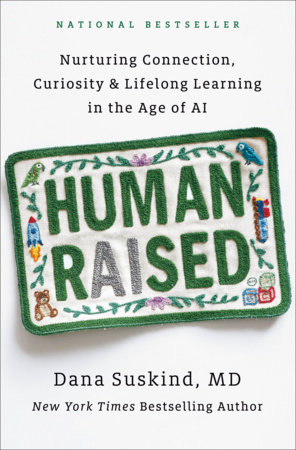
Excerpted from Human Raised: Nurturing Connection, Curiosity & Lifelong Learning in the Age of AI By Dana Suskind, MD, July 14, 2026, Dutton. Learn more here.