

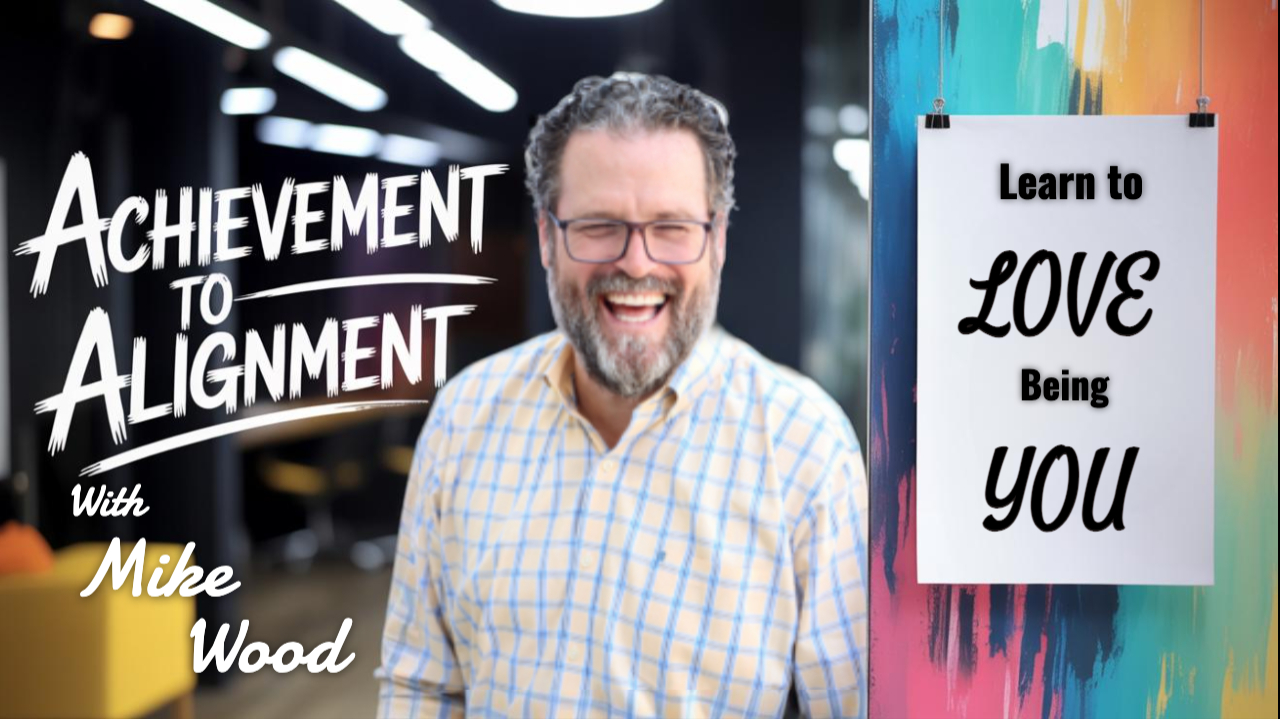
I was never afraid of fighting… I was afraid of how it would appear to everybody else if I lost.
– Mike Wood
Success checked every box for Mike Wood. The résumé was polished. The company was thriving. The family was healthy. From the outside, everything looked exactly right.
Inside, it was loud.
“I was never afraid of fighting,” Mike says. “I was afraid of how it would appear to everybody else if I lost.”
That sentence captures the heart of his story — and a struggle so many high achievers quietly carry. This is not a story about building a business. It’s about rebuilding an inner world.
When Achievement Doesn’t Equal Peace
Mike grew up at a time when dyslexia wasn’t widely recognized. School became a daily reminder that he processed words differently. He could solve complex math problems in his head, yet spelling simple words felt impossible. Early experiences planted something deeper than academic frustration — they planted shame.
Sports became his refuge. On the field or in the ring, he could move without overthinking. But under pressure, an old internal script would resurface: You’re not enough.
As an adult, he channeled that intensity into business. He became COO of a $100 million company. He optimized systems. He led teams. He worked 90-hour weeks during crisis periods.
And yet, even after external wins, the noise inside remained.
Six years ago, he hit a breaking point. “I told a friend I would quiet my mind by any means necessary,” he says. “I meant it.”
That decision marked the shift from performing to healing.
The Turning Point: Two Minutes of Peace
The transformation didn’t begin with something dramatic. It started with ten minutes of meditation.
For two of those minutes, Mike experienced something unfamiliar: real quiet.
That tiny pocket of peace became proof. If two minutes were possible, maybe more was too.
He approached inner work the way he approached business — systematically. He listened to multiple audiobooks a month. He meditated one to two hours a day. He experimented. He tracked results. He treated healing like research and development for the soul.
What he discovered changed everything.
Understanding the Subconscious — In Plain English
Mike explains the subconscious this way:
It’s your operating system.
It runs most of your life on autopilot — breathing, reacting, interpreting situations — without asking your permission. It doesn’t understand time. A painful memory from childhood can feel current until it’s processed. And it records what you repeatedly tell it.
The good news? It can be updated.
But change doesn’t happen through force. It happens through safety, repetition, and emotional resolution.
The Three-Phase Path From Pressure to Peace
Through years of deep work, Mike developed a structured approach to emotional healing — one that feels practical rather than abstract. He calls it a three-phase arc:
1. Think Control
This phase focuses on manual state regulation. Tools like box breathing (inhale four, hold four, exhale four, hold four) calm the nervous system. When the body feels safe, the mind becomes more flexible.
2. Unhook
Many emotional triggers come from labels we cling to — “the tough one,” “the successful one,” “the strong one.” When identity is rigid, feedback feels threatening. Unhooking from labels reduces unnecessary emotional reactivity.
3. Core Beliefs
A core belief forms when the subconscious assigns meaning during an emotionally charged moment. That meaning becomes a standing order. Rewriting a belief involves revisiting the memory, processing it fully, extending forgiveness, and installing a truer interpretation.
Mike estimates he has rewritten more than 170 negative core beliefs over three years of disciplined work.
The result? “Happiness with no external reason,” he says — something he had never experienced before.
Why Labels Keep Us Stuck
Any label we strongly identify with becomes something the subconscious feels obligated to defend.
If I’m “the tough one,” I must never appear weak.
If I’m “the successful one,” failure becomes intolerable.
The more tightly we cling to identity, the more fragile our inner stability becomes.
When identity softens — when we simply allow ourselves to be human — reactivity decreases. Emotional healing becomes possible.
Five Truths About the Subconscious
Through his work, Mike believes there are five essential truths everyone should understand:
- The subconscious only knows the present moment.
- It records repetition — especially emotionally charged repetition.
- It doesn’t distinguish between how you speak to others and how you speak to yourself.
- Safety unlocks change.
- Small, consistent inputs create deeper rewiring than intense but inconsistent efforts.
Healing, in this view, isn’t mystical. It’s methodical.
A Seven-Day Reset You Can Try
If you’re feeling overwhelmed, stuck, or internally noisy, Mike offers a simple micro-practice:
For seven days:
- Write down one fear-based thought you genuinely think.
- Reframe it into a truthful, grounded alternative.
- Pair it with two minutes of box breathing.
Track how long it takes your body to calm. By day seven, most people notice their “time-to-calm” shortens.
Consistency, not perfection, is what shifts patterns.
Leadership, Redefined
One of the most powerful outcomes of Mike’s emotional healing wasn’t just personal peace — it was improved leadership.
As his nervous system became steadier, decision-making sharpened. Delegation became strength-based rather than ego-driven. Mistakes were addressed more quickly. Systems became preventative rather than reactive.
“The company got healthier when my nervous system did,” he says.
Inner alignment translated directly into outer effectiveness.
If You Feel “Too Late” or “Too Broken”
Perhaps the most important part of this story is what it says about stuckness.
“You’re not broken,” Mike says. “You’re protected by a program that fits an earlier version of your life.”
Stuck is not a sentence. It’s a signal.
And signals can be understood.
Healing doesn’t require reinventing who you are. It requires meeting yourself without the noise of outdated scripts.
Success can build a life.
Alignment builds peace inside it.
For those who have checked every box but still feel unsettled, this story is a reminder: external achievement and emotional healing are not the same journey.
But one can lead beautifully into the other.
