

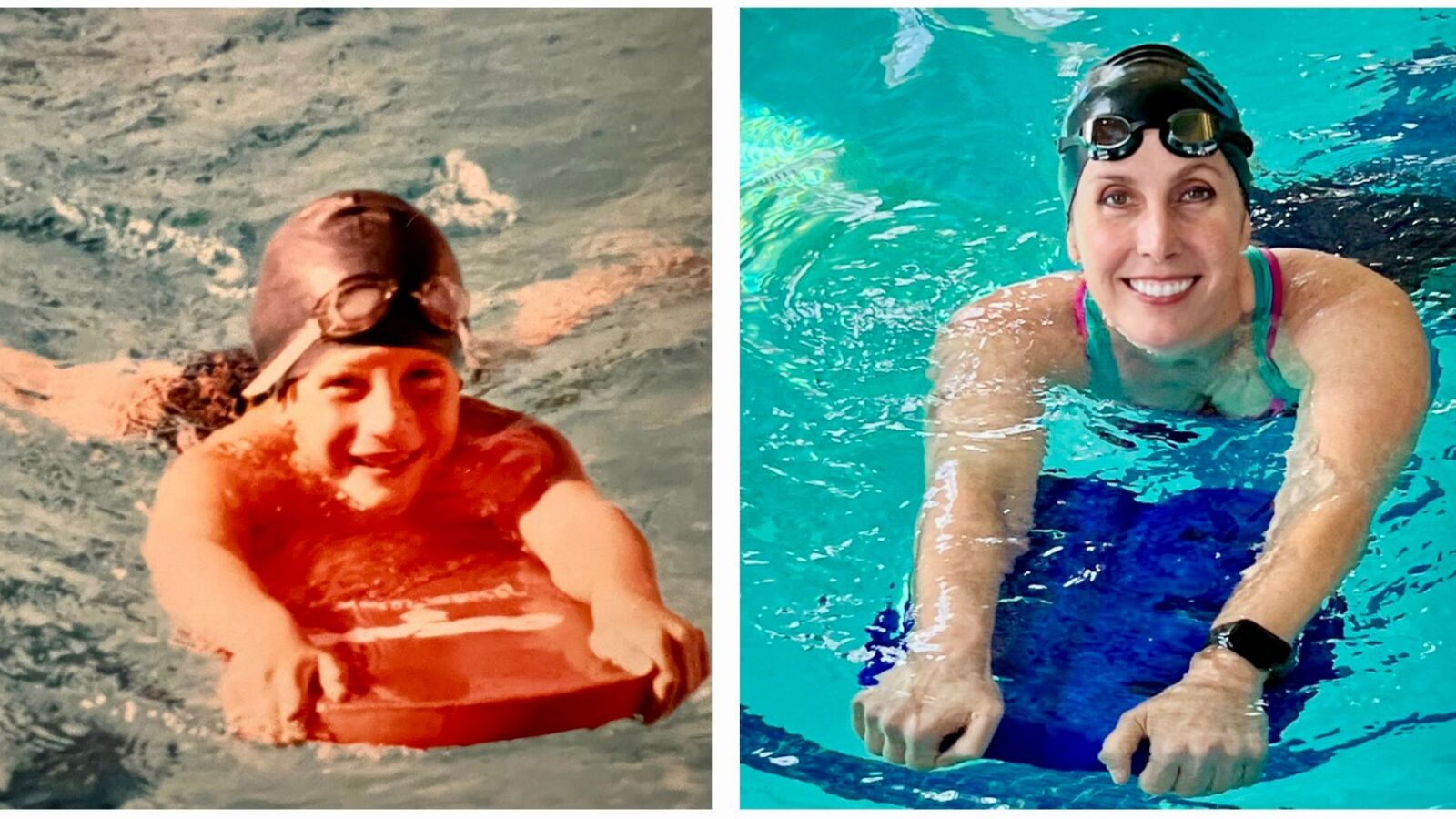
I grew up swimming competitively in Southern California, where year-round sunshine and serious age-group programs turn children into disciplined athletes early. In 1988, Olympic gold medalist Janet Evans was swimming in Lane 1. I was down in Lane 8 at the FAST pool in Fullerton, a 12-year-old studying her freestyle stroke and dreaming of accomplishing even a fraction of what she had.
At that age, everything aligned. It was the honeymoon stage of the sport. I was living my best athletic life and every swim was a high. My times dropped almost every meet. I trained twice a day, six days a week, chasing standards, podiums, and the next cut. Success was measurable and public. I pinned ribbons on my bedroom walls and lined trophies across my dresser. I loved seeing my name at the top of the results sheet. I was on the rise.
And then I peaked. At 13.
The shift wasn’t dramatic. It was gradual. The highest highs gave way to swims that were simply not my best. After races, I’d look up at the scoreboard and feel my heart sink when I had added time. I could forgive myself the first couple of times. Then it became a pattern. And it was deflating.
I held on for a couple more years, chasing the feeling of winning and improving. But the clock stopped cooperating. Progress slowed. I told myself I was burned out. That my body had been pushed too far, too fast.
It took more than 30 years for me to understand that I wasn’t burned out physically. I was exhausted from trying to get back to 13. I wanted to swim the way I used to, and when I couldn’t, I decided I was done.
When your identity is built around a peak, anything less feels like a fall. I measured every swim against who I had been back then. I wasn’t comparing effort; I was comparing outcomes. I watched my teammates continue to drop times and qualify for top meets. That comparison made swimming feel like pressure instead of freedom.
So I stepped away. What I didn’t realize at the time was that I wasn’t tired of swimming. I was tired of defining swimming by how fast I went.
Years later, living in Nashville as an empty nester, I returned to the sport in a different way. At local meets and national championships, I watched swimmers of every age and background step onto the blocks. Former Division I standouts stood beside first-time competitors in their 60s with shoulder or joint issues. A few were chasing records. Many were not.
One Saturday meet, I stood on the pool deck as a 95-year-old man finished a 500 freestyle. He climbed out, caught his breath, smiled, and said, “Well, that was a lot of fun.”
Someone told him he had broken the age-group state record.
“Oh… wow!” he replied, almost as an afterthought, and went about laughing with a teammate.
Breaking a record was a nice add-on. It wasn’t the point. He had already achieved what he came for: to finish and to enjoy it.
Around him were swimmers with the same mindset. They weren’t chasing who they had been decades earlier. They weren’t measuring today against a best time from their youth. They had recalibrated.
As a coach now, I see how difficult that recalibration can be, especially for former competitive swimmers — the ones who once defined themselves by conference finals and podium finishes. They return to the water and instinctively measure themselves against their younger bodies. The comparison is relentless.
I remind swimmers that there are many goals in the water: endurance, speed, form, mindset, social connection, and fun. On any given day, one of those might matter more than the others. If the only thing that counts is the clock or whether you’re the best, you’re setting yourself up to quit.
The honeymoon stage of swimming is often associated with youth, early breakthroughs, and visible progress. But that’s only one version of it. There is another version that doesn’t get talked about as much.
It’s the version where you show up consistently. Where you understand your body better than you did when you were younger. Where you find some much-needed me time as a mom, work through an injury that tempts you to become sedentary, or join a Masters swim program at 5 a.m. to jump-start your day.
That kind of honeymoon looks different. It’s about perspective. It’s built on swimming for what the water gives you now, not what it gave you decades ago.
That can happen at 13. It can happen at 43. It can happen at 95.
The goal is not to recreate the first high. The goal is to keep finding reasons to get back in. Sometimes that means chasing a time. Sometimes it means finishing. Sometimes it just means laughing with a teammate after a hard set.
For me, it meant rediscovering a love for the water without comparing myself to anyone, including my younger self.
The honeymoon stage never has to end. It just evolves.
About the Author: Cori Linder is a certified USMS Level 3 swim coach and longtime Masters swimmer. She is the USA Today bestselling author of The Self-Coached Swimmer’s Guide, written for swimmers who want more structure, creativity, and purpose in their training. Her latest book, Main Street and Mistletoe, she co-wrote with Los Angeles radio host, Lara Scott, releases November 10, 2026.