

Resilience may keep you standing, but recovery is what helps keep you whole.
– Laurinda Calongne
Burnout has become a catchall term for modern exhaustion. It comes up in conversations about overwork, caregiving, leadership, and the constant pressure of life in unstable times. But for Laurinda Calongne, a trauma-trained social worker and longtime healthcare executive, the word often stops the inquiry too soon.
In her view, many people described as “burned out” are dealing with something more layered and more consequential: cumulative stress with no true recovery, nervous system strain that compounds over time, and moral distress that arises when people know what care requires but cannot deliver it within the systems they work in.
That distinction matters because naming the problem incorrectly can lead to shallow solutions. If the issue is framed only as individual depletion, the response often centers on personal coping. If the deeper reality includes trauma exposure, unresolved grief, systemic constraint, and repeated ethical conflict, then the conversation has to widen.
A Career Inside Crisis-Tested Systems
Calongne brings both professional and lived experience to that argument. Over more than three decades in healthcare and education, she led through hurricanes, flooding, pandemic conditions, and institutional disruption. She has worked inside crisis-tested systems while also studying the human toll of those systems on the people expected to keep functioning within them.
“Burnout is real,” she said during our conversation. “The evidence tells us it exists.” But she is careful not to leave the discussion there. In the focus groups and organizational work she led, she noticed that what workers were carrying could not always be explained by workplace stress alone.
She recalls meeting employees who were still reporting for hospital shifts while living in shelters, having lost homes, vehicles, and a sense of stability. For some, the stress did not begin at work and did not end there. It was layered on top of earlier losses, family trauma, disaster exposure, and chronic over-responsibility. In those cases, “burnout” felt too small for what was happening.
When Stress Becomes Cumulative
What Calongne began to see, and eventually named more clearly, was cumulative overload.
Ordinary stress, she said, is part of life. It is difficult, but often manageable when people have sleep, support, movement, and time to recover. Cumulative stress is different. It is what happens when one destabilizing event lands before the body and mind have processed the last one.
For Calongne, that understanding is rooted in experience. She described returning from maternity leave as a young medical social worker and walking into an emergency room case involving an unresponsive two-month-old infant who resembled her own baby at home. Soon after, she was preparing to evacuate for an approaching hurricane. In later years came more disasters, more recovery periods cut short, and more examples of how professional trauma and personal upheaval can stack on top of one another until recovery becomes nearly impossible.
That is the condition she believes many high performers now live in: still functioning, still delivering, still appearing capable, but internally operating in a prolonged state of alarm.
The Body Often Signals Trouble First
The signs often emerge first in the body. Disturbed sleep, chronic fatigue, headaches, GI symptoms, irritability, emotional flattening, or a kind of checked-out disengagement can all signal overload. What looks like indifference may in fact be a nervous system trying to protect itself.
As Calongne put it, the body often starts asking for a pause before the mind is willing to listen.
Her own body eventually did exactly that. During a work trip, she developed severe swelling and was urged by physicians to seek immediate care. What she assumed was an orthopedic issue turned out to be rhabdomyolysis, a serious condition involving muscle breakdown that affected her kidneys and liver and required hospitalization.
Not long after, she began experiencing balance issues and fluid drainage from her ear. Further evaluation revealed tears in the temporal bone and brain tissue herniating into the middle ear, leading to brain surgery during the height of the COVID-19 pandemic.
The ordeal was frightening, disorienting, and physically devastating. It also became a reckoning.
The Hidden Cost of Over-Responsibility
After years of being dependable, responsive, and endlessly available, Calongne was forced into a long recovery. In that stillness, she began to think more seriously about what prolonged responsibility had cost her and what it costs others whose competence often disguises their depletion.
The lesson, she said, was not that resilience had failed. It was that resilience alone is not enough.
That point is central to her framing. The people most at risk are often not the ones visibly falling apart first. They are the ones others rely on. The capable ones. The steady ones. The leaders who have built identities around service, speed, fairness, and endurance. Many do not recognize trouble until their sleep deteriorates, their patience disappears, or their bodies force a stop.
Moral Distress Is Different From Burnout
Calongne’s analysis goes beyond overload into a domain that is receiving more attention across medicine, education, social work, and public service: moral distress and moral injury.
She distinguishes the two carefully. Moral distress, she said, arises when someone knows the right thing to do but cannot do it because of institutional limits, regulation, policy, politics, or lack of authority. Moral injury goes further. It is what happens when a person feels they have been made to participate in or uphold something that violates their core ethical beliefs.
That can happen in any number of professions. A child protection worker suspects abuse but lacks enough evidence to intervene. A police officer repeatedly sees vulnerable children returned to unsafe conditions. A clinician knows what a patient needs but cannot offer it under system rules. Over time, the injury is not only emotional. It becomes existential. People begin to feel estranged from the values that brought them into the work in the first place.
Why Wellness Efforts Often Miss the Mark
This is one reason many conventional workplace wellness efforts fall flat. Calongne is blunt about that. Organizations, she said, often reach for visible but superficial fixes: food trays, wellness apps, occasional classes scheduled at impractical hours, symbolic gestures that create the appearance of care without changing the lived conditions of work.
What workers tend to need is less ornamental and more concrete: time, staffing, role clarity, recovery space, psychological safety, and leaders willing to listen and respond.
A listening session, in her view, can be more useful than a branded wellness initiative if it asks the right questions and leads to action. What is getting in the way of your work? What is making recovery harder? What have we normalized that is not sustainable? The crucial step is not simply collecting the answers, but returning to staff with visible changes that reflect what was heard.
She also emphasized that organizations should stop treating workforce exhaustion as something to guess at. “You don’t treat sepsis without blood work,” she said. “You shouldn’t treat burnout without data.”
Recovery Is Practical Before It Is Transformational
At the individual level, Calongne’s approach is notably unsensational. She does not promise transformation through a perfect routine. She talks instead about interrupting the cycle in small, repeatable ways.
She recommends brief pauses during the day that actually allow the nervous system to reset, rather than filling every spare moment with digital noise. She points to breathing practices not as a cure-all, but as a low-cost tool that many people dismiss because it seems too simple to matter. She also urges people to identify one person who reliably lifts them rather than reinforces the spiral.
Under stress, she noted, people often cluster with others who are equally depleted; connection helps most when it restores perspective rather than intensifies helplessness.
Rebuilding Without Shame
One of the more grounded aspects of Calongne’s message is its refusal to moralize exhaustion. People do not fail because they have limits. Bodies do not collapse as a character flaw. Recovery begins, in part, when shame gives way to clearer interpretation.
For leaders, that may require a more honest definition of strength. Not performative toughness. Not endless accessibility. Sustainable strength, as Calongne describes it, is visible in routines that include care, rest, movement, reflection, and boundaries sturdy enough to protect what the work depends on most: a functioning human being.
Final Thoughts
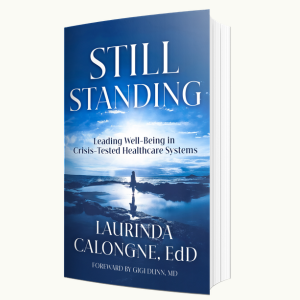
What gives Calongne hope is not that the problem is solved, but that more people are finding language for it. There are leaders, teams, and organizations beginning to understand that exhaustion is not always a motivation problem, a mindset problem, or a resilience deficit. Sometimes it is the predictable result of prolonged strain in systems that extract more than they restore.
In that sense, Calongne is not arguing against burnout as a concept. She is asking for a more precise and more humane conversation. One that includes the body. One that includes ethics. One that includes grief, recovery, and the hidden cost of being the person who keeps showing up.