

True selling is championing someone’s brighter future—walk them from uncertainty to clarity with heartfelt empathy and hard evidence, and you don’t just close a deal; you unlock their confidence to soar.
– Roger Knecht
In a marketplace where attention spans are shrinking and competition is fiercer than ever, knowing how to “cut to the chase” can be the decisive edge between a stalled conversation and a signed contract. Few professionals embody that mastery better than Roger Knecht, president of Universal Accounting Center, whose career has been dedicated to transforming technically brilliant—but commercially hesitant—experts into confident, high-earning entrepreneurs. By blending deep financial acumen with street-smart sales tactics, Knecht has distilled decades of experience into a universal, six-step formula that promises clarity, authenticity, and closing power in equal measure.
In this insightful interview with Stacey Chillemi, Roger breaks down each stage of his framework—from forging genuine rapport to inviting the final decision—while sharing the neuroscience, storytelling techniques, and mindset shifts that make it work. Whether you’re an accountant looking to price advisory services, a consultant selling expertise, or a founder seeking scalable revenue, this interview offers a practical blueprint for turning hesitant prospects into enthusiastic clients. Dive in to learn why laughter lowers defenses, how “pain” and “paint” create the emotional gap that drives action, and what it really takes to project the energy that closes deals without feeling salesy.
Thank you so much for joining us! Our readers would love to get to know you a bit better. Can you tell us a bit about your backstory?
I grew up in a household where “entrepreneur” was both noun and verb—my father ran a small construction shop from our garage, and my earliest memories include sweeping sawdust while he taught me that cash flow, not profit, keeps doors open. By sixteen I was reconciling his ledgers; by eighteen, tutoring classmates in accounting. After college I took a sales-leadership role with a Fortune 500 office-supply company and quickly realized that most technically brilliant professionals stumble when the conversation shifts from craft to commerce. That discovery ultimately led me to Universal Accounting Center, where for the past two decades I’ve helped more than 50,000 accountants and service entrepreneurs transform small practices into scalable, lifestyle-rich businesses. Personally, I’m a husband, a father of four, and a staunch believer that dinner around the same table is non-negotiable—even during tax season.
What originally sparked your passion for helping accountants and other service professionals build stronger businesses?
During my corporate tenure I watched CPAs and bookkeepers—people who could dissect IRS regulations in their sleep—undercut their value because they felt “salesy” discussing fees. One client confessed she charged $35 an hour because “that’s what the guy down the street charges.” Seeing expertise discounted so steeply lit a fire in me. I realized the missing ingredient wasn’t intellect but a repeatable playbook for positioning, selling, and leading. That “light-bulb moment” convinced me to leave the corporate ladder and throw my energy into teaching the business of accounting in human language, so great technicians could finally earn great compensation.
In today’s discussion you stress “cutting to the chase.” For readers new to sales, what does that phrase really mean?
It’s the disciplined art of respecting two scarce resources—time and attention—without sacrificing depth. When a prospect asks, “So what exactly do you do and how much does it cost?” they’re signaling a readiness to decide. Cutting to the chase means guiding them swiftly yet thoughtfully through a conversation that surfaces needs, confirms fit, and clarifies investment. Done right, it feels like a well-paced documentary: rich, purposeful, and free of filler.
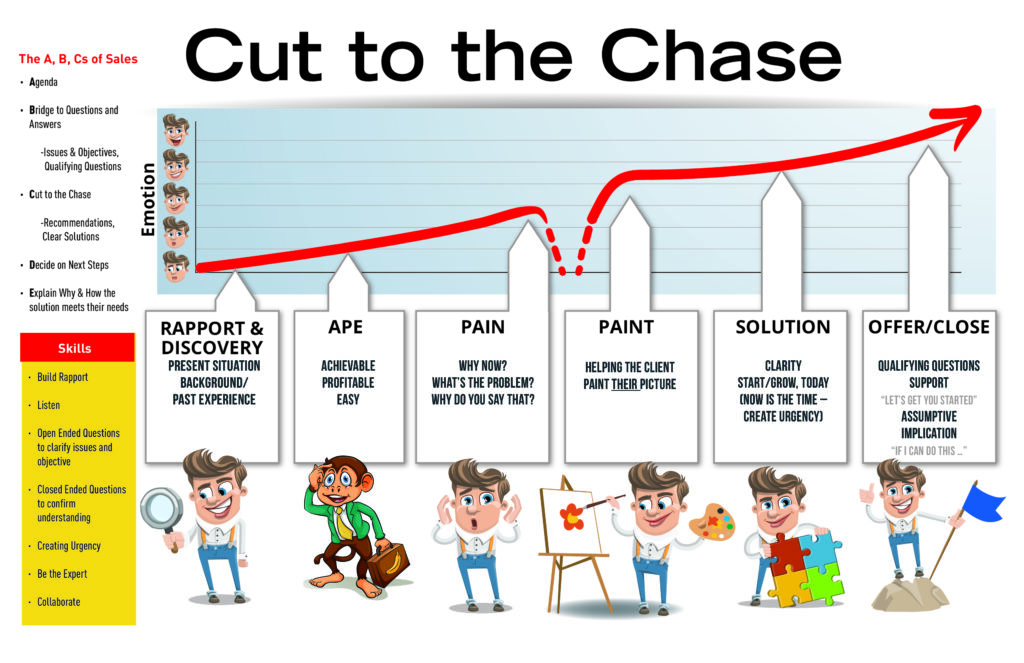
You teach a six-step framework called CUT to the CHASE. Could you walk us through it in detail?
Gladly.
- Rapport & Discovery: Open with genuine curiosity. Swap transactional chit-chat for questions about current wins, strategic goals, and personal motivators. Listen twice as much as you speak.
- AP—Achievable, Profitable, Easy: Position your solution as realistic, high-ROI, and frictionless. Explain what success looks like, why it pays for itself, and how onboarding won’t derail their operations.
- Pain: Quantify the cost of inaction—lost revenue, compliance risk, morale drain—so urgency becomes their idea, not yours.
- Paint: Invite them to describe life after the problem is solved. Vivid, sensory language (“I’ll finally turn my phone off at 5 p.m.”) deepens emotional pull.
- Solution: Map your product or service feature-by-feature to the future state they just painted. Use snapshots of similar clients to prove credibility.
- Offer & Close: Summarize agreed benefits, disclose investment and implementation logistics, then extend a clear invitation to move forward—silence is your ally here.
Why do you insist on hearing a prospect laugh before leaving the rapport stage?
Laughter is neuroscience in action. A genuine chuckle releases oxytocin, the hormone linked to trust and social bonding. If I can’t earn even a small laugh or smile, my prospect’s guard is still up; any subsequent pitch will ricochet off that invisible armor. When they laugh, walls crumble, candor rises, and difficult topics—budget, timeline, fear—surface far more quickly.
You emphasize diving deep into pain (or missed opportunity). Why is that so powerful?
Behavioral-economics legend Daniel Kahneman showed that humans weigh losses roughly twice as heavily as equivalent gains. By quantifying pain—“This delay bleeds $8,000 a month”—or by dramatizing opportunity-cost—“Early adopters captured 20% more market share”—you invoke primal risk-avoidance circuitry. When the chasm between today’s pain and tomorrow’s relief is enormous, buyers move mountains to cross it and happily pay the toll.
Many sellers reveal price prematurely. Why do you delay it until after solution alignment?
Price outside of value is noise. Say my advisory package costs $12,000. If the buyer hasn’t yet internalized that it will save $120,000 in taxes and headaches, then $12K feels absurd. But once they see the 10-to-1 return, the same $12K seems almost suspiciously low. Sequence matters: value first, price second, always.
Once price is on the table, objections inevitably surface. How do you address them effectively?
I celebrate objections; they’re evidence of engagement. My playbook:
Find the real obstacle through open questions.
Validate so the buyer feels heard (“That’s a sensible concern”).
Isolate by asking, “Aside from X, is anything else making you hesitate?”
Overcome the biggest hurdle collaboratively—maybe a phased rollout or financing.
Invite the decision again, confidently. Two out of three “yes” responses arrive on this second ask.
What core soft skills hold this entire process together?
Three pillars support every step: deep listening (hear what’s said and unsaid), financial storytelling (translate numbers into life outcomes), and adaptive empathy (mirror the prospect’s decision style). Add the discipline to pause—silence is a sales superpower—and you have a repertoire that engages analysts and visionaries alike.
Many sellers freeze when a buyer’s personality differs from theirs. Any advice for adapting without feeling fake?
Think of decision styles as radio frequencies. BANK’s “Blueprint” channel loves process; “Action” craves speed; “Nurturing” seeks harmony; “Knowledge” demands data. You’re still broadcasting the same song—your solution—just tuning it to their preferred station. Authenticity isn’t your vocabulary; it’s your intention. As long as your motive is to serve, adaptation never feels disingenuous.
How can a salesperson identify and shore up weak spots in their own approach?
Run a 30-day diagnostic sprint: record every discovery call, then each night grade one against a six-step rubric (1-5 per step). Patterns surface fast—maybe AP scores lag because you skip ROI proof. For the lagging step, binge micro-practice: role-play, mirror work, or even AI chat simulations. Improvement compounds when effort is laser-focused.
You often link belief in one’s own product with the energy they project. Can you elaborate on that connection?
When I personally buy the solution I sell—be it software, advisory, or an alarm system—I acquire stories, not scripts: the midnight alert that saved my inventory, the tax deduction that funded my daughter’s tuition. Story plus conviction fuels natural energy, which calibrates the emotional tone of every call. Prospects will never be more excited than you are; your conviction sets their thermostat.
Beyond accounting curricula, what other professional development do you offer, and how does your new simulator fit in?
Under our Universal Business Builder umbrella we teach digital lead funnels, strategic pricing, high-impact delegation, and even couples-finance communication—because a stressed home budget sabotages entrepreneurial focus. This year we’re rolling out the Strategic Selling Simulator, a gamified platform where users engage AI-powered prospects in branching dialogues, receive instant scoring on empathy, listening, and value articulation, and can “rewind” choices to see alternate outcomes. It’s the flight simulator of business development: crash safely, learn fast, and graduate cockpit-ready.
Could you share a quick, practical win readers can implement today to cut to the chase more effectively?
Create a one-page “Conversation Compass.” Draw six boxes—one per step—and jot two bullet prompts in each. Tape it to your monitor. On your next call, let the compass steer flow, not script words. Within ten conversations you’ll internalize structure so completely that your brain is free to notice tone shifts, buying signals, and moments to pause.
What’s the single most common mistake entrepreneurs make when selling their own product or service?
They host a talent show—feature after feature—when prospects really want a medical consult. Imagine a surgeon describing every scalpel brand before diagnosing. Diagnose first, prescribe second. Features only matter once the patient trusts your cure.
If you had to condense today’s conversation into one core takeaway, what would it be?
Authentic sales is a structured empathy exercise: illuminate the cost of staying stuck, paint a compelling alternative, and present your offer as the logical bridge. Do that with integrity and discipline, and revenue becomes the natural by-product of service.
Looking ahead, what exciting projects or broader vision are you pursuing over the next three to five years?
We’re doubling down on community-centric learning. Picture a global map where graduates host in-person “boardroom circles” to troubleshoot real-time business challenges with peer accountability. Layered onto that will be augmented-reality walkthroughs—think HoloLens overlays that guide you through a live client meeting, highlighting body-language cues and suggesting probing questions in your peripheral vision. The goal: compress decades of trial-and-error into months of immersive experience.
How can our readers further follow your work online?
Download our free “Biz Benchmarks & Breakthroughs” toolkit at https://universalaccounting.com/free-resources —it includes pricing calculators, ROI templates, and a mini value-pricing course. Then connect with me on LinkedIn. Drop a quick note referencing this interview and I’ll invite you to our next live masterclass.
Want to learn how to master the six-step formula to close more deal fast? Enroll in the Strategic Selling Training today.
Roger, thank you for such an in-depth, actionable conversation. I know our readers will walk away with a richer toolkit—and renewed confidence.
The pleasure is mine, Stacey. Remember, if it’s about business, it is universal.