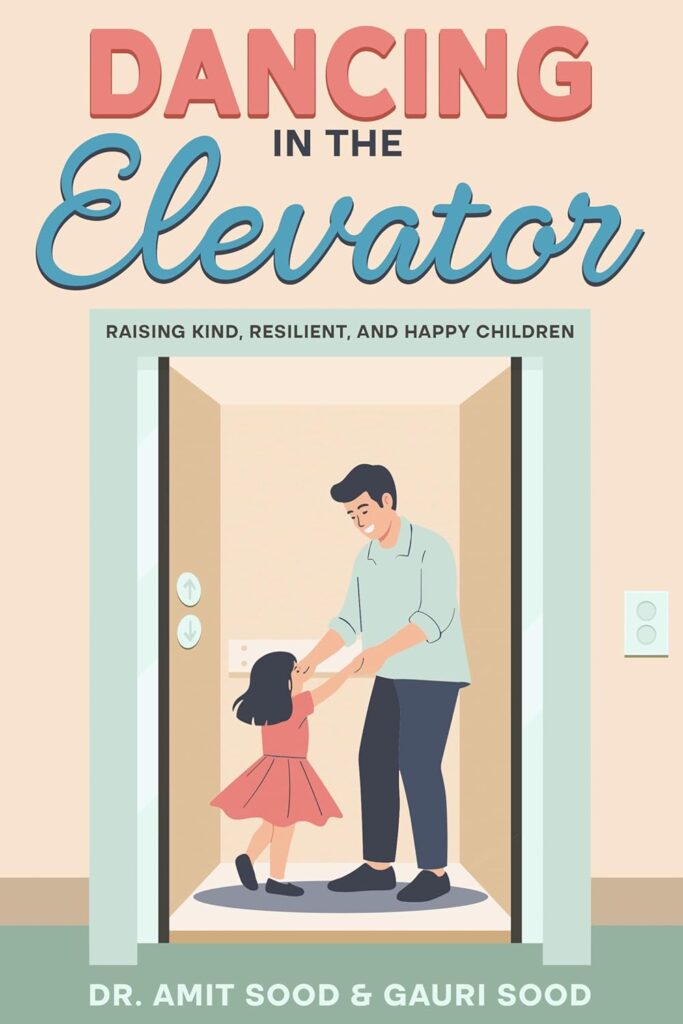


“Daddy, we forgot to dance!” Gauri teased me as the elevator started moving.
I blinked out of my reverie. “Let’s fix that right away.”
Within seconds, we were moving. Gauri, with effortless rhythm and teenage cool; me, with the grace of a malfunctioning windmill. Still, those thirty seconds of joyful chaos visiting Gauri’s college campus were worth the entire trip.
This wasn’t our first elevator performance. The tradition began years ago, on a weary evening after a long hospital visit. The elevator doors closed, no audience in sight, and someone—no one remembers who—started moving to imaginary music. Within seconds, we were staging a playful rebellion against the confines of our life at that moment, dancing away our exhaustion. And it worked. Like instant therapy.
“Why not?” we said the next time. And the next. Before long, elevator dancing became our family’s ritual, performed without fail in vertically moving ballrooms with dubious acoustics and zero witnesses. It became a symbol of breaking free from social norms, finding lightness in limitation, and celebrating in an emotionless space, even though we were “between floors.”
The brief waltz at Gauri’s college was a tiny validation of seventeen years of parenting: proof that amid homework battles and bedtime negotiations, something joyful had stuck. Over the years, my wife Richa and I have shamelessly plagiarized or invented dozens of such family quirks to help our daughters guard their attention, thinking, and emotions from the daily siege of stress and screens. This book captures a few reflections from my journey as a father, mentor, coach, and friend, hoping my learnings might help you (or at least make you smile).
Like most first-time parents, I began with a cocktail of excitement and panic; the thrill of welcoming a new soul mixed with the sobering realization that there was no user manual. So, I enrolled myself in a lifelong program called “Parenting 101.” Two decades later, I’m still attending classes, turning in assignments late, and have absolutely no hope of graduating.
Nevertheless, early in that learning, I stumbled on a line that summarized a large body of child development research: The strongest predictor of resilience in children is having at least one steady, supportive relationship with a caring, capable adult. In other words, a resilient child needs a caring, empowered, and engaged parent (or another adult).
That was my wake-up call. I was caring, sure, but also distracted, impatient, and not exactly “Dad of the Year” material. So, I turned to books, articles, fellow parents, and the occasional 5 a.m. search for “how to remove peanut butter from hair without industrial solvents.” I had to learn it all, and fast. I only had 900 weeks before Gauri would head off to college.
I posed many questions to my fellow parents and family elders: How do they maintain composure under stress without slipping into theatrically villainous behavior? Where do they stash their stamina? Does gratitude last, or spoil like cheese? I tested the answers I got against research, my conscience, and daily life with my kids.
As Gauri and Sia grew, I learned patience (via six back-to-back readings of the same story), humility (via my kids’ public reviews of my singing voice), and survival (via staying sane despite three hours of sleep). I learned that ego is overrated; letting kids be your tutors in persistence and empathy makes life lighter.
When Gauri headed off to college, I experienced a second upswing in my learning. Many lessons came from her classmates and their parents, spanning the whole spectrum of thriving. I learned that it’s possible to raise dazzlingly accomplished children who are also humble, kind, and genuinely happy, without burning out as a parent. It was like finding out someone baked a five-layer cake that’s gluten-free, sugar-free, and still delicious!
Today, after more than two decades of trial, error, laughter, and peanut-butter extractions—and after having observed and mentored thousands of students—I feel ready to distill my journey through what may be the most challenging task we adults face.
And it’s not just my voice. Gauri, now a college student with a flair for fact-checking her father, joins me as co-narrator.
I (Amit) am wearing three hats:
- Student-parent of twenty-one years, having experienced the highs and lows of this most meaningful privilege.
- Researcher and teacher of resilience and happiness, reaching millions of individuals and families across generations.
- Former Director of Student Life and Wellness at Mayo Clinic, supporting thousands of students, and creator of the PACE approach to parenting.
Gauri is also triple-hatted:
- Providing the inside scoop on every messy experiment Richa and I tried.
- Founder of the Harvard SPARK initiative (Supporting Policy, Advocacy, and Research for Kids) and co-creator of HappiGenius (a social-emotional learning program), working across youth groups, from students at elite schools to those navigating much harder roads.
- A peer and classmate, watching what truly fuels today’s youth.
Together, we’ve wandered through the past, explored the present, and squinted into the future to shape the approach we share. While the pages that follow speak in Amit’s voice (yes, Dad grabbed the mic!), they carry the hearts and minds of both of us.
Friend, think of this book as a small care package from our family to yours—filled with science, stories, and practical skills, all wrapped in the promise that you are not alone. May it help us, together, nurture a kinder, happier, and more hopeful world for every child.