
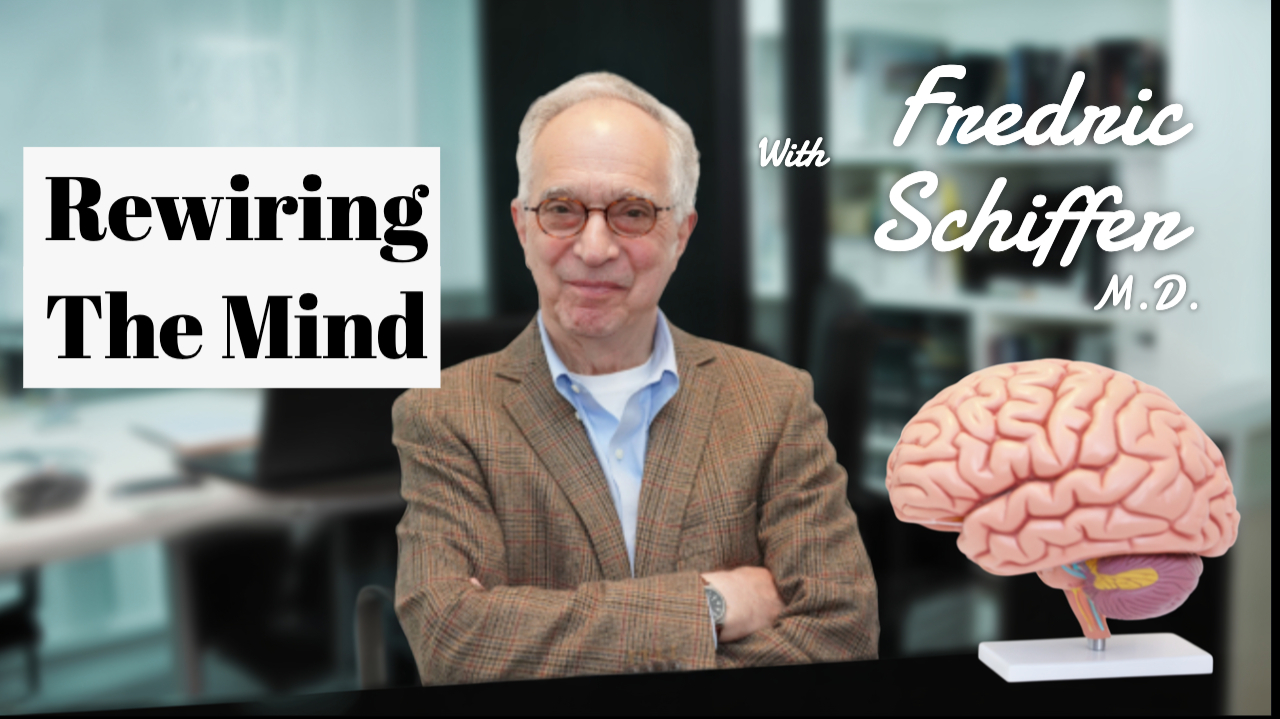
Dual-Brain Psychology suggests that each hemisphere of the brain can support a different “mind” — one often mature and balanced, the other shaped by trauma — and learning to work with both may transform how we understand anxiety, depression, addiction, and PTSD.
– Fredric Schiffer, M.D.
When Anxiety Isn’t Just Anxiety
Anxiety and depression are often treated as chemical imbalances, stress responses, or lifestyle issues. But what if part of the problem lies in how different regions of the brain interpret reality?
Fredric Schiffer, M.D., a Harvard-trained psychiatrist and researcher, has spent decades exploring an unconventional yet clinically grounded idea: that each hemisphere of the brain may house a distinct psychological experience. In his Dual-Brain Psychology framework, one hemisphere often reflects a mature, balanced perspective, while the other may hold unresolved trauma and heightened threat perception.
Rather than viewing mental health struggles as singular experiences, Schiffer proposes that many emotional disturbances stem from one “mind” dominating the other.
Understanding this distinction may offer patients a new pathway toward healing.
The Two Minds Hypothesis
Dual-Brain Psychology is rooted in both clinical observation and neurological structure. Anatomically, the brain is divided into two hemispheres, each containing its own amygdala, hippocampus, and frontal regions. Schiffer’s theory suggests that these hemispheres can process emotional reality differently.
One hemisphere tends to be calmer and more grounded. The other may carry emotional residues from childhood adversity or trauma, interpreting neutral situations as threatening.
This framework helps explain why someone can feel safe one moment and suddenly overwhelmed the next — without any clear external trigger.
The shift, according to Schiffer, may be neurological rather than purely psychological.
A Practical Demonstration: The “Envelope Technique”
One of the most discussed tools within Dual-Brain Psychology is a simple lateralized viewing exercise sometimes called the “envelope technique.”
By covering specific portions of visual input to stimulate one hemisphere more than the other, patients can experience a measurable emotional shift when thinking about the same distressing memory.
While the technique itself is not a cure, it serves as a powerful demonstration. Patients often report that the emotional tone of a memory changes depending on which hemisphere is more engaged.
This immediate contrast can help individuals recognize that their emotional response is not fixed — it is influenced by which “mind” is leading.
The insight becomes the doorway to deeper trauma work.
Trauma and the Child-Mind
One of the most significant implications of Schiffer’s work involves childhood development.
Experiences during formative years often shape the trauma-bearing hemisphere. Criticism, neglect, instability, or fear can become embedded patterns that later color adult perception.
These patterns may present as:
- Hypervigilance in safe environments
- Hopelessness when options exist
- Repeating relationship dynamics that mirror early wounds
- Addictive behaviors as coping mechanisms
The “troubled” mind is not irrational — it is protective. It responds to current situations as though they mirror earlier threats.
Therapeutic work, in this framework, involves inviting the healthier hemisphere to engage with the traumatized one — not to suppress it, but to help it reinterpret present reality safely.
When Normal Emotions Become Disordered
Fear and sadness are normal human experiences. They become problematic when they no longer match present circumstances.
Anxiety is adaptive in the presence of real danger. It becomes disordered when danger is perceived where none exists.
Depression is natural during genuine loss. It becomes dysfunctional when hopelessness persists despite opportunity.
Dual-Brain Psychology proposes that disordered emotional states often emerge when the trauma-shaped hemisphere overrides the balanced one.
Helping patients distinguish between present reality and past injury becomes central to treatment.
The Role of Repetition and Gentle Reality Testing
The envelope demonstration provides awareness, but healing requires repetition.
Patients are encouraged to:
- Notice which “mind” feels active
- Identify what current emotions resemble from the past
- Invite the healthier perspective forward
- Speak internally with clarity and reassurance
This process resembles how one might comfort a frightened child — patiently, consistently, without force.
Over time, the nervous system begins to register safety in situations that once triggered alarm.
Applications Beyond Anxiety and Depression
Emerging research connected to Dual-Brain Psychology is exploring its application in addiction treatment, including early studies involving hemispheric stimulation.
While results remain preliminary, the underlying principle remains consistent: when individuals learn to identify and engage their balanced “mind,” emotional regulation improves.
This model does not replace traditional therapy or medication when needed. Instead, it offers an additional lens through which clinicians and patients can understand persistent emotional distress.
A Shift in Perspective
Perhaps the most powerful takeaway from Schiffer’s work is this:
Emotional suffering may not be a fixed identity. It may be the perspective of one hemisphere speaking louder than the other.
If two different internal experiences can exist within the same person, then healing may not require eliminating anxiety or trauma entirely — but helping the healthier mind take a more consistent lead.
Simple awareness, practiced consistently, can reshape perception.
And perception shapes life.