

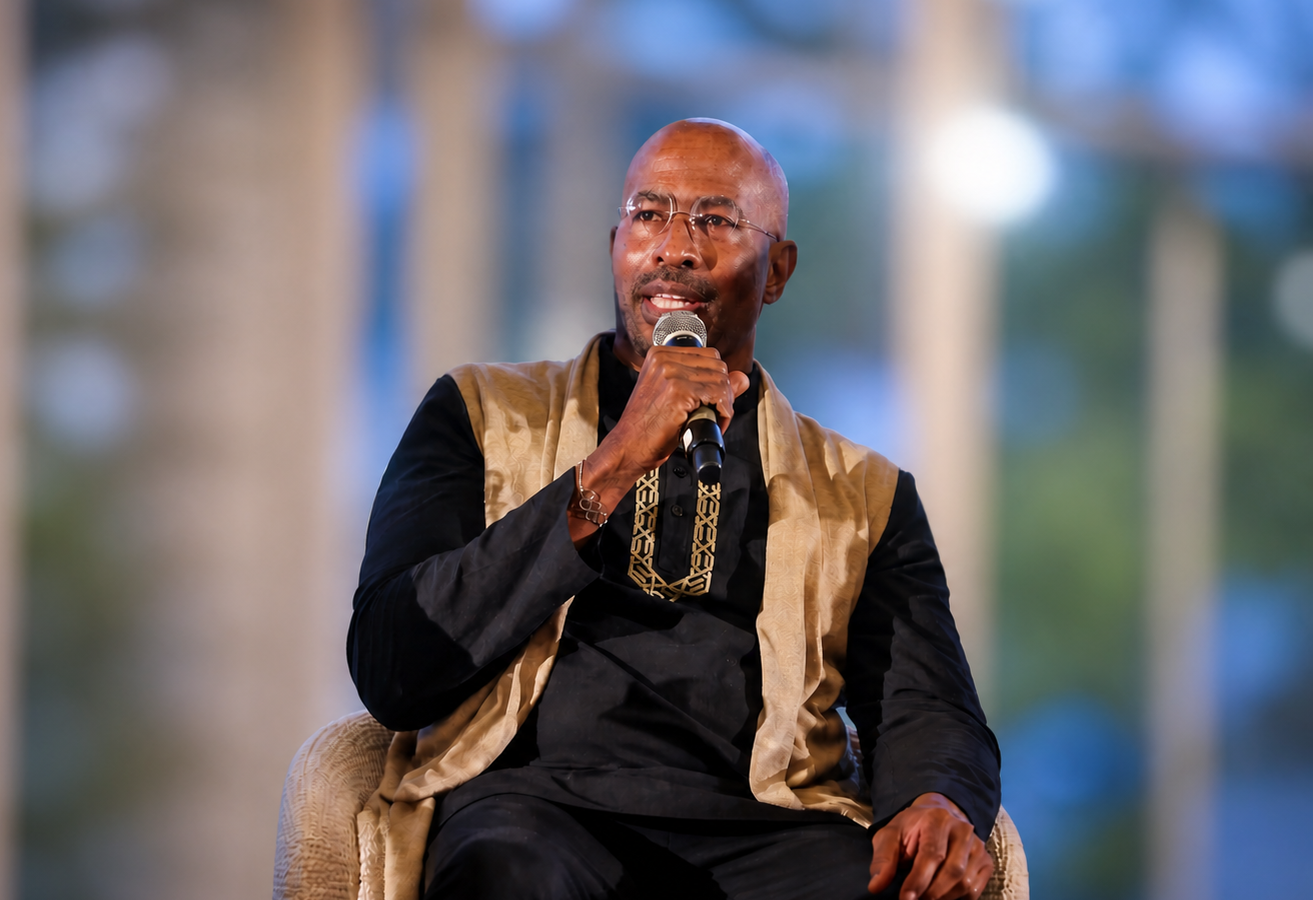
By Amina Zamani
There’s a concept in twelve-step recovery that doesn’t get nearly enough airtime outside those rooms.
When someone is drowning in self — in shame, in obsession, in the grinding loop of their own story — the prescribed antidote isn’t more introspection. It isn’t better journaling or a stronger morning routine. The instruction is almost shockingly simple: get out of self and go help a newcomer. Find someone newer to the struggle than you are. Show up for them. Your ego, which has been eating you alive, cannot survive genuine service. It starves.
I thought about that concept a lot after I sat down with Van Jones.
Within minutes of us starting he was completely present, warm, and almost disarmingly generous with his thinking. He spoke the way people speak when they’re not managing an image. He said things like I got lucky and I let people down, including myself and I’m still trying to be a good man — not as practiced humility, but as plain, accurate accounting from someone who has actually been through it.
What struck me, as a neuroplasticity specialist who spends a lot of time thinking about how belief systems shape the brain’s architecture, was this: Van Jones has somehow structured his entire psychological operating system around the newcomer principle. He has been unusually public about his mental health work — the therapy, the men’s groups, the meditation retreats — not as a brand move, but because he seems to genuinely believe that the internal work is the work. He doesn’t just help people. He seems to approach the world — every conversation, every broken system, every young man without a role model — like it’s someone in their first week, needing someone to show up.
That’s not a communication style. That’s a neurological orientation. And it has measurable consequences for how the brain works, how it ages, and how it recovers from being knocked flat.
What Beliefs Actually Do to the Brain
Before we get to Van Jones’s story, a quick primer — because the neuroscience here is genuinely important and wildly underreported.
Your beliefs are not abstract opinions. They are physical structures. Every belief you hold — about yourself, about what’s possible, about whether your actions matter — is encoded as a pattern of neural connectivity. Neurons that fire together wire together, as the saying goes, and over time, the beliefs you return to most become the brain’s default routing. They literally shape which information you notice, which problems you attempt, and how much energy your prefrontal cortex allocates toward creative problem-solving versus threat management.
Here’s why this matters: the brain runs a constant cost-benefit calculation on effort. If a deep belief says things can’t change or I don’t matter that much, the brain treats ambitious action as wasteful. It downregulates motivation at the neurochemical level — less dopamine in the anticipation circuits, less norepinephrine for sustained effort. You don’t just feel less motivated. You are, chemically, less motivated, because your belief system instructed your brain to conserve resources.
The inverse is equally true. A genuine belief that anything is possible — not as a poster slogan but as a lived, embodied conviction — rewires the brain’s reward anticipation system. It expands what researchers call the “possibility space” your prefrontal cortex is willing to work on. Big goals activate broader cognitive networks. They make you, literally, more capable of creative and strategic thinking.
Van Jones told me his core belief, unprompted, in four words: anything is possible.
What I heard, underneath that, was a description of a brain that had been deliberately trained — through therapy, meditation, men’s groups, Vipassana retreats, years of doing the unglamorous internal work — to stay in the expansive register rather than the defensive one.
That doesn’t happen by accident. And it doesn’t happen without going through some things first.
The Fall, Told Plainly
The polished version of Van Jones’s biography skips fairly quickly over the hard part.
He was appointed Special Advisor for Green Jobs under President Obama in 2009. Within months, a coordinated conservative media campaign surfaced old statements and past associations. He resigned under pressure. The nonprofit organizations he’d built before Washington lost their footing without him. For a stretch, by his own account, he was wandering — without the institutional identity that had defined him, without a clear next chapter.
This is the part of the story I think matters most. Not because public falls are unusual, but because of what he did with it.
He didn’t outrun the pain. He didn’t immediately launch the next thing. He did the internal work — work he’d actually started years earlier, in his late twenties, when burnout and fractured relationships had already been signaling that something needed attention. Burnout recovery, for Jones, wasn’t a weekend retreat or a productivity hack. It was years of therapy, coaching, Buddhist practice, men’s groups, workshops. He tried, as he put it, “everything you can do.”
From a neuroplasticity standpoint, this is the critical variable. Unprocessed emotional pain doesn’t disappear. It gets routed into the body and into behavior — chronic stress activation, reactivity, the slow calcification of someone who once cared into someone who performs caring. The brain under sustained threat doesn’t problem-solve. It protects. It narrows.
Processing experience does the opposite. When difficult events are actually metabolized — felt, examined, integrated — the nervous system shifts from threat response to meaning-making. The prefrontal cortex comes back online. Neuroplasticity, the brain’s capacity to rewire itself, is highest when we’re in that meaning-making state rather than the defensive one.
Van Jones, whether or not he frames it in these terms, spent years deliberately keeping his brain in the state where growth is possible. That is a skill. Most people never develop it.
Arianna, and What “Guardian Angels” Actually Means
There’s a moment in our conversation where Jones mentions Arianna Huffington — not effusively, not as a name-drop, but as an example of something he clearly believes deeply.
“We all need our guardian angels,” he said.
When he said it, something shifted for me personally. I met Arianna in my twenties — at a dinner with Marianne Williamson, the kind of evening where you expect to be invisible. Within twenty minutes she had turned to me, an Afghan woman still figuring out what she had to say and whether anyone would want to hear it, and told me I needed to write my story. Not suggested it. Told me. With the quiet certainty of someone who already knows the answer before you do.
She has championed me from a distance ever since — a quiet champion, the kind who plants a seed in one conversation and then trusts you to grow it. I’ve thought about that dinner more times than I can count. So when Van Jones said her name the same way — as someone who showed up at a hard moment and believed in him when the conditions for belief were not obvious — I felt the full weight of what he meant.
That’s the thing about Arianna. She didn’t build Thrive Global as an abstract wellness project. She built it from a lived reckoning — a collapse on the floor of her office, a broken cheekbone, the moment her body finally sent the bill for years of treating herself as expendable in service of the mission. What came out of that was a conviction that has since reached millions: that the human underneath the output is not a liability to manage. It is the whole point.
That both Jones and I have experienced her as a guardian angel is not a coincidence. It is the Thrive thesis made personal, twice over. The people who last — who fall and come back with more depth rather than less — are almost never the ones who went it alone. They are the ones who were met, at a critical moment, by someone who understood that sustainable performance and sustainable impact both require tending to the person doing the work.
Leadership narratives have a stubborn bias toward the solitary comeback. The individual who hit rock bottom, dug deep, and clawed back through sheer will. It’s a compelling story. It’s also, neurologically, mostly fiction. Human beings co-regulate stress through connection. We literally calm each other’s nervous systems through proximity, trust, and the felt experience of being believed in when we can’t quite manage it ourselves.
Behind almost every visible recovery is an invisible network of people who kept showing up. Jones names his. He names Rebecca Cutler, the CNN executive who offered him a contract post-White House when most doors were closing — without whom, he says flatly, “we wouldn’t be talking.” He names the guardian angels. He gives the web credit.
In a culture that rewards self-made mythology, that kind of honest accounting is its own form of courage.
Prey, Predator, Protector — The Healthy Masculinity Model Nobody’s Talking About
One of the sharpest things Jones said to me didn’t come with fanfare. He was talking about young men, about the confusion he sees in how they try to figure out what strength means — and about what a healthy masculinity model might actually look like in practice. He laid out three archetypes.
The prey. The man who shrinks, appeases, becomes a target.
The predator. The man who uses strength to dominate and take.
And then the third — the one he argued has been quietly removed from the cultural menu over the past twenty years — the protector. The man who develops genuine strength in order to safeguard those who are vulnerable to people who abuse theirs.
“When you outlaw chivalry,” he said, “you’re left with wimps and bullies.”
You can argue with the word chivalry. But the underlying point is neurologically and psychologically solid. Human identity is organized around available models. When a culture stops presenting a viable image of strength-in-service — strength that is muscular and accountable, capable and oriented toward others — people don’t become ideologically neutral. They migrate toward the available extremes.
I’ve watched this play out up close. The men I’ve known who went sideways didn’t lack intelligence or capability. They lacked a frame for what to do with their strength that didn’t require either suppressing it or weaponizing it. Nobody ever handed them the protector model. Nobody said: your capacity for power is not the problem. The question is what you point it at.
Jones grew up in the Black church in the rural South. Communities that were, as he described them, materially thin but relationally and spiritually dense. He absorbed early that being a man meant being responsible to people. Not above them. Not despite them. To them.
That’s the neurological opposite of ego. The ego is oriented inward — toward self-protection, status, the management of how you’re perceived. The protector orientation is outward — toward others’ vulnerability, others’ becoming, others’ need. Different brain regions. Different neurochemistry. Different life outcomes.
Eat the Whales
On Jones’s desk sits a fossilized megalodon tooth.
The megalodon has been extinct for roughly two and a half million years. It was so large that whales — actual whales — were its primary food source.
“You should eat the whales,” Jones told me. “Take on the biggest challenges you can find. Because why not? It’s the same amount of work to do a bunch of small things. And the chances of winning and losing are about the same regardless.”
I’ve turned this over many times since. On the surface it sounds like a motivational line. Underneath, it’s a sophisticated energy management argument. If effort is unavoidable — and for people wired like Jones, it clearly is — then the only variable you control is direction. Small targets and large targets cost roughly the same amount of courage and time. The difference is what they develop in you, and what they make possible for others.
There’s a neuroscience layer here too. The brain’s goal-setting architecture responds differently to scale. Large, meaningful goals activate the default mode network in ways that generate associative, creative thinking. They also engage the anterior cingulate cortex, which is involved in sustained attention and effort allocation. In plain terms: big goals make you smarter and more focused, not less. The brain expands to meet the size of what it’s reaching for.
Small thinking, neurologically, narrows the very faculties you need to execute it well.
Jones has also thought carefully about the belief side of this. I asked him how he knows anything is possible — what internal evidence he has for that conviction after everything he’s been through.
“Some things you have to believe to see,” he said.
Not see to believe. Believe to see. The evidence for possibility is everywhere, he argued, but it’s only legible if you’re already oriented toward it. This is exactly what neuroplasticity research bears out: the brain finds what it’s primed to find. Your reticular activating system — the filtering mechanism that decides what information reaches your conscious attention — is tuned by your beliefs. If you believe things can change, you notice the signals that confirm it. If you don’t, you filter them out. The belief isn’t just motivational. It’s perceptual. It literally changes what you see.
The Newcomer Principle
Here is what I kept coming back to throughout our conversation, and after.
In twelve-step recovery, one of the most counterintuitive prescriptions for someone in the depths of self-obsession — trapped in shame or grandiosity or the endless recursive loop of their own story — is this: stop thinking about yourself and go find someone who just walked through the door. Help them. Not because you’ve got it figured out. Not because you’re healed. But because the act of genuine service to another person is one of the only reliable ways to interrupt the ego’s feedback loop.
The neuroscience behind this is real. Prosocial behavior — acting in service of others — activates the brain’s reward circuitry in ways that self-focused behavior often doesn’t. It releases oxytocin, which downregulates the stress response. It engages the prefrontal cortex, pulling attention away from threat processing. Chronic service orientation has been associated with reduced cortisol, better immune function, and — perhaps most relevant here — a more stable sense of identity that isn’t contingent on external outcomes.
Van Jones seems to have internalized something close to the newcomer principle and applied it not just to individuals, but to the world. Every broken system he encounters, every young man without a model, every community left out of the technological future — he treats them like someone in their first week who needs someone to show up. It’s the operating logic behind Dream Machine Innovation Lab, his initiative to bring AI access and imagination to Black and brown communities. It’s the logic behind RAPPORT, his AI company built not to replace human intelligence but to increase emotional intelligence inside organizations. In both cases the question is the same: who’s been left out, and how do we show up for them?
He was tired when we spoke. It was visible. But he gave the interview fully, thought carefully, and at the end apologized because he had another call he’d forgotten about. He was the most unfussy version of someone significant I’ve encountered. No entourage energy. No image management. Just a man in a T-shirt who had a lot of things he still wanted to try to do.
That, I think, is what service as a neurological default actually looks like in a human body. It doesn’t look like a TED Talk. It looks like someone who is a little worn down, still showing up, and genuinely glad you came.
Still Trying
Near the end of our conversation Jones said the thing that stayed with me longest.
Not a vision statement. Not a call to action. Just this:
“I’m still trying to be a good man. That’s pretty much all I’ve got.”
In a media environment that rewards the performed arrival — the person who has solved themselves, packaged the lessons, and is now ready to sell you the methodology — that kind of unfinished honesty is almost disorienting. He’s not offering a system. He’s reporting from inside a process.
But that, it turns out, is precisely the neurological posture associated with continued growth. Carol Dweck’s research on growth mindset, now replicated extensively, shows that people who see themselves as permanently in-process — rather than fixed in their abilities or identities — maintain more adaptive neural plasticity across their lifetimes. They recover faster from failure. They extract more learning from difficulty. They stay open in ways that people who have “arrived” cannot.
Van Jones has been through the fire. He has the falls and the wandering and the public dismantling on his resume alongside the White House and the Emmy. What he has, that a lot of people who go through equivalent experiences don’t have, is a belief system structured around service rather than self — and an internal practice rigorous enough to keep that belief from being just words.
He treats the world like a newcomer. He shows up tired and shows up anyway. He names the people who held him up instead of writing them out of the story.
That’s not a leadership philosophy. That’s a way of running a nervous system.
And in 2026, when most public discourse is optimized for outrage and most “wellness” content is optimized for consumption, it might be the most radical thing going.
About the author
Amina Zamani is a neuroplasticity specialist, executive coach, writer, and global speaker who helps individuals and organizations rewire limiting beliefs, unlock emotional resilience, and step into visionary leadership. Born in Pakistan and raised across cultures, she bridges neuroscience, soul, and systems thinking to catalyze both personal and generational transformation.
Amina has worked with Fortune 500 executives, award-winning creatives, and founders across venture-backed startups. Her upcoming book—rooted in her passion for financial literacy and equity for women—explores the neuroscience and spirituality of money: how early emotional trauma shapes our financial behaviors, beliefs, and capacity to receive. She has been featured on CBS, USA Today, and Lifestyle Magazine, among others. Through her writing, media, and workshops, she champions a future where visibility becomes medicine and belief becomes biology.