
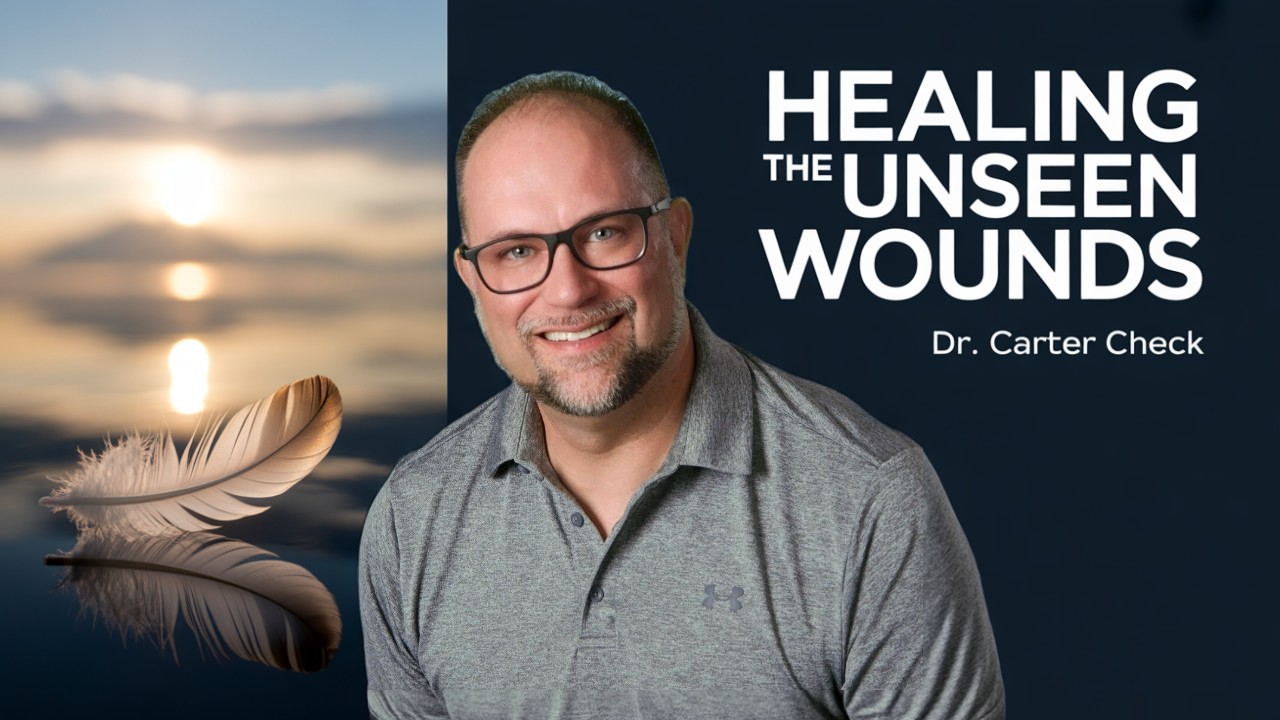
“Healing doesn’t mean forgetting what broke you—it means remembering differently. The deepest wounds don’t bleed, but they can still be healed when we reconnect to what truly matters and remember that our story isn’t over yet.”
— Dr. Carter Check
In a world that celebrates resilience but often hides pain, few conversations are as necessary—or as neglected—as the ones about unseen wounds. Behind the statistics of trauma and suicide are human beings quietly carrying the weight of betrayal, loss, and shame that can’t be diagnosed with a scan or healed with a prescription. These are what Dr. Carter Check, a U.S. Army veteran and VA suicide prevention chaplain, calls moral injuries—the invisible fractures of the soul that occur when what we believe is right is violated. Through his groundbreaking work and his book Healing in the Wild, Dr. Check is helping people move beyond mere survival toward restoration, reminding us that healing is not just about managing pain but reclaiming meaning and purpose.
In this heartfelt and deeply illuminating conversation, Dr. Check sits down with Stacey Chillemi to discuss the critical difference between mental and moral health, the dangerous impact of loneliness, and why connection—not medication—is often the missing piece in suicide prevention. From his own journey through trauma and betrayal to his transformative approach of using nature as a “co-therapist,” Dr. Check shares how the Wild teaches us that silence isn’t empty—it’s safe. His message is both timeless and timely: we don’t stop suicide by studying death; we stop it by restoring reasons to live.
Thank you so much for joining us, Dr. Carter! Our readers would love to get to know you a bit better. Can you tell us a bit about your backstory?
Absolutely—and thank you for having me. I’m a U.S. Army veteran, a dad of five, a husband, and I serve as a suicide prevention chaplain and medical ethicist in the VA. Long before those titles, I was a young man shaped by trauma, silence, and survival. Those early experiences are why my life’s work centers on moral health: helping people heal the unseen wounds of betrayal, grief, and shame—injuries that never show up on a scan but can reroute a life. My purpose is simple: to companion people until they see not only why they shouldn’t die, but why their life is worth living.
What drew you specifically to the language of “moral health”?
Traditional mental health often asks, “What’s wrong with you?” Moral health asks, “What still matters to you?” That shift is everything. It moves us from managing symptoms to restoring meaning, identity, and integrity of the self. When someone’s core values are violated—by betrayal, abandonment, or disenfranchised grief—the wound is moral. It requires presence, ritual, truth, and reconnection, not pills alone.
For readers new to the term, what is moral injury—and how is it different from PTSD?
Moral injury is a violation of what’s right to you. PTSD is fear-based—triggered by threat and danger—and it sounds like, “I might not be safe.” Moral injury is shame- and betrayal-based; it sounds like, “I don’t belong anymore.” One fractures our sense of safety; the other fractures our sense of self. Moral health work is about helping people rebuild integrity, belonging, meaning, and voice.
You’ve lived through a defining episode during your Army service. How did that shape this work?
At 18, overseas, my battle buddy and I were attacked. I acted to protect him—fast, decisive, necessary. The aftermath turned political; I faced life sentences in a foreign court. Though the judge ultimately spared prison, the institutional abandonment and the hazing that followed back home broke something in me that no X-ray could find. Later, a divorce and custody loss—decisions made by systems, not by truth—compounded it. Those events taught me: some wounds don’t bleed, but they bury you alive unless you’re given language, community, and a way back to yourself.
Why are isolation and loneliness so dangerous in suicide risk?
Because loneliness is an accelerant—it pours gasoline on suicidal thoughts. Across dozens of studies I analyzed, loneliness was a motivational phase factor: it doesn’t just correlate with risk; it speeds it up. The antidote isn’t a formula—it’s connection and community. Create belonging, restore purpose, and you begin to starve suicidality of its fuel.
You say, “We don’t stop suicide by studying death—we stop it by restoring reasons to live.” What does that look like in practice?
When I ask someone, “On a scale of 0–10, how important is it for you to live?” most say five—or zero. If they say five, I ask, “Help me understand why you’re not a one.” If they say zero, I ask, “Help me understand why you’re still alive.” Then I listen. Whatever they say—kids, a promise, a dog, a sunrise—that’s the seed we water. We don’t drag people to ten; we honor the ember that’s already glowing and build around it.
What early signs suggest someone may be carrying unseen wounds—even if they “look fine”?
Withdrawing from community. Shame and silence—believing their story is “too heavy” for others. Loss of meaning—asking, “What’s the point?” Identity fracture—“I don’t recognize myself anymore.” Persistent rage or bitterness that signals a sacred boundary was violated. Spiritual distress—feeling cut off from what once grounded them. And compulsive numbing—using substances, overwork, or busyness to avoid sitting with the pain.
How can friends and family respond when they notice these signs?
Show up without judgment. Don’t try to fix—walk with. If risk is acute, call 988 (veterans press 1) and stay with them through the handoff. Most of all, offer presence. Sit beside them in the dark; don’t analyze from across the room. Healing is relational before it’s clinical.
You take people into the outdoors as part of recovery. Why the Wild?
Because the Wild tells the truth. Trees don’t interrupt. Rivers don’t condemn. The sky never argues. In nature, silence isn’t empty—it’s safe. Trauma shrinks the world down to the wound; the Wild expands it again. Under a sky full of stars, pain is still real—but it’s no longer everything. The body remembers what the mind forgets: walking, breathing, casting a line, drawing a bow—these practices unlock what’s locked inside.
What’s a simple ritual someone can try to honor grief or moral injury?
A ritual of remembrance. Write the names of those you carry—or the words you never got to say—on a card. Take them with you into the Wild: a hike, a shoreline, a backyard sunrise. Read them aloud. Give those words movement—a stone placed, a flower left, a card released in a safe, eco-friendly way (or burned in a fire pit). Grief needs form. Ritual turns weight into motion.
You often say, “Healing isn’t forgetting—it’s remembering differently.” Can you unpack that?
Time doesn’t heal all wounds; it gives us space to carry them with strength. A mentor taught me to transform unbearable pain into livable disappointment. That may not sound glamorous, but against the alternative, it’s everything. Remembering differently means the story no longer defines your identity—it informs your wisdom.
How do we move from symptom management to reintegrating the self?
Presence over performance. Naming over numbing. Whatever comes out of your mouth will silence the chaos in your head. Moral injury thrives in secrecy; voice dissolves it. Pair that with places that ground your nervous system—the woods, rivers, fields—and with people who companion, not correct. That’s reintegration.
For leaders—parents, partners, employers—what does truly supportive leadership look like?
Come around the desk. Sit with, not over. Replace checklists with questions like, “What do you need to get to tomorrow?” and “How can I help you be the best version of you?” Moral injury isolates; supportive leadership re-humanizes. It restores dignity by staying present through discomfort.
If someone reading this feels seen and stuck, what’s the first step today?
Tell one safe person the truth. A chaplain, therapist, pastor, friend—someone who will hold your words without judgment or fixing. We were not designed for isolation. If you’re in a crowded room and feel alone, that’s your signal to reach out. Courage isn’t the absence of pain; it’s choosing connection in the middle of it.
You developed four components of moral health. What are they—and how can readers apply them?
Integrity: realign life with your values (name them, choose one tiny aligned action today).
Belonging: rebuild community (one text, one coffee, one group).
Meaning: remember why your life matters (list the reasons you’re not at “one”).
Voice: speak truth without shame (share one sentence with someone safe). Small, consistent steps rebuild the inner framework faster than any grand gesture.
Nature seems to function as a “co-therapist” in your model. What does that look like in session?
We let the land do what four walls can’t. A sunrise becomes the metaphor: a little light does dispel darkness. A campfire gives permission to speak. Casting a line slows breath. Walking paces story. I’ve watched veterans who couldn’t speak in clinic find their voice by a river. The Wild doesn’t heal for us—it makes it safe enough that we can heal in it.
Tell us about your book, Healing in the Wild. What will readers find inside?
It’s an instructional memoir: my model for using nature to overcome trauma and loss. You’ll find breathwork, mindfulness, rituals of remembrance, and practical tools for rebuilding meaning, identity, and integrity. It’s being translated into Arabic for refugee communities—evidence that these principles are human, not culture-bound. If you prefer listening, the audiobook carries the cadence of the stories; the print helps you mark up your own path.
Where can people find the book—and additional resources?
Visit drcartercheck.com and healinginthewild.com. The book is on Amazon and most audio platforms. If hearing me resonates, grab audio; if you like to underline and journal, grab the print. Both point you back to your own life.
What are the most important ideas you hope readers carry forward from this conversation?
The deepest wounds aren’t visible—and they need a voice. Mental health asks what’s wrong with you; moral health asks what still matters to you. We don’t stop suicide by focusing only on death; we restore reasons to live. In the Wild, silence isn’t empty—it’s safe. And if you’re still here, your story still matters. As long as you hold the pen, you decide how it ends.
How can our readers further follow your work online?
Head to drcartercheck.com and healinginthewild.com for articles, retreats, and resources. You can also find Healing in the Wild on Amazon and major audio platforms, and follow along on social media @DrCarterCheck for daily tools and updates.
Dr. Carter, this was insightful, compassionate, and profoundly actionable. Thank you for your service—and for bringing such human clarity to a topic too many avoid.
Thank you, Stacey. Your thoughtful questions made this conversation easy and meaningful. I’m grateful for the chance to encourage your readers to start small, reconnect, and keep living—one honest step at a time.