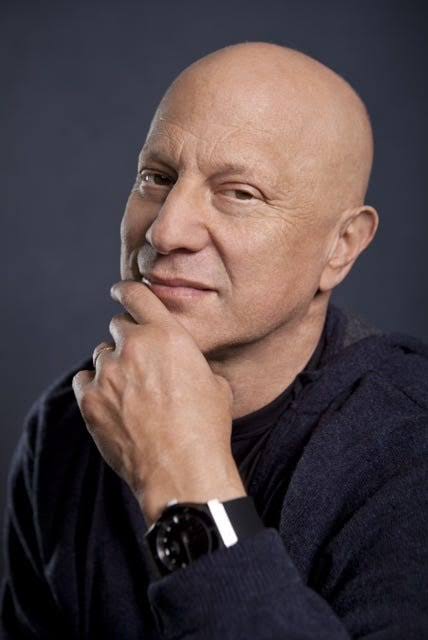

At 17, Jim Stavis was diagnosed with Type 1 diabetes and told he would be lucky to live to 50. The list of what might come with it was daunting for a teenager: heart disease, kidney disease, amputations, and blindness. In his 40s, the predictions began to come true. On a ropes course during a family camp, his heart stopped while he was at the top of a pole 20 feet in the air. A close friend gave him CPR and brought him back before paramedics could even arrive, and he later learned that one of his arteries was 95 percent closed. Eventually, the head cardiologist at Cedars-Sinai told him he needed a new heart, a new kidney, and ideally a new pancreas. The doctor added that, as far as he knew, a triple organ transplant like that had never been done anywhere in the world. Stavis looked at him and said, “Well then, I’ll be the first.”
He was. Jim Stavis is the founder and CEO of Paragon Steel, a company he has led for 38 years, and the author of When Hope Is Your Only Option, a Montaigne Medal finalist. At the end of 2005, he received a heart and kidney from one donor, and a few months later, a pancreas from a second. Now past 70, he has also lost his business partner of 25 years and cared for his wife, Renee, through ovarian cancer until her death. What makes his perspective so useful is not that he never struggled. It is that he learned to treat hope as a set of habits and decisions, something anyone facing illness, loss, or uncertainty can practice.
Why Hope Works Like an Action Verb
Before his surgery, Stavis met with a social worker at Cedars-Sinai whose job was to assess whether he was ready for an operation of that magnitude. He admits he was rolling his eyes through most of the questions. Then she asked one that stopped him: “What is your source of hope?” He had never put the answer into words before.
When he thought it through, he found two answers. The first was a belief that everything happens for a reason. The second was evidence from his own life. He had survived close calls before, and things had a way of breaking in his favor, as if an angel were looking after him. “So I would put it as fatalism and optimism kind of merged together,” he said. That combination became the foundation for how he faced every hard moment that followed.
Stavis is clear that hope, for him, is not passive wishing. He describes it as something you do, which might include prayer or educating yourself about whatever is besetting you. The point is that hope involves a strategy and an action, and those actions shape attitude and behavior over time. A simple place to start is the same question the social worker asked him, which he now poses to every audience he speaks to: What is your source of hope? Knowing what gets you up every day gives you something solid to stand on when circumstances turn.
“I’ve always viewed hope as an action verb. So it’s not just a thing.”
Jim Stavis, Founder and CEO of Paragon Steel
Endure, Hope, Prevail: The Three Stages of Facing Adversity
In his book, Jim Stavis describes three stages people move through when confronted with adversity. Naming them helps turn an overwhelming experience into something with a shape and a direction.
The first stage is to endure. Stavis says this means you have to “be honest with yourself, look at the situation, know what you’re confronted with.” As he put it plainly, “don’t live in denial.” Enduring is about getting through the pain and hardship while understanding clearly what it will take to reach the other side.
The second stage is hope, which Stavis considers the most important of the three in his own case. Here, hope is used deliberately to shape your attitude and, ultimately, your behavior. That shift is what eventually lets you look back from the other side, perhaps from a hospital bed you have long since left, and see everything you accomplished.
The third stage is to prevail. Once you have climbed the mountain and overcome the illness or injury, Stavis asks what you will do with the experience. You can go on with your life as if it never happened, or you can use it to help others. He considers himself still in this stage, focused on helping other people overcome whatever adversity they face. If you are in the middle of something hard, it can help to ask which stage you are in right now and what that stage is asking of you.
Resilience Is a Muscle You Build Before You Need It
Stavis does not claim he never lost hope. “It would be unrealistic for me to say that I didn’t lose hope, because I think everyone does,” he said. What he learned was how to move through those moments. He would try to compartmentalize the feeling: acknowledge that it was there, step back to look at the bigger picture, and remind himself that he had gotten through hard things before. “It’s almost like a muscle,” he explained. Each time you work it, the next challenge becomes something you can meet with the thought that you did it before and can do it again.
He saw the opposite play out with his business partner, a big teddy bear of a man who had never faced a serious health setback. In 2012, an infection spread through his partner’s body and kept returning over two years, and he passed away. Stavis believes his partner was defeated from the start, not from a lack of effort, but because the experience was entirely new to him. “He had no muscle memory,” Stavis said.
This is also why Stavis distinguishes his approach from the familiar advice to just stay positive. Telling someone to stay positive without any steps, he said, is “like you’re asking for peace in the world.” The aspiration is fine, but it does not become real until you take steps toward it. For Stavis, the steps are small and concrete. When you go to bed at night, you hold a positive thought rather than a negative one. When you wake up, your first thought is not “another day of this.” You look for something to appreciate, whether it is birds singing outside your door or a beautiful day. Over time, he believes, this shifts how you see your world. He never asked “why me?” when his diagnosis came. “I would almost say, why not me?” Ultimately, he said, “It’s a choice.”
Making Decisions When You Cannot Know the Outcome
One of the hardest parts of living with a serious diagnosis is the uncertainty. For decades, Stavis lived with what he called an expiration date he had no control over. “I had to get comfortable with the notion that I can’t know,” he said. Rather than fighting that reality, he let go of the need to know. “I’m not worrying about that which I can’t control,” he explained, trusting that he would deal with things as they came. He applies the same thinking to business, where no one truly knows what the economy, tariffs, or AI will bring.
That acceptance did not make him passive about the decisions he could control. Stavis firmly believes that “all medical advice is not equal.” When his heart was failing, he took his case to multiple doctors at different institutions. One told him, in effect, that he was diabetic and there was nothing more to be done, which Stavis took as a clear signal to find someone else. Others suggested different paths, including open-heart surgery. Finally, one doctor asked whether he had considered a transplant, noting that the rest of his body was relatively healthy. That question led to the solution that saved his life.
Stavis credits his business instincts with helping him make that call. In business, he said, you can often course correct when you make the wrong decision. “And yet with your health, you don’t necessarily get a mulligan.” When the stakes are that high, he believes it is worth getting a second or third opinion before deciding. He is also careful to note that his story is not a forecast for everyone with diabetes. Care has changed dramatically since he was diagnosed in the early 1970s, when there was no home blood testing equipment. With today’s automatic insulin pumps and treatments, many people with diabetes can lead very normal lives.
What Caregiving and Grief Teach About Acceptance
When Renee was diagnosed with ovarian cancer, Stavis became a caregiver for the first time, and he found it harder in some ways than being the patient. As a patient, he felt he had control over his own emotions. As a caregiver, he could stay positive, but he could not control how the person he loved felt or what would happen. “It’s their life, not yours,” he said, and “in some ways you’re powerless to really have control over the outcome.”
Doctors initially told the couple that Renee would be lucky to live four to five years. Around the four-year mark, her health began to decline. She was a fighter with a deep fear of death, but as the treatment options ran out, Stavis watched something shift. “The fear of death started to dissipate,” he said, and she began to accept her situation. She passed away about two months after that conversation with her doctors. Witnessing that change taught him how much acceptance can ease suffering at the end of life.
Grief, he learned, is not one experience. After his partner died, Stavis was so focused on keeping the business going and making sure everyone else was okay that he never fully grieved. “I just kind of fast forwarded through it,” he said. With Renee, there was no fast-forwarding, especially as he watched his children lose their mother. What struck him most were the small things. “I felt like the furniture in my house, everything was the same, but it was different,” he said, describing the experience of making coffee for one rather than two. In time, he said, you adapt and move forward. His message to anyone who feels they have lost what gave their life meaning is simple: “There’s always a way forward.” You may not see it yet, and the weight may feel enormous, but in time, you will work through it.
The Gratitude That Comes With a Second Chance
The donor whose heart now beats in Stavis’s chest was a boy of 16 going on 17, the same age Stavis was when his own story began. He was a kicker on his football team with hopes of playing in college, and he died in a car accident north of Santa Barbara. From a purely anatomical standpoint, the young athlete had what Stavis called a “thoroughbred heart.”
The boy’s mother, a woman of deep faith, wrote to Stavis with scriptures and told him she believed her son still lived within him. Wanting to understand her perspective, Stavis met with a priest, who told him he was intended to survive because he had a greater good to accomplish. He was unsure what to make of that at the time. Over the years, he has come to believe there was truth in it, because sharing his story through his book and documentary has become, in part, a way to honor the boy’s life. He still reaches out to the family on the boy’s birthday and on the anniversary of his death. “It’s like a second family to me,” he said.
People sometimes ask whether receiving another person’s heart changed who he is. Stavis does not believe it did, although he once joked to his family about suddenly craving Mexican food. What changed, he said, was a great deal of perspective and a great deal of gratitude for a second chance at life. Another religious leader he spoke with put it this way: most people reach the end of their lives wishing they could do things differently, while Stavis was given a second chance at 50 to make any changes he wanted. Gratitude, in this sense, is not just a pleasant feeling. It is a lens that turns survival into an opportunity.
You Choose to Be Hopeful
When asked what someone in the dark can do today, Stavis did not offer a universal formula. Instead, he pointed to the Serenity Prayer and the wisdom inside it: “accept that which you can’t and try and work on the things that you can.” That distinction sits at the heart of everything he practiced, from letting go of an uncertain prognosis to seeking a third medical opinion.
He also lives firmly in the present. “If I can live for today, that’s a good day,” he said. The saying he identifies with most is that you never know what a day may bring, and he finds it a thrill to wake up each morning and find out. As a transplant survivor, he also encourages everyone to consider becoming an organ donor.
If you take one thing from his story, let it be this: tonight, before you fall asleep, choose one positive thought and hold on to it, and tomorrow, let your first thought be something other than dread. Hope does not have to be felt before it can be practiced. Jim Stavis, a founder, author, and triple organ transplant survivor who was once told he would be lucky to reach 50, is living proof of what that practice can build.