I am assuming that you are ethical and strive to remain that way. Most of us are not at either ethical extreme; we are neither saints, whose decisions are always faultless, nor the few “bad apples” acting from a place of malice. Instead, most of us think of ourselves as generally good people, not always perfect but trying to do the best we can with all the things that life can throw at us. Most of us fall in the middle somewhere, capable of being ethical and yet also vulnerable to lapses for any number of reasons—we who have good days and bad days, who never set out to be unethical but over time may have found ourselves halfway down a slippery slope that we did not see coming, perhaps one to which our own pressures or biases led us. Or it may be we did see it coming but didn’t have the guts or guidance to avert a disaster. We’ve probably all witnessed someone having to step down in embarrassment and incur great familial or financial loss, and we don’t want to be the next one.
In these normal ethical and reputational tripwires of life, those of us in what I call the Moveable
Middle need a sturdy ethical framework as part of our normal “operating system,” one that lies beyond whatever might be tugging at us in the moment and helps us get to know ourselves better over time. By naming the things that can derail us, we can better avoid them. We can take action to cultivate self-awareness and actions to insulate us from our subconscious selves and help find “the better angels of our nature,” in the final words of Abraham Lincoln’s first inaugural address in 1861. In health and wellness, physical fitness comprises several domains and activity, including diet, muscle strength and tone, cardio exercises, flexibility, mental strength and focus, and so on. Elite athletes develop strategies to tend to each of those components of their fitness. Similarly, ethical fitness in the workplace and in life has individual components that need special attention.
Our focus here is to empower by giving you the tools to bring that range of factors to greater awareness and intention so that your final choice and its consequences can be as sound as possible… and you can feel as peaceful as possible in retrospect. Decisions have consequences, from small to great, positive to negative, and personal to financial and reputational. We can easily find ourselves grappling with tricky situations such as conflicts of interest, whistleblowing, sexual or financial misconduct, accepting job offers and then reneging, lying or bluffing, discrimination, and needing to restore broken trust. These may be on a larger scale, but they also happen in all kinds of smaller ways throughout our regular workdays—probably more than we realize at first. And often, we simply find ourselves in the ethical gray zone, where even with all good intentions, we don’t know what the best ethical choice is for the best outcome.
To me, ethics is not simply about laws and compliance. Rather, it’s also about character (yours) and culture (your organization’s). This is not to take away from compliance officers and departments; indeed, hopefully, it will affirm their importance as one piece in the larger picture. Compliance departments and guidelines are necessary but not sufficient. They tend to look backward, focused on catching those who’ve violated laws and regulations, whereas ethics is focused on avoiding future mistakes. Law, codes, and policies are important places to begin, but we need to use other ethical perspectives as well. Similarly, ethics is not merely about telling people to be “good” or “moral,” an approach that can be misleading and unhelpful. First, telling someone just to “be moral” can put inordinate pressure on them without giving them the tools they need to fulfill the expectation. More helpful is an approach that helps you identify ethical problems as such and know your own ethical sources and tools for making an ethical decision. Such an approach helps you be better able to imagine possible outcomes, either positive or negative, and see yourself working through them.
Our ethical choices aren’t as freely made as we think they are, and our human decision-making processes are even more fragile. A decision may seem as though it is about a particular moment in time, but it involves the whole person, even the things we might be less aware of—past, present, and future (more on that later). As we sort through a decision, feelings and motivations may come into play, many of which are affected by biases and triggers of all kinds, both conscious and unconscious. Those in turn can impact the soundness and clarity of our decision-making—particularly if the triggers remain unconscious.
Our ethical decisions shape us over time, but they also shape the world around us. The greater our awareness of our decision-making habits and the more intentional our processes are for making decisions, the stronger our track record will be and, not only that but, the greater integrity our lives will have. Often—probably most of the time, if we’re honest—our decisions both reflect the values we have shaped over the course of our lives and pay those values forward into the future, like the ripples created when you toss a stone into a pond. As my wife, Karen, has said, it’s not only about what you do in a situation, but what you inspire someone else to do.
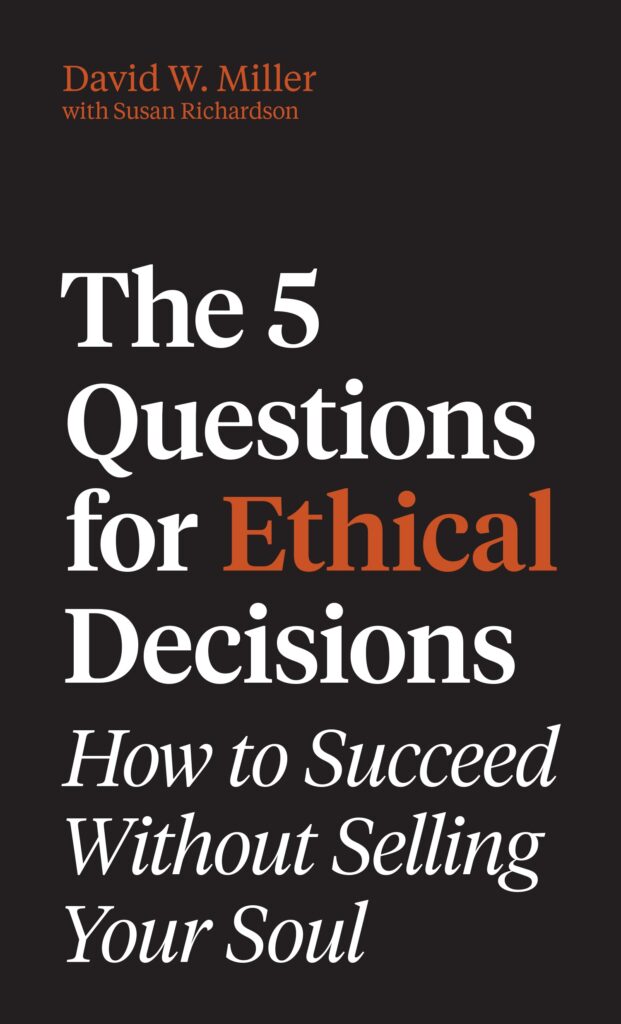
In my book, The 5 Questions for Ethical Decision Making, I tell readers that the point is to give them tools for ethical fitness and the awareness they need to live a life of meaning, purpose, and integrity. That’s where we make the larger shift from simply having a conscience to developing greater consciousness, from just being reactive to finding deeper meaning and developing maturity.
As the late Clayton Christensen has put it, how will you measure your life?
In Christensen’s article—tellingly subtitled “Don’t reserve your best business thinking for your career”—he discusses the most important points he wanted students to take away from business school, and they weren’t financial engineering or supply-chain skills. Instead, there were three key questions he wanted students to remember: How can I be sure I’ll be happy in my career? How can I be sure that my relationships with my spouse and my family become an enduring source of happiness? And how can I be sure I’ll stay out of jail?
Christensen answers the third question using the analogy of marginal costs from the business world. We often use it unconsciously, he says, when choosing between right and wrong in our personal lives. “A voice in our head,” he writes, “says, ‘Look, I know that as a general rule, most people shouldn’t do this. But in this particular extenuating circumstance, just this once, it’s OK.’” We don’t look at where the path is taking us and the full cost it entails. “Justification for infidelity and dishonesty in all their manifestations lies in the marginal cost economics of ‘just this once.’”
“Just this once” can lead to a series of seemingly small ethical errors that allow for more and more rationalization, causing your ethical framework to weaken. The life lesson he feels he has learned is that “it’s easier to hold to your principles 100 percent of the time than it is to hold to them 98 percent of the time.”
Adapted from THE 5 QUESTIONS FOR ETHICAL DECISIONS: HOW TO SUCCEED WITHOUT SELLING YOUR SOUL. Copyright © 2026 by David W. Miller with Susan Richardson. Reprinted by permission of Princeton University Press.