

It was one of those soft Irish evenings where the light lingers like a song that doesn’t want to end. After a dinner of farls and colcannon with friends in the misty folds of Baltimore, County Cork, we wandered into a pub stitched into the bones of the village. The walls leaned in like old storytellers, and the air was thick with the familiar perfume of Guinness and turf smoke. Then, like a transatlantic time machine, the band launched into a set not of jigs or reels, but of…The Beatles.

Photo Bushes Bar Baltimore
It’s been more than sixty years since the lads from Liverpool sent a seismic wave through the world from the Ed Sullivan stage. And yet, here in rural Ireland, the echoes seem louder than ever—streaming from radios, coursing through film and theater, and gently falling from the lips of those whose grandparents once swooned in packed stadiums and concert halls. But it is here, more than anywhere else, that the origin story of the Beatles quietly begins—not in a recording studio or club, but in a diaspora, born of tragedy, that sent Irish souls across the sea… to Liverpool.
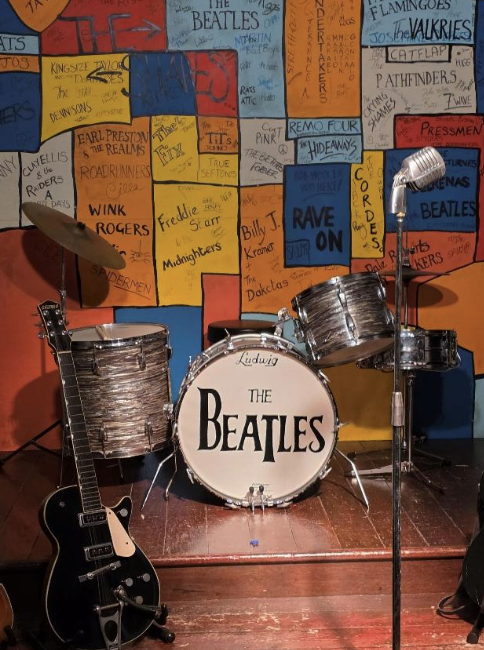
Photo by Richard Bangs
To grok this lineage, dial back to the 17th century, when Oliver Cromwell’s campaign turned lush Ireland into a land of dispossession. The Irish lost homes, land, livestock, and dignity—but they never lost their music. They clung to it like a lifeline. In taverns and fields, in whispered ballads and raucous gatherings, it became both defiance and consolation—playful, poetic, subversive. It filled the silence of loss with melody.
The next day, at the Skibbereen Heritage Centre, I found myself face-to-face with the dark legacy of the Great Famine, that cataclysm of blight and indifference from 1845 to 1851. Over a million dead. Two million fled. One and a half million of those refugees crossed the narrow sea to Liverpool—a mere 273 miles from the southern shores of Cork.
Liverpool—a port city on the Irish Sea born of tide and trade—absorbed wave after wave of Irish immigrants. Today, some 75% of its population has Irish roots, as did four young sons of the city who would change music forever: John, Paul, George, and Ringo.
Ireland may have gone quiet in the years after the famine, steeped in grief and colonial shame. But in Liverpool, its spirit began to hum again. In 1839 Herman Melville, who crafted his acclaimed novel Redburn here, wrote, “From the various boarding houses proceeds the noise of revelry and dancing.”
During World War II Liverpool was the most heavily bombed British city outside London. The Blitz destroyed theatres, dance halls, and pubs where live music had been central to entertainment for the melting pot working-class. In a strange way, the bombing created a tighter-knit music community. Surviving venues became gathering points where dockworkers, evacuees, and service personnel mixed freely. That cross-pollination of audiences and styles, much of it sourced from the Emerald Isle to the west, contributed to Liverpool’s later reputation as Britain’s most musically adventurous city.
After years of destruction and restriction, people craved novelty and amusement. The music scene shifted from survival mode to a creative boom, blending local traditions with imported sounds, including tunes featured in records brought to the port from Ireland.
At the start of the 60s Irish melodies collided with American rock and roll, R&B, and skiffle—a musical stew stirred by sailors, street performers, and second-generation immigrants. This hybrid sound featured melodic phrasing, lyrical storytelling, and group-harmony sensibility learned from céilí culture. The result? The Merseybeat sound of the 1960s: insistent, consonant, joyful. Beneath its driving rhythms lay the lilt of Irish folk, the pulse of a culture that refused to vanish.
Paul McCartney’s heritage includes Irish grandparents on both sides. Lennon’s father was Irish. Harrison’s maternal grandfather hailed from County Wexford. Ringo Starr, born in the heart of Liverpool’s Irish quarter, bore the green blood of Mayo. McCartney would later record “Give Ireland Back to the Irish”—a political anthem veiled as a pop song. The arc of “Hey Jude,” which could as easily have been sung in a Dublin back room as on the world stage, is built on the Irish balladry invitation of communal participation—where the singer invites you into the refrain—and The Beatles mastered that invitation with unprecedented scale. Eleanor Rigby has the narrative structure of an Irish folk song, a fictional tab of ordinary people, loneliness, loss, and death. The mournful tone is reminiscent of Irish laments (caoineadh), which highlight emotional storytelling. These Celtic associations are rich throughout the Lennon/McCartney catalogue.
The Beatles didn’t just spring from Liverpool—they were distilled from the centuries-old songbook of Ireland, carried across the sea in the hearts of migrants who refused to let the music die.
With time to spare, I flew from Cork to Liverpool, drawn by that gravitational pull of nostalgia and curiosity. The city’s airport bears Lennon’s name, and just beyond the terminal sails a huge cartoonish yellow submarine, as though summoned from an hallucination.
I checked into the Hope Street Hotel, a refined wood-lined retreat in the Georgian Quarter, across from the Liverpool Philharmonic Dining Rooms—the same pub where McCartney surprised patrons with a performance during James Corden’s Carpool Karaoke special in 2018. That clip, like a bolt of joy, had stayed with me. So, I went, ordered a Hawksmoor lager, and took in the musical motifs that adorn the space like votive offerings. The room was quiet, but I could imagine Hey Jude echoing in its corners.


Photos by Richard Bangs
At the dockside, past the life-size bronze statues of the four Beatles, I took the Mersey Ferry, where the Fab Four played four times in early career. Overhead a tinny speaker played Jerry and the Pacemakers’ 1964 hit, Ferry Cross the Mersey, a quintessential Merseybeat song that I swayed to in my basement room in Bethesda, Maryland. The lyrics “We don’t care what your name is, boy. We’ll never turn you away,” affected me, as I lived in a redlined neighborhood that excluded blacks; and the nearby Kensington Country Club excluded Jews. In my young mind I wondered what kind of paradise was Liverpool, a place where anyone could play guitar and live and thrive? I did not know then that the port town opened doors to torrents of Irish famine refugees and daily dealt with seafarers from around the globe. It had, and still has, a big-armed embrace of diversity and tolerance. The original lyrics to Get Back were meant to be a political satire, poking fun at the xenophobic rhetoric in British politics and tabloids during the late 1960s. An early version included the lines, “Don’t dig no Pakistanis taking all the people’s jobs…Get back to where you once belonged.” Also in 1964, The Beatles refused to play a concert in Jacksonville, Florida if the audiences were segregated, the norm at the time, and then added a contract clause for all future U.S. concerts saying they would only play at integrated venues.
Liverpool, it turns out, had always been a sanctuary—for the starving Irish, for sailors, for musicians—and in a divided world, it offered something rare: belonging.
The next few days were a blur of Beatles lore: the re-vamped Cavern Club, Penny Lane, Strawberry Field. Menus featured playlists (with “When I’m 64” senior discounts); coffee foam etched famous profiles. The music seemed to seep from the cobblestones. But something was missing—a last note before the coda.
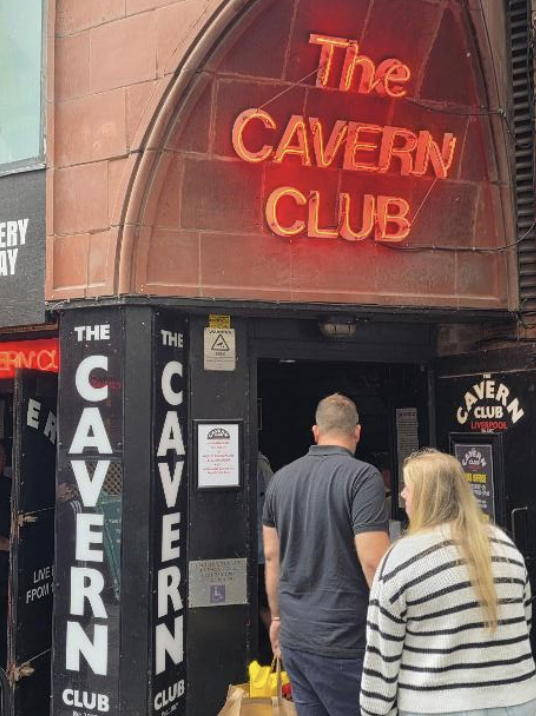


Photos by Richard Bangs
The missing element was the real thing, seeing one of the two surviving boys from the band. I heard that though Paul lived primarily on his 160-acre Sussex estate, he would sometimes return to Liverpool and make an unannounced appearance at a pub, as he did on the James Cordon special. The Hope Street Hotel is finely located for walking to the many pubs throughout the town, and I haunted a number, hoping I might run into the good Sir. But, to no avail, though his sounds were everywhere. Finally, though, for me, it was time to get back.
On the morning of my departure, a flicker of serendipity. The hotel receptionist leaned in conspiratorially. Paul McCartney, she whispered, might be attending a ceremony at the Philharmonic Hall across the street—an event for graduates of LIPA, the Liverpool Institute for Performing Arts, which he co-founded. No time was given. Only possibility.
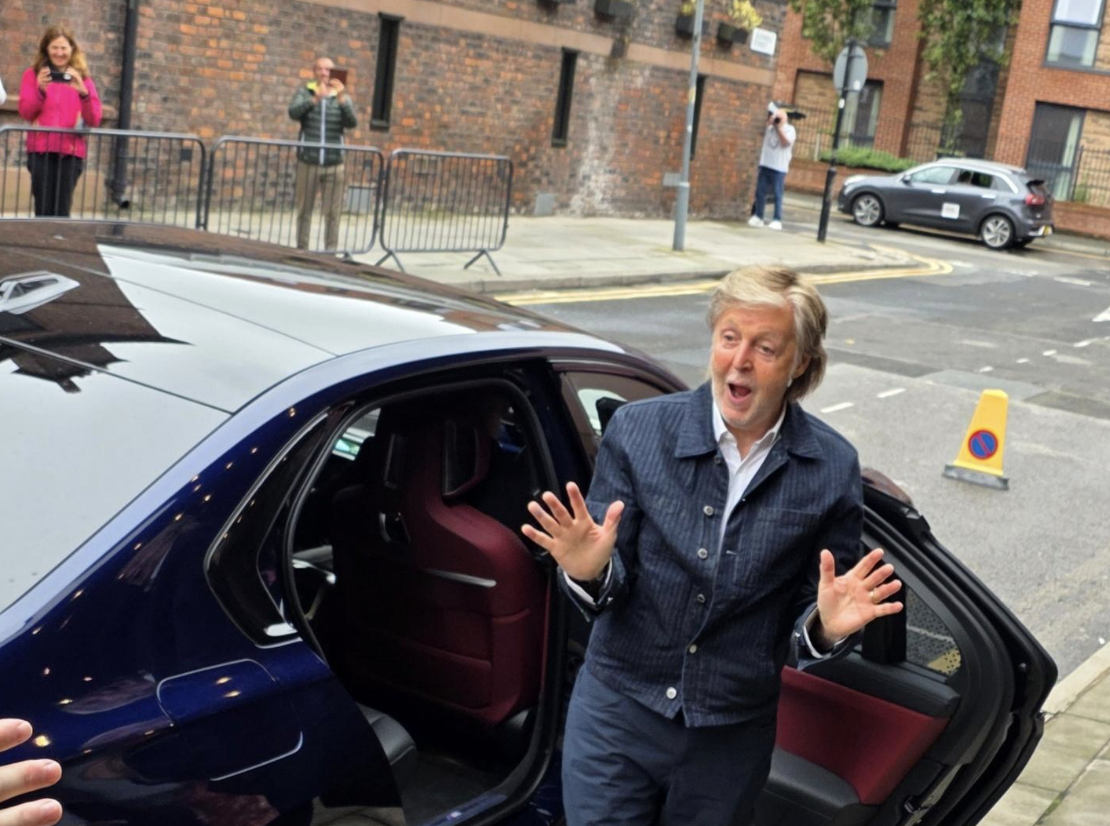
So, I wandered outside to a crowd of about 100 in front of the magnificent Art Deco Philharmonic Hall. It did not seem the ideal atmosphere for a celebrity arrival, so, drawn by the traveler’s instinct to seek the path less traveled, I made my way to the back of the building. About a dozen folks had the same idea and were gathered about the unassuming rear entrance. Then, as if summoned from a dreamscape, a shiny black BMW wheeled to the curb, and out stepped Sir Paul, with what might be described as Irish eyes a-smiling, just inches from where I stood.
There was no fanfare, no entourage. Just the man, and the moment. My wife, Laura, called from across the car, “Thank you for the music, Paul!” I like to think he heard her, a small shout of gratitude that connected the pub in Baltimore, Ireland, with the streets of Liverpool, a full-circle moment for a journey that began long before our mothers were born.
##.