

How Matthew McConaughey’s Poems and Prayers met me where I am
I didn’t realize what I was searching for until I heard it spoken aloud. What followed was a quiet reckoning with meaning, faith, and grace.
I am proud to be a Riverbender. It’s not a vocation or a title, Riverbend is the church I’ve been going to since I moved to Austin. It’s not so much a calling as it is faith in the leadership of Pastor Dave.
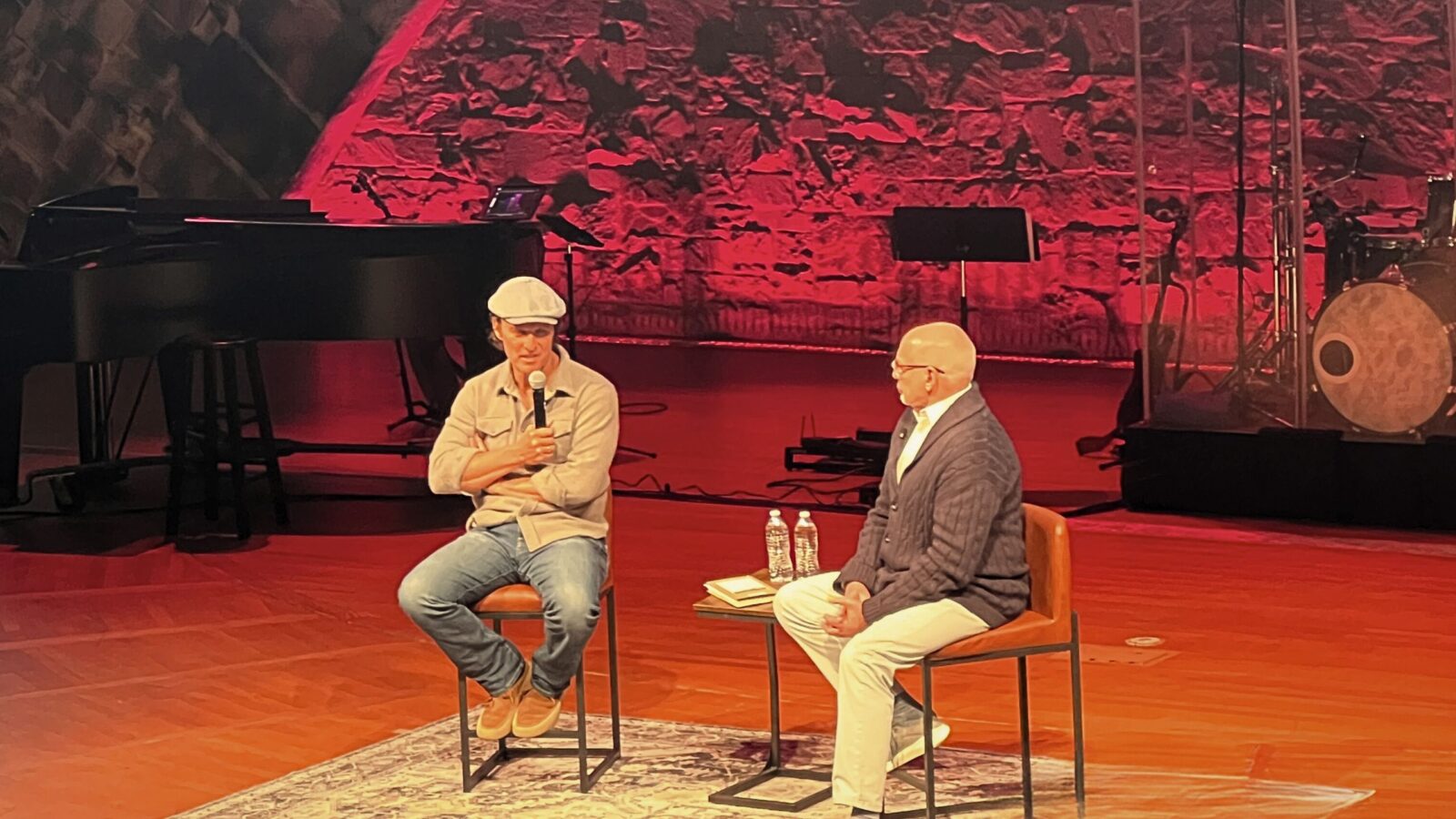
You know who else is a Riverbender? Matthew McConaughey. And no, I wasn’t aware of this until he showed up at church this Sunday to read from his book Poems and Prayers.
What they spoke about resonated with feelings I had been carrying but hadn’t yet been able to name. They spoke about grace and gave shape to a struggle I recognized in myself. There was a sense of shared ground in what he said, and that was enough to draw me to the book.
My carnal desires multiply and compress…
I’m lost and blind and can’t seem to see, with nowhere to go’s no place to be…..
I need to get back my anonymous soul…
Bound by the woven crimson thread of grace, where I know, show and see you in my own face. Please, amen.”
- Poems and Prayers, Mathew McConaughey
The above is not the entire poem, just a fragment of it, the lines that stepped out of the page to meet me where I am.
The lines speak of desire multiplying, of blindness, of being nowhere with nowhere to go. After having achieved so much, after effort, striving, building and arriving, I find myself in a similar space. Not lost. Not broken. Not unhappy. Simply unable to locate the reason I’m moving forward at all.
I’m aware that these lines are incomplete and have been taken from the middle of something larger. My own experience feels like that too, suspended between what came before and what has not yet revealed itself. I turn to these lines because they stand with me in the not knowing, and for now, that is enough.
Desire That Multiplies and Compresses
Buddhist scholars describe craving not simply as a desire for pleasure, but as the mind’s attempt to establish a sense of identity and location in a changing world. This suggests that the craving to find purpose intensifies not because life is abundant, but because the self has begun to lose its grip. The structures that once held identity, roles, goals, and achievements have loosened, and craving rushes in to stabilize what no longer feels solid.
What I can’t ignore is this exact feeling. I have much to look forward to: my husband, whom I love dearly; my children; the joys my future grandchildren may bring; the possibility of travel; and the natural continuation of life. And yet, my past keeps calling me. My past, not my future. I feel a quiet but persistent longing to meet my grandparents who have passed, as though something unfinished still lives there. I no longer find myself relishing the familiar things like going out, dressing up, partying, socializing, dining out. There is no aversion, only an absence of desire to make the effort or participate. It feels as though I have already done what there was to do, and the question that remains in steady insistence is: “Am I done, and if not, what comes next?”
Not Alone
Across spiritual traditions, this feeling appears as a recognizable passage, not a sign that something has gone wrong. Knowing this does not remove the discomfort, but it does remove the isolation. It tells me I am not broken, and I am not failing at life.
In Jewish and Christian thought, there are seasons when clarity is withdrawn. Times when God does not guide forward with light, but with absence. This state is not described as a punishment or loss of faith, but as concealment, or perhaps a deliberate quieting meant to interrupt forward momentum. In these traditions, one does not push through it, one remains within it and endures.
Jewish tradition even names this state — the hiding of the face — a time when God’s presence is concealed rather than withdrawn.
“And I will surely hide my face on that day.” — Torah
That understanding brings an unexpected comfort as the question shifts. It is no longer “What is wrong with me?” but, “What is being asked of me now?” After reading the scriptures I feel this is no longer a demand to react, or strive, or even understand, but rather an invitation to reassess. And any urgency would not be helpful.
I do not yet know what comes next. But it helps to recognize that this blindness has been lived before, written about before, and survived before, and that this is a place rather than an end.
Grace
What about Grace? Let’s circle back to the conversation Pastor Dave had with Matthew McConaughey
I was struck by a moment when Pastor Dave pressed him on what grace meant to him. He spoke of grace as something freely given, something offered without control. Many words were exchanged, but what I took away was perhaps that I need to offer myself some grace.
The grace to remain here without urgency. Without self-correction. Grace, as I am beginning to see it, is not guidance but allowance. As we discussed last week, “Grace allows another person to remain unfinished in our presence,” and this is the grace I need to offer myself. If I rush to fix this, I will replace listening with action. I will shorten the moment in which I am still feeling, still understanding and that would not be right.
I am in this place because God intends this quiet, because forward momentum has been interrupted on purpose, so something deeper can be seen. In philosophy this quiet is called a liminal state.
That is why the image of a thread still feels right to me. Not a rope to pull myself out, but a quiet tether that asks very little. The crimson thread of grace is keeping me present long enough to listen, to write from inside what is unfolding, and to trust that understanding will come in its own time. For now, that is enough.
I’m grateful for the space to reflect.
This article is published in Women Write Publication. A growing, strong community built by women for women. All thoughts are welcome.