I’m kneeling in a plastic Rubbermaid tub, wearing only bicycle shorts, surrounded by three men wearing blue latex TSA gloves. It feels like I am about to get whacked like an informant in Breaking Bad, but this is a public hallway at the University of Connecticut, and I am about to be humiliated in the name of science.
“Time to wash you down,” announces David Martin, a lanky, triathlete-looking lab assistant. With that, he begins pouring distilled water over my head and shoulders.
The cool water feels delightful, because I’ve just spent an hour riding a stationary bicycle inside the heat lab of UCONN’s Korey Stringer Institute, which is dedicated to studying the effects of extreme heat on workers and athletes. The point of this exercise, pedaling for an hour at 100 degrees Fahrenheit, was to determine my “heat tolerance.” (Results: poor.)
This is part 2: The “Sweat Test.”
“It’s like the most awkward bath you’ve ever had,” says lab director Robert Huggins, as he rinses away the last shreds of my dignity.
The goal of this procedure is to determine exactly how much liquid I sweat out while exercising in the heat — and, crucially, how much salt and other electrolytes that sweat contains. That information will help me understand how much fluid, and what types of electrolytes, I will need to consume in order to survive an extreme cycling event called the “Hotter’n Hell Hundred” — 100 miles, in 100-degree weather, held every August in Wichita Falls, Texas — that I am supposed to ride in a few weeks.
My broader goal is to dig into the science of hydration. Hydration is one of the top wellness virtues—who could be against hydration? But the actual science of hydration turns out to be shockingly contentious and riddled with corporate influence and online misinformation, so that it is almost impossible to separate scientific truth from marketing.
Not that long ago, athletes were warned not to drink anything while competing, lest they get sick. As recently as 1980, half the finishers of the Melbourne Marathon had drunk no water at all during the race. Now, it’s gone completely the other way: At a running event or a school soccer game, nearly everyone—spectators and participants alike—will be joined at the lip to their emotional support water bottles. Meanwhile, the internet and social media are buzzing with hype about hydration and health—check the TikTok hashtag #gallonchallenge.
While true dehydration (defined as losing 3 percent or more of one’s body weight to sweat) can be a miserable experience affecting focus, mood, and athletic performance, some experts are beginning to worry about the dangers of overhydration, drinking too much.
Sound crazy? It nearly killed Brooke Shields in September 2024. After she passed out with a grand mal seizure, in a restaurant near her Manhattan home, doctors told her that her episode was caused by drinking too much water. “I flooded my system, and I drowned myself,” she told Glamour magazine a few days later.
Her seizure was likely caused by something called hyponatremia, or insufficient concentration of sodium—basically, the body gets too diluted with water—which can lead to organ dysfunction and even fatal brain swelling. Shields is far from the only victim: A year earlier, an Indiana mom died of hyponatremia after guzzling two big water bottles in quick succession, after a hot July Fourth boat trip on a local lake.
Athletes are at particular risk: In 2002, a 28-year-old Boston Marathon runner named Cynthia Lucero died of hyponatremia after collapsing at Mile 21 of the course. Doctors later attributed her death to excessive fluid consumption during the race. The high temperature that day was 52 degrees.
At the time, sports-science guidelines urged athletes to consume “the maximal amount [of fluid] that can be tolerated without gastrointestinal discomfort.” As an amateur cyclist back then, I vividly recall guzzling bottle after bottle before and during races, as liquid sloshed around in my gut and occasionally emerged, quite rapidly, via my mouth. A study done at the 2002 Boston Marathon, the same race where Lucero had died, discovered that as many as one in eight recreational runners likely finished the race with some degree of hyponatremia, defined as a blood sodium concentration below135 mmol/l.
Those guidelines were supposedly backed by solid science. But when the South African sports scientist Tim Noakes took a closer look, he found that much of that research had been funded by Gatorade, the global drinks giant. Uh huh. Now, guidelines for athletes have relaxed somewhat — but on social media, hydration mania has exploded and (shockingly) not all of the advice is sound.
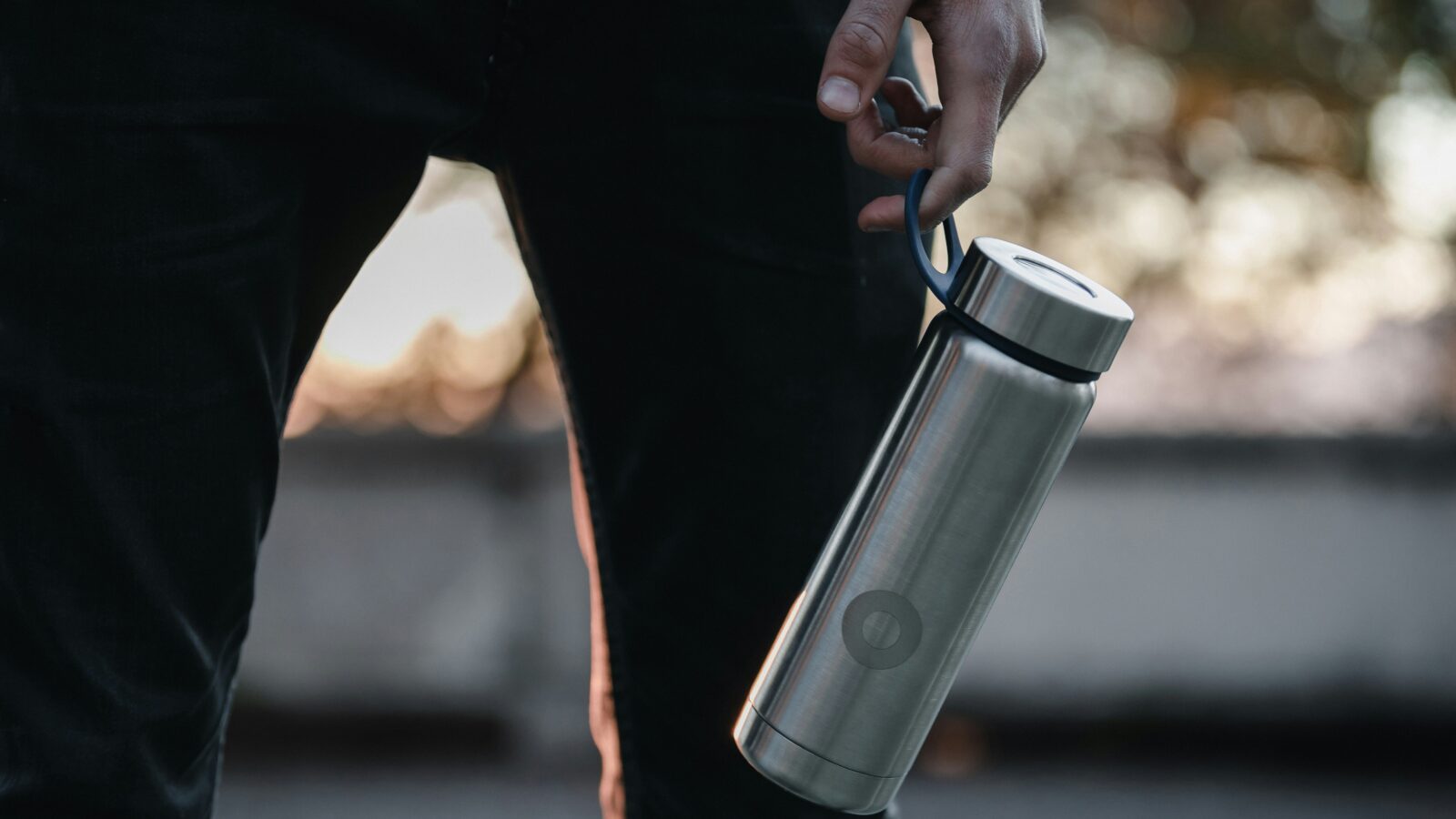
Exhibit A: the #gallonchallenge. Naturally it requires a special water bottle, Kardashian-approved and available on Amazon, marked with motivational slogans and timestamps, from “HYDRATE YOURSELF” at 9 a.m. to “REMEMBER YOUR GOAL” at 11 a.m. to “KEEP CHUGGING” at 1 p.m. to “DON’T GIVE UP” at 5 p.m. Beyoncé has said that she drinks a gallon of water a day, with lemon. Jennifer Aniston and Courtney Cox insist that hydration is their beauty secret. Not to be outdone, celebrities including Gwyneth Paltrow, Victoria Beckham, and Drew Barrymore swear by their crystal-equipped water bottles that are said to “charge the water with vibrational energy” Which it might? Brooke Shields might disagree.
Even in the more sober corners of Health Instagram, MD influencers urge viewers to drink eight 8-ounce glasses of water per day—even though “8-by-8” (as it’s known) was debunked a quarter-century ago by a Dartmouth medical school professor named Heinz Valtin, who found exactly zero published evidence supporting 8-by-8. “On the contrary,” Valtin wrote, “there are publications that state the opposite.”
Yet 8-by-8 persists, as a kind of zombie health myth. Where did it come from? It first appeared in an obscure 1921 study where the researcher measured his own daily water intake at two liters per day, and extrapolated from that to declare that therefore everyone needed to drink that much (two liters per day.
This might seem weedsy, but it illustrates perfectly why these kinds of blanket recommendation (“8 glasses a day”) rarely make sense, in any area of biology. We vary enormously, in many domains of life. Also, we get a considerable amount of water with our food, and the non-water beverages we drink (surprisingly, research has found that coffee and even lighter beers rehydrate us to some degree, although milk is the best drink of all for hydration).
So how much do we actually need to drink? It depends on who we are and what we are doing — and, crucially, how much we sweat while doing it.
One easy way to understand our sweat rate, says Robert Huggins, requires only a bathroom scale: Before you work out, weigh yourself — naked — holding whatever water bottles you intend to drink during the workout. Then weigh yourself again after the activity, holding the same water bottles to account for any liquid you may have drunk. The difference in weight represents how much fluid you lost to sweating — and gives a good idea of how much you actually need to drink while exercising.
For activities lasting an hour or less, most people actually don’t need to drink much, or anything, during the event, according to research by Stephen Cheuvront and Robert Kennefick, two veteran heat researchers with the US Army; it isn’t necessary to bring a water bottle into a yoga class or an exercise class, as long as you start out well hydrated (although it make make some of us feel more comfortable). For longer events, up to about four hours, one should aim to replace roughly half of one’s fluid losses in real time, although that could vary depending on body size and gender; a 130-pound female can become dehydrated more quickly than a larger male in some situations. Also, consider the conditions: If it’s hot, obviously, you will need to drink more; if it’s cool, not so much. But our stomachs can only handle so much fluid, so replacing all of our sweat losses in real time may be unrealistic.
As for electrolytes, most people get plenty of salt from the good old American diet (especially that superfood known as “French fries”), according to Huggins. For longer and sweatier events — including intensive sauna sessions — you can gauge your electrolyte losses using a clever wearable device called the Nix, a sensor patch worn on the upper arm that connects with your phone and measures electrolyte and fluid losses in real time.
Above all, rather than heeding prescriptive advice from strangers or succumbing to social-media fads, most of us are better off paying attention to signals from our own bodies—especially the built-in hydration gauge and drinking prompt called thirst. “We have these incredible mechanisms built into us by evolution,” says Paul Laursen, a performance coach and physiologist based in British Columbia. “The rest is just marketing.”
Excerpted from the book HOTWIRED by Bill Gifford. Copyright © 2026 by William C. Gifford. From Harper Wave, an imprint of HarperCollins Publishers. Reprinted by permission.