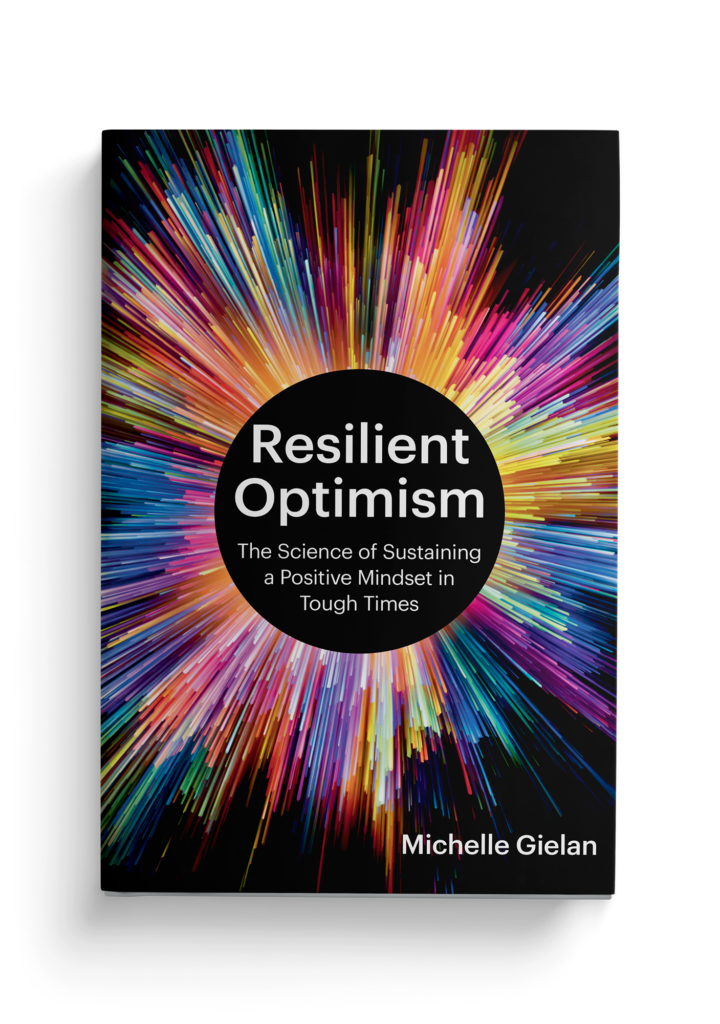

In this excerpt from her new book, Resilient Optimism: The Science of Sustaining a Positive Mindset in Tough Times (Harvard Business Review Press), researcher and bestselling author Michelle Gielan shares research she conducted with Thrive Global founder Arianna Huffington on how negative information affects the brain—and what happens when we pair problems with possible solutions. The findings helped shape Michelle’s central argument: sustaining optimism is less about producing a positive feeling and more about the behaviors that keep us engaged with possibility and action.
A Broken Formula for Positive Change
My fascination with creating positive change began during my time as a national news anchor at CBS News. There I covered one heartbreaking story after another about problems in our world during the height of the Great Recession. After I left the network to pursue an advanced degree in positive psychology at the University of Pennsylvania, the central research question I focused on was how to make the brain perform better in the face of problems in order to make positive change easier. I sought to investigate how to optimize our mindset given how much our brains are constantly being bombarded with negativity. I wanted to understand the kind of information we needed to feed our brains to build resilience and optimism for good.
What I discovered was that we have the formula for creating positive change backward. A pair of studies I conducted with Arianna Huffington that we published in Harvard Business Review shine a light on the problem and the path forward. Founder of the Huffington Post and later Thrive Global, Arianna and I partnered on research to quantify the impact of negative information on mood and brain performance. I had no idea the data would be so astounding. So much so that the results of the second study became part of the impetus to write this book.
In the first study, we split research participants randomly into two groups. One group we exposed to three minutes of negative news. The control group was exposed to three minutes of neutral news. Then we tested both groups on a whole host of psychological and performance metrics. As you might imagine, we found a negative impact on a range of metrics for participants in the negative-news group. That part did not surprise me. What made the results eye-opening was that we tested the impact on mood and performance six to eight hours after exposure to the negative content. Nearly a full workday later—when participants were picking up their kids from school or wrapping up work—they were 27 percent more likely to say they’d had a negative day compared to the neutral group. It is stunning that a mere three minutes of negativity during your morning could result in such a quantifiable change to how you perceive the outcome of your day.
Given this dramatic, lasting impact, we aimed to find out what would happen if we changed the information input—what kind of effect that would have on how the brain responded to challenges and how long the effect would last. In a follow-up study, we exposed half of the research participants to an article detailing a serious problem—in this case, rising food insecurity in major cities. For the other half of the research participants, we appended a short list of potential solutions. Hours later we gave both groups a problem-solving task, and those exposed to solutions exhibited a 20 percent increase in problem-solving abilities. What this means is that by making a small change to the way we process information, we can change well-being and performance. Specifically, if we get the brain to focus on solutions and what’s working in the face of challenges, it makes us better problem-solvers.
These two studies encapsulate what’s wrong with our current formula for creating positive change.
Common wisdom suggests that to improve our lives, we must start by focusing on what’s broken. That leads us to zero in on problems—at the office, at home, in our relationships—and attempt to fix them from the ground up. This mindset undergirds everything from performance reviews to educational strategies to how we parent. And because it’s so deeply ingrained, it’s often hard to recognize just how much it hampers our success.
Focusing on what’s broken limits the brain’s potential. A teacher who only works to bring up low grades without celebrating small gains risks capping student motivation. A marriage counselor who skips over what’s working can miss the very foundation on which reconnection is built. A manager who rushes through praise to get to “constructive criticism” may unknowingly derail a high-performing team member.
That’s because the brain runs best when fueled by optimism. The human brain is already naturally good at detecting threats—we call it negativity bias. When we focus solely on what’s broken, the brain’s threat center (the amygdala) lights up, pulling resources away from the problem-solving prefrontal cortex. But when we also engage with what’s working, the brain responds with creativity, energy, and greater resilience.
The old formula tells us: focus on what’s broken, fix problems, and hope things improve. The new formula—backed by science—shows that resilience grows when we intentionally focus on solutions and what’s working.
What this showed me was startling: we don’t need more content about problems—we need more intentional design in how we process information. In other words, we’ve been taught to chase an emotional response to create change, as if the right feeling will unlock the right outcome. We try to “think positive,” deliver motivational pep talks, or wait until we feel inspired to act—but emotion is fleeting. When the mood dips, progress disappears.
What the research shows is far more sustainable: we don’t need an emotional reset—we need a behavioral shift.
Instead of simply trying to “feel more optimistic” in the face of problems, we must implement successful work routines that sustain optimism during the droughts. That’s what makes challenges fuel for resilience, performance, and well-being.
Resilient optimism is not a personality trait or a mood; it’s a trained mindset supported by behavior. That insight became the cornerstone of this framework. I use the term resilient optimists to describe people who sustain optimism through intentional, repeatable behavior. Resilient optimists train themselves to see both problems and potential. They seek to understand challenges, but they don’t get stuck in them. They stay locked on solutions and draw energy from progress. Most importantly, resilient optimists create a drumbeat of optimism by intentionally sourcing and sharing information that fuels well-being and performance.
One way to start is by changing the information you give your own brain. Curating is consciously scanning your life for good things happening. The behavioral routine of curating the good has reminded me how much joy lives in the little things. You don’t need a grand gesture to reframe your day. Two minutes is often all it takes to notice, savor, and hold on to the moments that make life meaningful.
Curating isn’t about ignoring challenges or pretending every day is perfect; it’s about sifting through the noise to recalibrate the brain on what’s worth holding on to. By actively choosing to notice and capture the best parts of your day, you create a personal collection of optimism-building moments—one that can remind you, even on the hardest days, of the beauty and value in your life. It shifts the lens through which you view the world to be more positive and optimistic, solidifying the belief that good things happen. This simple tool empowers you to shape your narrative and ensure the moments that matter most don’t fade away.
I do it by texting my husband 3-4 best moments from the day. If you choose to record your best moments, jot down a few highlights from the past 24 hours. Keep it simple—this is about noticing, not perfect phrasing. Share it with a loved one or keep it for yourself. It can be focused on the best moments of the day at work, home, or both. Ideally do it at the same time each day and pair it with something you’re already doing so you don’t forget. I was already in the habit of completing the New York Times mini crossword puzzle at bedtime, so I promised myself I would do Best Moments before that. Now I don’t even do the crossword anymore, but Best Moments stuck. Over time I have collected more than 1500 of these notes.
That’s how resilient optimism is built: not by waiting to feel more positive, but by giving your brain new evidence of what’s still good, working, and possible.