


What does it really take to thrive? Not just achieve, but genuinely flourish in our work and relationships?
High achievement is often held up as the ultimate goal. But as many of us know from lived experience, achievement alone does not guarantee thriving.
That paradox sits at the heart of my recent conversation with Jennifer Breheny Wallace, award-winning journalist and author of Mattering: The Secret to a Life of Deep Connection and Purpose and Never Enough: When Achievement Culture Becomes Toxic—and What We Can Do About It. Her work explores why so many high-performing individuals and communities are struggling, and what truly allows people to do well under pressure.
As Wallace notes, the answer is not grit alone, nor is it success at all costs. It is something far more fundamental, and far more overlooked.
For the full interview, listen to our Evolving with Gratitude podcast episode, embedded in this article (above) and also available on your favorite podcast platform.
What Is Mattering and Why So Few of Us Name It
“Mattering is a basic, fundamental human need that researchers have been studying since the 1980s,” Jennifer says. “It is the feeling of feeling valued and having an opportunity to add value to the world.”
Researchers describe mattering as a meta need, an umbrella need that sits above other essential experiences like belonging, connection, and mastery.
“You could belong to a friend group and not feel like you actually matter to those people,” Wallace says. “Mattering takes that sense of belonging… and says, actually my voice matters here.”
After the drive for food and shelter, it is the motivation to matter that drives human behavior, for better or for worse.
—Jennifer Breheny Wallace
When people feel they matter, they engage, connect, and contribute. When they do not, Jennifer observes, people often withdraw or lash out.
“People will go to extremes to try to get this need met.”
The Upstream Insight: Why Adults Mattering Changes Everything
Wallace’s focus on mattering emerged through her earlier research on achievement culture. In Never Enough, she studied students attending high-achieving schools who were newly identified as being at risk for anxiety and depression.
“What it boiled down to,” she says, “was mattering.”
The young people who were doing well despite intense pressure felt they mattered “for who they were deep at their core, away from their achievements.”
What surprised Jennifer was how often the adults in those students’ lives felt the opposite.
“So many adults in their lives felt like they didn’t matter,” she says.
Parents, caregivers, and professionals were spending long days in environments where they felt replaceable or invisible.
“How can parents show up as the first responders to their kids’ struggles if they are spending eight, 10, sometimes 12 hours a day in work environments where they are chronically being made to feel like they don’t matter?” she asks. “The truth is they can’t.”
Her answer? “If we want to solve for the youth mental health crisis, to make a dent in it, we need to go upstream and take care of the adults in their lives,” she says.
The Counter-Cultural Truth About Achievement and Worth
Wallace is clear: “I’m not anti-achievement. I’m not anti-success. I love achieving. I love having successes, but my worth does not rest on my success or my failures.”
That distinction sits at the center of her research. What surprised Jennifer most was not that achievement culture creates pressure, but that sustainable achievement actually depends on mattering.
Wallace connects this dynamic to what Dutch theologian Henri Nouwen called “the three great lies of our society”: I am what I have, I am what I do, and I am what people say and think about me.
To counter those lies, she offers a simple but disarming question.
“The next time you don’t feel worthy, the next time you don’t feel like you’re enough,” Jennifer says, “I want you to pause and I want you to think about who is profiting off of making you feel that way.”
The SAID Framework: Four Ingredients of Mattering
Wallace organizes the research on mattering into what she calls the SAID framework:
Significance
Feeling remembered and thought of in everyday ways. Jennifer shares the story of a teacher moved to tears when colleagues gave him a large bag of M&Ms, remembering his favorite 3 p.m. treat. “He felt seen,” she says.
Appreciated
Appreciation that recognizes the person, not just the action. “It’s appreciating the doer, not just the deed.”
Invested In
Having people who are invested in your success and setbacks. Wallace describes this as having a “corner man,” someone who believes in you and whose joy is tied to your growth.
Depended On
Feeling relied upon and knowing that if you weren’t there, you would be missed. Wallace sees asking for help as a way of reinforcing this: “asking for help is actually a way of signaling to somebody else in my life that they matter to me.”
Asking for help isn’t weak. It’s an act of generosity.
—Jennifer Breheny Wallace
When Mattering Gets Rattled and the Power of Agency
“Mattering is not something you have once and you put it up on your shelf like a trophy,” Jennifer explains. “Mattering is something that needs to be continually fed or it will erode.”
Life transitions like moving, grief, or becoming an empty nester can quickly erode our sense of mattering. Wallace recalls moving to London and feeling deeply lonely. With the mattering lens, she says, she could have recognized that “of course you don’t feel significant… of course you don’t know how you’re adding value.”
The first step is normalizing the experience. “You are not the first person to go through this,” Jennifer reminds us. She encourages seeking out role models: people who have navigated similar transitions, whether through podcasts, books, or conversations over coffee.
The key is agency.
“You are one action, one decision away from starting to feel like you matter again,” she says.
Sometimes that action is issuing an invitation. Sometimes it is accepting one. And sometimes it is allowing others to see what Jennifer calls your “beautiful mess.” Research shows that when we reveal messy parts of our lives, “the other people see you as warmer and more authentic.” The very thing we think will repel people often brings them closer.
The fastest way to feel like we matter again is by reminding someone else why they do.
—Jennifer Breheny Wallace
Everyone Is Wearing a Sign
If Jennifer could leave us with one image, it is this: “Imagine everyone you meet—strangers, colleagues, friends, acquaintances—wearing a sign around their neck that says, ‘Tell me, do I matter?'”
You can answer that question with a smile, with warmth, with presence.
And just as importantly, Wallace cautions us to notice when we unintentionally signal the opposite.
“Be mindful of the mattering energy you’re putting out there,” she says.
Today, choose one person and answer their invisible sign. Let them know, through your words or presence, that they matter.
When we tend to our own sense of mattering and actively nurture it in others, we create the conditions not just for achievement, but for sustainable thriving.
In Bold Gratitude,
Lainie
Connect with and learn from Jennifer Breheny Wallace:
JenniferBWallace.com
Instagram
LinkedIn
Newsletter: Sign up at JenniferBWallace.com
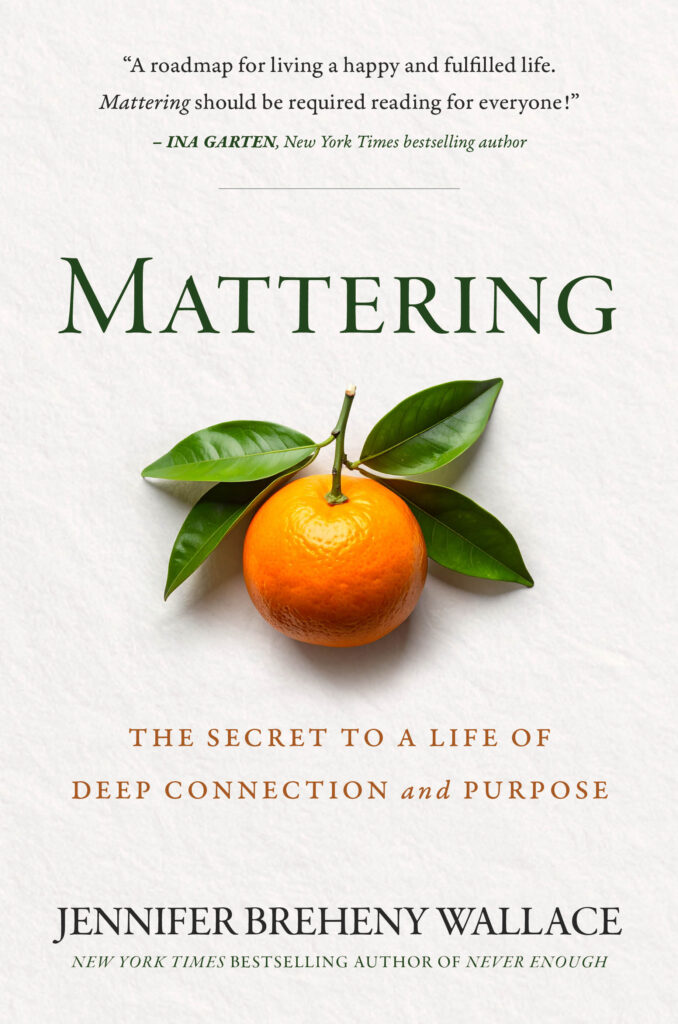
Mattering: The Secret to a Life of Deep Connection and Purpose by Jennifer Breheny Wallace on Mattering