

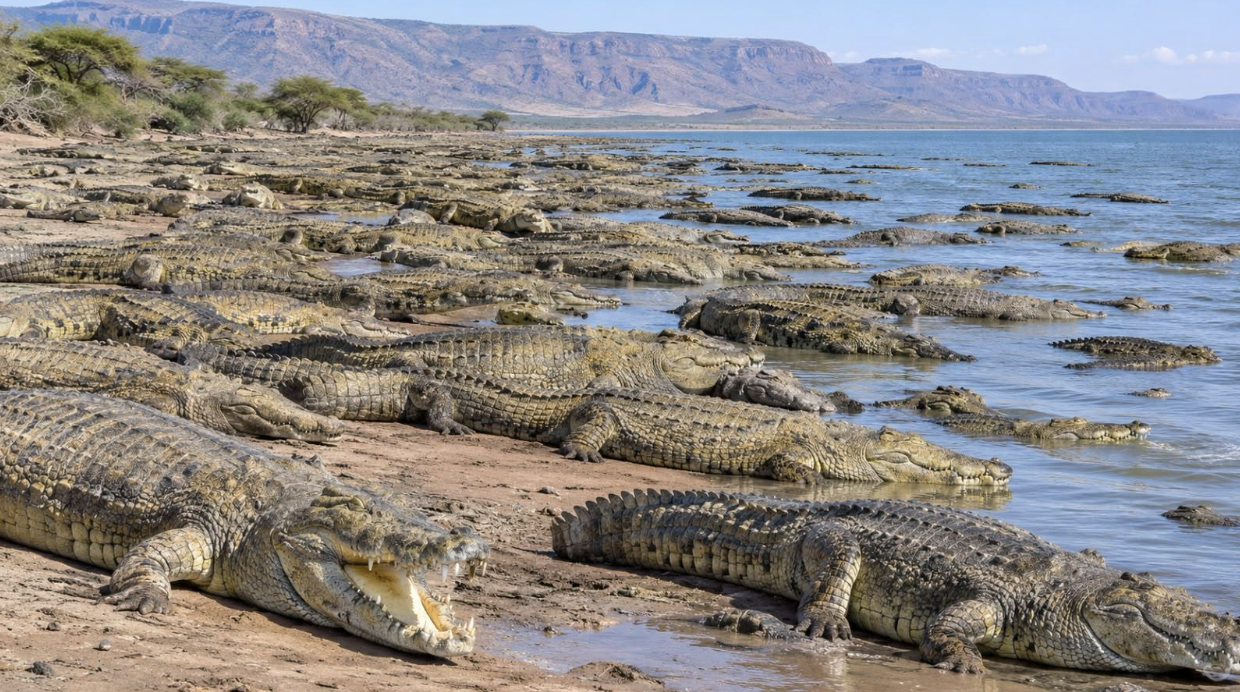
Some lakes invite. Lake Turkana dares. It is the largest desert lake on Earth, a 180-mile gash of jade laid into the bottom of the Great Rift Valley, ringed by lava, scoured by wind, and patrolled by one of the largest congregations of Nile crocodiles left in Africa. The Samburu call it Basso Narok, the dark lake. The Turkana call it Anam Ka’alakol, the sea of many fish. Travelers who have seen it at the right hour call it the Jade Sea. I have called it, for most of my life, unfinished business.
Lake of bones is no figure of speech. The Turkana Basin is often called the cradle of mankind, and with reason: its eroding shores have given up more early-human fossils, across a longer span of time, than almost anywhere on Earth. In 1984, on a slope near the western shore at Nariokotome, the fossil hunter Kamoya Kimeu spotted a sliver of skull, and Richard Leakey’s team went on to unearth the most complete early-human skeleton ever found: a Homo erectus youth, now known as Turkana Boy, who died beside this water some 1.5 million years ago.
Across the lake at Koobi Fora, our ancestors lie stacked in the sediments like pages in a family album, and at Lomekwi, researchers have dug up stone tools 3.3 million years old, older than our genus itself. People and their forebears have been living and dying on these shores for longer than our species has existed. Everyone the lake has taken since is just the latest entry in a very old ledger.
The first Europeans to stand on its shore were an odd couple: Count Sámuel Teleki, a Hungarian aristocrat with an appetite for big game and bigger maps, and his Austrian second-in-command, naval lieutenant Ludwig von Höhnel, the expedition’s cartographer and diarist. In March 1888, after more than a year of walking from the coast, through famine country and over a black-lava wasteland that radiated heat like Hell with the lid off, they crested a rise and saw it. “We gazed in speechless delight, spell-bound by the beauty of the scene before us,” Höhnel wrote.
The delight did not survive the first sip. They had prayed for fresh water and found it brackish and alkaline. The men were starving, fevered, some sick with dysentery; porters deserted or died along the way. Teleki shot game almost daily to keep the caravan fed and grew gaunt doing it. Still, he named the lake for his friend and patron, Crown Prince Rudolf of Austria-Hungary, a keen amateur naturalist who had nudged the journey into being.
History has a dark sense of humor. Less than a year later, in January 1889, Rudolf, heir to the Austro-Hungarian throne, was found dead at Mayerling, his hunting lodge in the Vienna Woods. Beside him lay his 17-year-old mistress, Baroness Mary Vetsera. The accepted account is that Rudolf shot Mary, sat with her body for hours, and then shot himself.
Most of the world learned of Lake Rudolf only after the man it honored was gone. Both explorers made it home. Höhnel came back to East Africa in 1893, was gored by a rhinoceros, and still lived to 84. After Kenya’s independence the colonial label was retired, and in 1975 the lake took the name of the Turkana people who live along its western shore.
The lake still collects its toll. Its crocodiles are the stuff of nightmare and natural history: in the years Alistair Graham surveyed them, an estimated 14,000 were said to breed on Central Island alone. They still take people. A local leader recently counted more than 40 killed by crocodiles, and fishermen whisper of others who simply never came back. The wind is a second predator. It can rise in an afternoon from nothing to a shriek, heaping the water into six-foot waves. Since 2014, capsized boats have drowned at least 55 people in reported accidents alone, 17 of them in a single swamping in 2024.
And then there is the human weather. On the night of November 19, 1965, shifta, armed raiders from the Somali secessionist war then burning across northern Kenya, stormed the Oasis Lodge at Loiyangalani on the southeast shore. They killed the manager, a Seychellois named Poole, reportedly in revenge for the killing of local livestock, and Father Michele Stallone, a Consolata missionary from Giovinazzo, Italy, who had arrived that very day to open a mission. Police found the priest tied to a chair, shot twice in the back, his breviary beside him. A wooden cross still stands at the lodge.
The lodge’s dark history did not escape John le Carré. In The Constant Gardener, his heroine, Tessa Quayle, spends her last night at the Oasis and sets off at dawn in a borrowed four-by-four toward Allia Bay and the Leakey fossil beds; she never arrives. When Fernando Meirelles filmed the novel in 2005, his crew shot in Loiyangalani and came away so shaken by what they saw that the producer, Simon Channing Williams, set up a charity, the Constant Gardener Trust, to fund schools and sanitation there and in Nairobi’s Kibera slum. Among the production assistants was a young Kenyan named Lupita Nyong’o, who nine years later would win an Oscar for 12 Years a Slave.
But the lake’s violence is no fiction, and it never quite left. In 2012, Turkana cattle raiders ambushed and killed 42 police officers in the Suguta Valley just south of the lake. As recently as February 2025, militia from across the Ethiopian border killed at least 20 fishermen near Todonyang, at the lake’s northern tip; a memorial there lists 40 names.
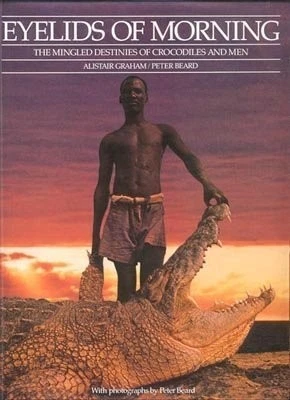
I was 23 when the lake first got its hooks in me. In 1973 I bought a first edition of Eyelids of Morning: The Mingled Destinies of Crocodiles and Men, Alistair Graham’s account of his Lake Rudolf crocodile survey, with Peter Beard’s photographs of reptiles the size of voyageur canoes and men who had met them at close range. The book shocked me. It also recruited me.
I had applied to guide a National Geographic expedition down Ethiopia’s Omo River, advertised as “The Last Great First,” and been turned down. So, I did what the young and the underfunded do: I organized my own. With a few friends, a handful of sponsors and very little money, we put in high on the Abyssinian Plateau and floated down into the unknown, bound for the Omo’s terminus in Lake Rudolf. For three weeks we met peoples who had rarely, if ever, seen outsiders. We counted more than 4,000 hippos. We passed hundreds of crocodiles, one of which bit into a raft and ruined it, a reminder that Graham had not been exaggerating. That was the first descent of the Omo, and the first Sobek expedition.
We never reached the lake. We ran out of food, and word came that the border was closed. We pulled out at the Mui River, not far upstream of the lake, a premature evacuation. The Omo pours in most of Turkana’s water, and the lake gives none of it back: thousands of years ago, in a wetter age, it spilled northwest toward the Nile, but now it has no outlet, and the desert sun drinks what the river brings. Our trip ended the same way, in a dead end short of the destination. Not finishing gnawed at me for half a century.
Then when Nicole Russo, who runs the Africa desk at MT Sobek, asked whether I might lead a Kenya walking safari, I said yes, with one condition: we add Lake Turkana to the itinerary.
We base at Koros Camp, a handful of thatched bandas in the South Horr Valley, between the volcanic shoulders of Mount Nyiro and Ol Doinyo Mara, some 28 rough miles from the shore. The final stretch to the lake is a drive through a landscape that looks assembled from the leftovers of creation. Along it we meet caravans of bony camels, sandy brown with a hint of toasted orange that suggests what might happen to sunlight if it were barreled and aged.
And we meet the Turkana, with wide white smiles, waving us over to stop and visit.
The Turkana have made a life in a place that seems designed to refuse one. The wind sandblasts everything; the sun has no mercy. Yet they fish the brackish water, herd camels and goats across lava fields, and weave doum-palm fronds into baskets, mats and shade. Nothing is wasted. A carved wooden headrest is a stool, a pillow and a walking companion. The women wear necklaces stacked so high they become a kind of architecture, a record of marriage and wealth worn at the throat. The greeting is Ejok, which means “good,” and in a land where so little is, the word does heavy lifting. It is offered to me with laughter every time.
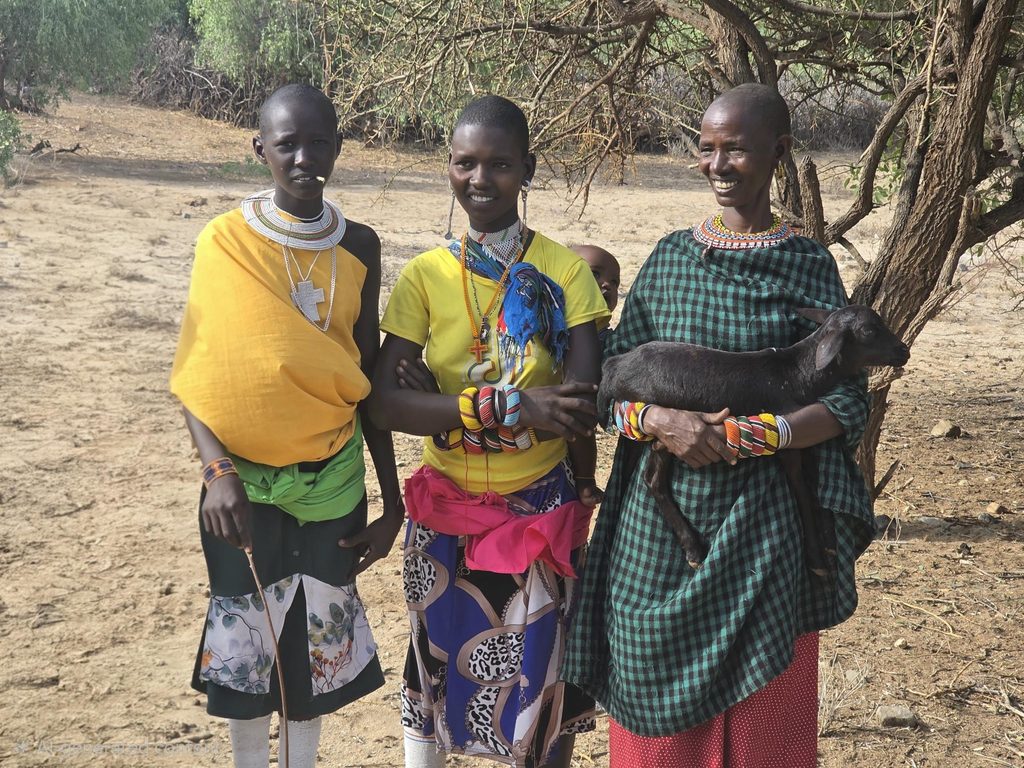
Turkana women. Photo by Richard Bangs
The banks of the lake look like scraped hide; bits of hair still tufted to it. At the water’s edge the fleet is waiting, if fleet is the word: rafts of two or three doum-palm logs lashed together with rope. More than half the vessels on this lake are still built this way. On such platforms the El Molo, among the smallest peoples in Kenya, have long gone out to harpoon hippos and crocodiles. Watching them bob on the chop, I understand the crocodile statistics in my gut.
Our own craft is less romantic and more reassuring: a 24-foot aluminum boat with twin 100-horsepower Suzuki four-strokes, christened Fiammetta, Italian for “little flame.” We point her toward South Island, a young volcano of basalt flows, cinder cones and ash that was still steaming in the nineteenth century.
The island has a reputation. The El Molo and other lakeside peoples have long treated it as a place of spirits, the island that swallows people. In 1934, two members of Vivian Fuchs’s Lake Rudolf Rift Valley Expedition, the medical officer Dr. W. S. Dyson and the surveyor W. R. H. Martin, set out for it in a flimsy collapsible canoe, planning to be gone a week. They were never seen again. Search planes and trackers found almost nothing; only a few scraps of their gear ever came ashore. The island’s legend has fed on them ever since.
On the crossing we troll and hook Blue Nile perch, among the largest freshwater fish on Earth; the giants can top six feet and 400 pounds. Fifty-three years ago, perch like these fed my hungry crew on the Omo. Today we let them go, back to the lake, back to the men on the palm-log rafts.
We circle the island past beaches lined with basking crocodiles and stop to pay respects to Old Smiley, a fabled giant with a crooked grin of bent teeth, resting his enormous head on the stones. He is not a young man, but his lineage is very, very old. Crocodilians go back more than 200 million years; with the birds, they are the last survivors of the archosaurs, the ruling reptiles that gave rise to the dinosaurs. Old Smiley has one job, to catch and eat meat, and his relatives have been doing so since before the continents took their present shape.
Yet he is a shrimp beside his ancestors. Buried in the same basin as Turkana Boy are the skulls of Crocodylus thorbjarnarsoni, a monster that cruised these waters two to four million years ago and stretched some 25 feet, big enough, paleontologists suspect, to swallow an early human whole. For our forebears, every trip to the water’s edge was a roll of the dice. As the paleontologist Christopher Brochu put it, “you die if you don’t drink, you may die if you do.” Old Smiley, it seems, is just keeping up the family business.
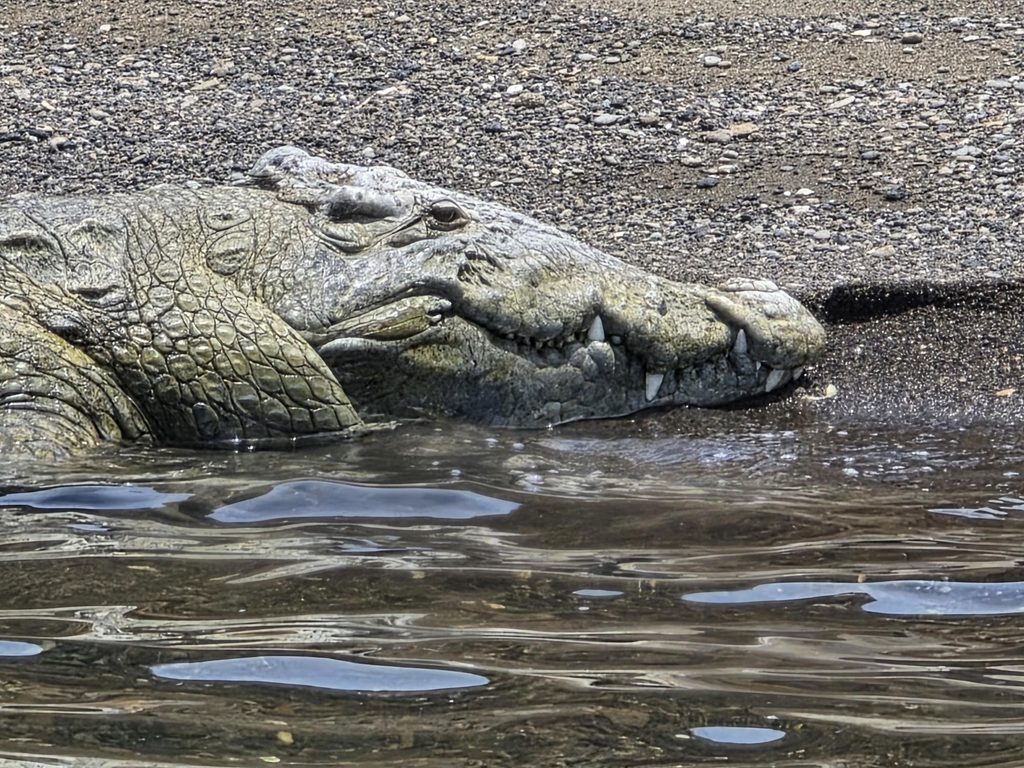
Old Smiley. Photo by Richard Bangs
We land for lunch at a temporary camp on the island’s western shore. Under the thin shade of an acacia, someone has piled big rocks into a half-moon, making a small pool sealed off from anything with teeth. One by one we wade in. I sink my head below the surface and open my eyes to candy-colored stones, blow bubbles like a boy, wave my arms at nothing.
Teleki and Höhnel tasted this water and were disappointed. Graham and Beard counted its monsters. Dyson and Martin vanished into it. I came at it once by river and was turned back. Now I am floating in it, fifty-three years late, inside a ring of stones on a lake of bones. Turkana is a reminder that under the streamlined world there is a volcanic core whose lifeforms operate according to an ancient, oozing, chthonic logic.
I cannot quite name the feeling. Somewhere between absolution and arrival, in some decuman billow of bliss. The quest I began in 1973, to touch the waters of a lake at the end of the world, is finished. Ejok.
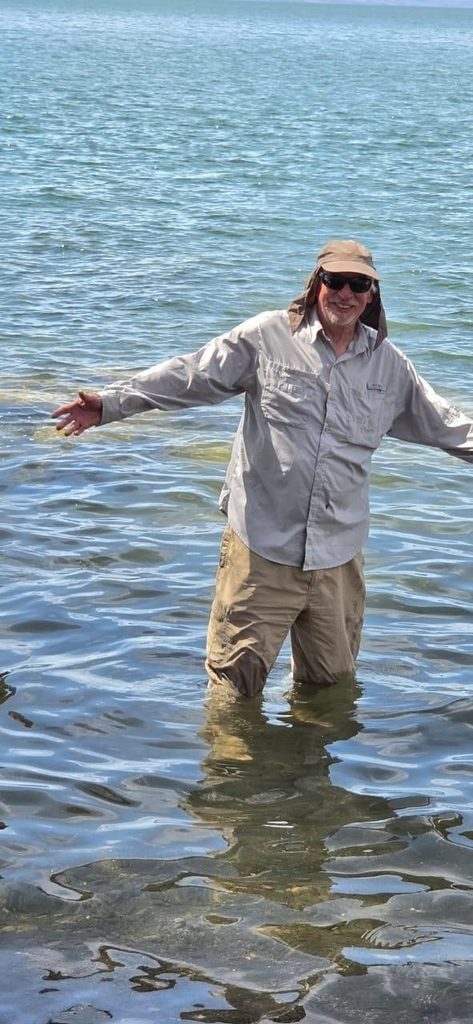
Richard Bangs baptizing in the waters of Lake Turkana. Photo by Raymond Teelishe