

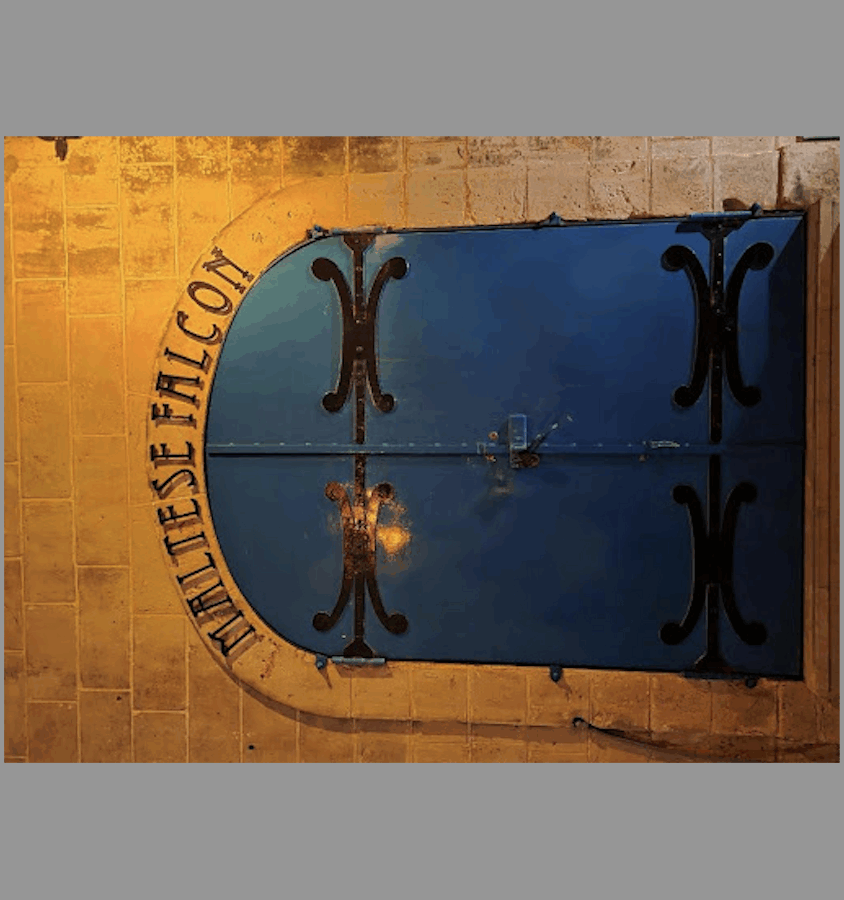
In college, hunched in the flickering dark of a campus theater, I first encountered The Maltese Falcon. The room smelled faintly of dust and popcorn oil. On the screen, in sumptuous black-and-white chiaroscuro, marched Humphrey Bogart, Peter Lorre, Sydney Greenstreet, and Mary Astor—icons cast in shadow and cigarette smoke. John Huston, making his directorial debut, unfurled a tale that felt less like fiction and more like an encoded truth waiting to be deciphered. Even then, the myth coiled in my imagination: a jewel-encrusted bird, centuries lost, pulsing with secrets.
Dashiell Hammett’s story reaches back to 1530, when Charles V, Holy Roman Emperor and King of Sicily, granted Malta and Gozo to the Knights of St. John—the Hospitallers exiled from Rhodes, hungry for a new fortress from which to stare down the Ottoman menace. But sovereignty carried stipulation. Malta was a fief, and its rent—so small yet so symbolically immense—was one live falcon, delivered each year on All Souls’ Day to the Viceroy of Sicily. Tribute as myth seed.
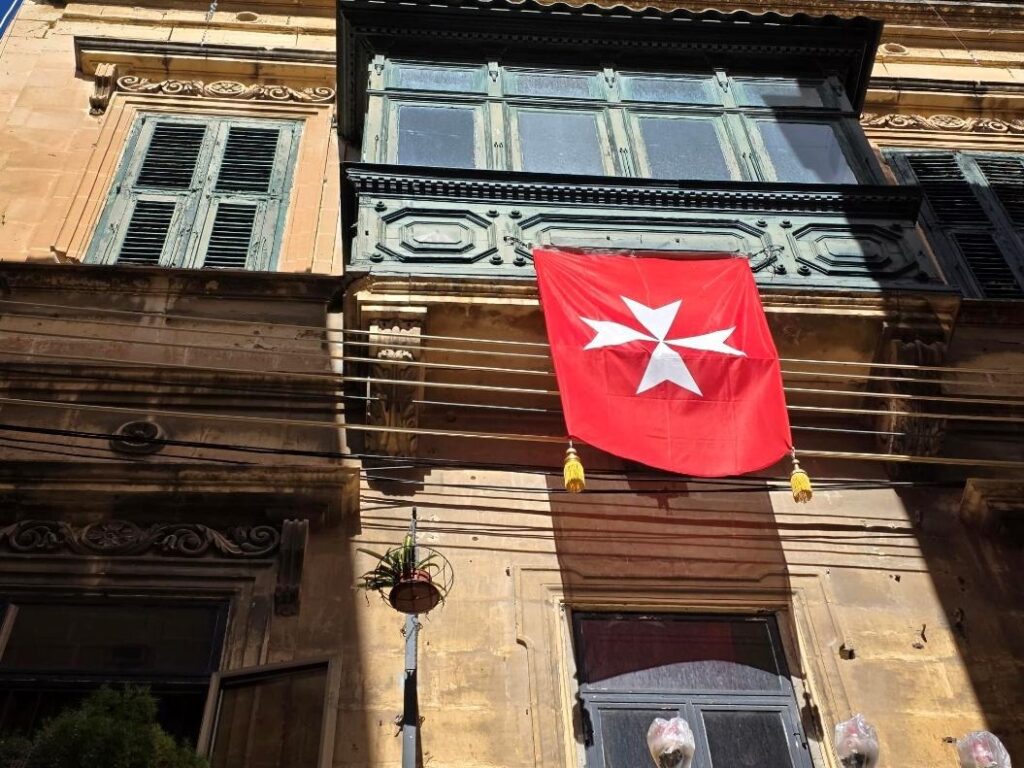
The Maltese Cross, symbol of the Knights of St. John. Photo by Richard Bangs
Somewhere along the centuries, the live bird morphed into a jeweled one—a golden statuette sent, so rumor claimed, as a special gift to Charles V in 1539. Pirates seized the galley. The bird vanished. Then—if you trust Hammett’s smoke-trail—it resurfaced in San Francisco, where Sam Spade chased it through alleys of deceit, murder, and double-cross.
For decades I harbored a private vow: to journey to Malta and press my palms against the limestone that birthed this legend. What alchemy in this tiny archipelago could have given rise to such a story? My chance came at the invitation of historian Jack Wheeler and the indefatigable travel conjurer Rebel Holiday—a week-long sweep across the Repubblikka at the center of the Mediterranean compass rose.
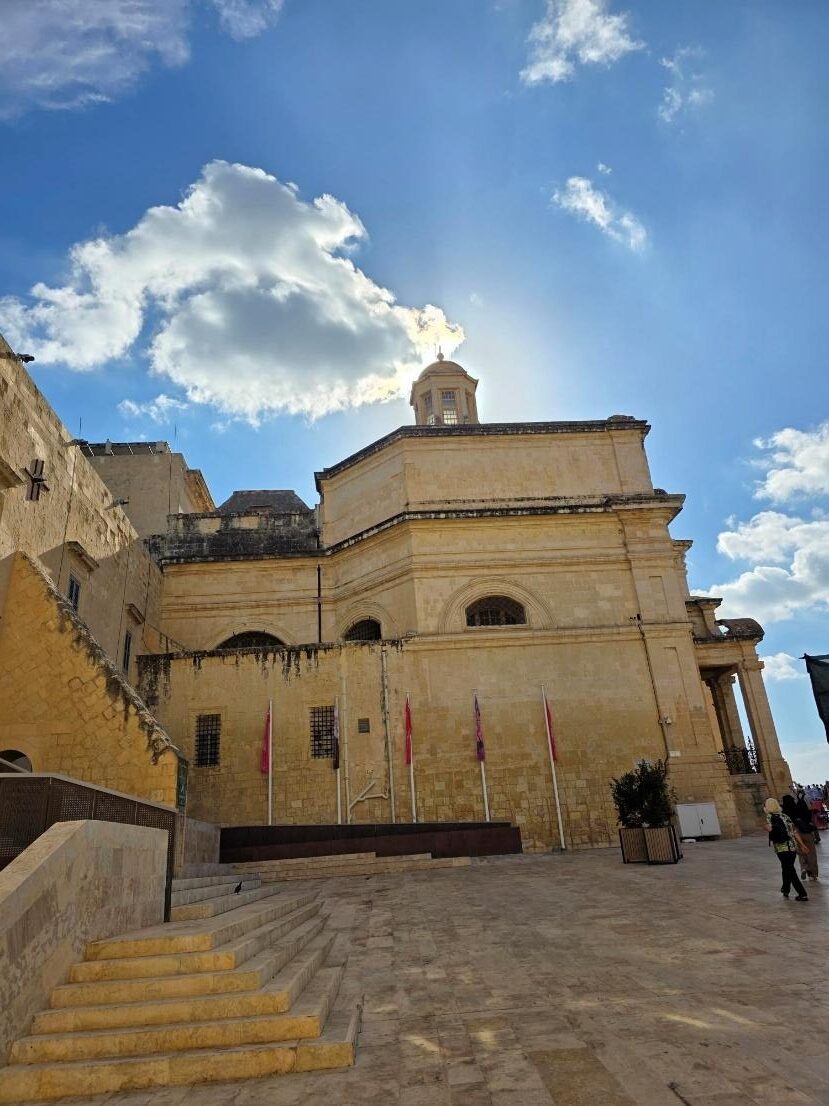
Church of St. Catherine, Valletta, Malta. Photo by Richard Bangs
The Phoenicians once used Malta as a trading node, a maritime hinge between continents. They likely named it Maleth—haven. As our plane banked toward Valletta, I felt the pull of that word. The island lay below, sun-bleached and honey-stoned, a fortress rising from cobalt waters.
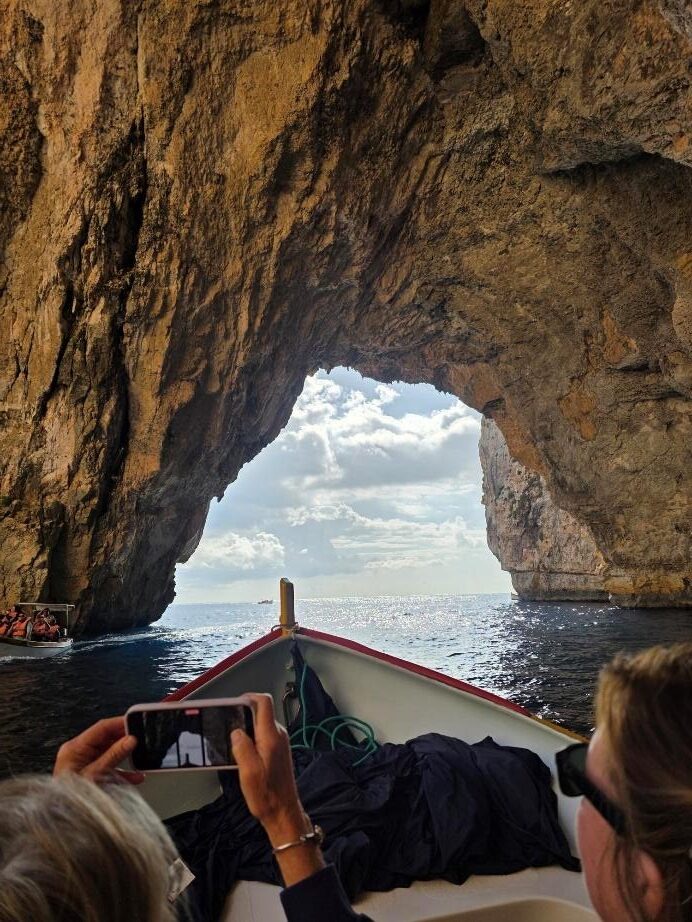
The Blue Grotto. Photo by Richard Bangs
I arrived brimming with expectation, scanning every cornice and crenellation for a hint of falconry. At the Upper Barrakka Gardens, perched high like a lookout of the gods, cannons stared across the Grand Harbour, but no birds of prey circled above. At St. John’s Co-Cathedral—an explosion of gold leaf, marble, and Caravaggio’s lurid chiaroscuro—I searched for iconography that might whisper of the fabled bird. Nothing.

Jack Wheeler and Richard Bangs looking for wayward birds in St. Paul’s Cathedral. Photo by Rebel Holiday
We overnighted at the Gomerina Hotel in Valletta, a capital built like a clenched fist. Malta has been besieged by nearly every empire with a navy—Phoenicians, Romans, Arabs, Normans, Aragonese, Ottomans, French, British—and during WWII endured 3,700 air raids and 154 days of blitzkrieg. Valletta’s bastions still wear their scars, though now polished with pride. I asked the concierge about the origin of the falcon myth; he shrugged. No one knows, he said. Some legends prefer their shadows.
The next morning, we wandered the Gardjola Gardens at Senglea, passing beneath the stone watchtower carved with an all-seeing eye and listening ear—symbols of vigilance over waters that once carried the world’s contraband. At Bormla’s waterfront, where the great empires once unloaded treasures, spices, coins, and captives, I tried to imagine the flutter of a bird’s delivery amidst the clang of chains and the cry of merchants.
Fort St. Angelo rose ahead—grim, resolute. Here, during the Great Siege of 1565, defenders fired the severed heads of Ottoman prisoners from cannons, a ghastly message that Malta would not yield. If ever a place hid stolen treasure, this would be the vault. But the stones kept their counsel.

The Saluting Battery, where they once fired the heads of Ottomans. Photo by Rolf Falschebner
At Birgu we hired a traditional dgħajsa, its colors bright as a child’s kite, and skimmed across the Grand Harbour. The clouds drifted like sails. The water carried a thousand ghostly wakes—Phoenician cargo ships, Roman galleys, the dread corsairs of Barbary. You could almost hear the clink of gold and the whisper of illicit deals.
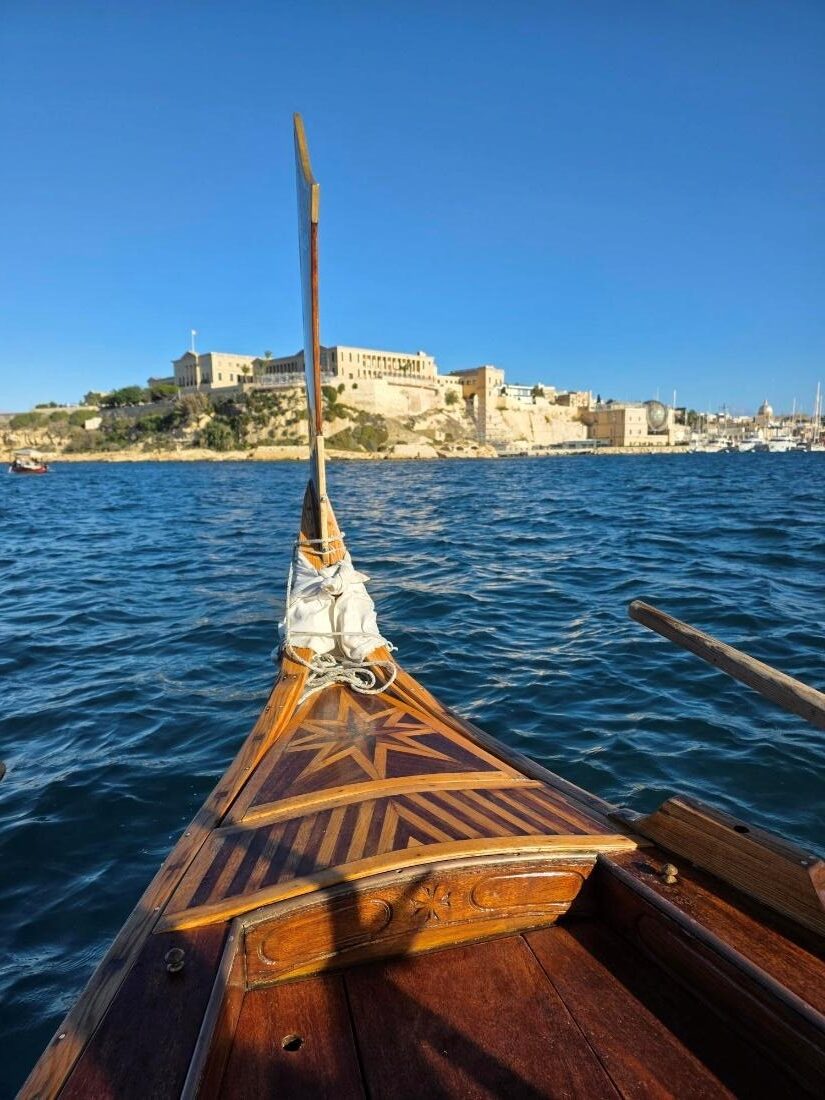
Traditional dgħajsa sailing to the fortified city of Valletta. Photo by Richard Bangs
The next day we followed the pulse of prehistory: Hagar Qim, Mnajdra, Tarxien—temples older than the pyramids, carved by hands that measured the movements of the sun. Their stones, honeyed by millennia, were carved with spirals and altars, but no falcons perched among them.
At St. Paul’s Grotto and the subterranean labyrinth of St. Paul’s Catacombs, I felt the hush of early Christianity, the trickle of candles, the weight of the earth—but again, no avian clues.
So we boarded the Cirkewwa ferry to Gozo, that rocky sibling island that looks torn from North Africa and tossed into a sapphire sea. As we crossed, the horizon dissolved: sea and sky stitched from the same shimmering cloth.
Gozo bears a scarred history. In 1551 the pirate Dragut descended like a storm. The Cittadella fell. Five thousand islanders were taken into slavery, vanishing like smoke. For years, Gozo lay hollowed and haunted. Later, the Barbary pirates prowled the coast with a predator’s patience until the shores of Tripoli tamed them in 1801 under the rising banner of the U.S. Marines.
If ever pirates seized a jeweled falcon en route to Sicily, Gozo—with its hidden coves, storm-cut caverns, and high basalt ledges—would have been their natural lair.
We probed Mixta Cave, a cavern mouth yawning over Ramla Bay, its orange sands glowing like burnished copper. Rumors of treasure echo through its chambers, though the only jewels we found were shafts of morning light. Aboard the KelSea we explored the Crystal Lagoon’s sea caves—blue vaults shimmering with underwater lightning. No secrets spilled from the Coraline limestone, but the silence itself felt conspiratorial.
By late afternoon we sailed toward Sliema Bay, named for a chapel dedicated to Our Lady of Good Voyage—the eternal companion of sailors threading perilous channels. The northern coast glittered with modern cafés and promenades, yet beneath it ran the ancient current of Malta’s seafaring soul.
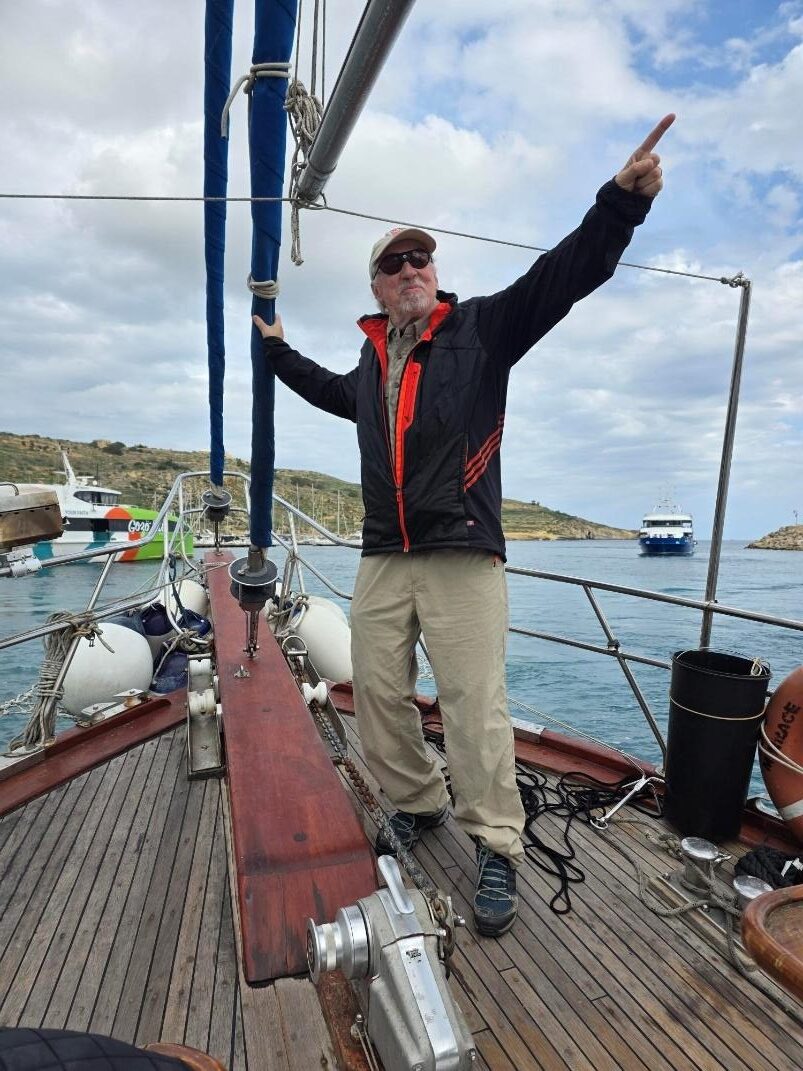
Richard Bangs pointing to a mythical bird while Sailing to Sliema. Photo by Rebel Holiday.
We checked into Hotel Juliani, where a pack of twelve-year-old girls shrieked in birthday ecstasy. I asked them if they’d heard of The Maltese Falcon. Blank stares. Then they dissolved back into their bright screens, the glow of a new century.
Our final day brought us to Fort St. Elmo for the in Guardia reenactment—a pageant of clanking armor, cracking muskets, plumed helmets, and ceremonial rigor. No live falcons soared overhead, but symbols of the bird adorned banners, shields, and pageantry—a heraldic echo of that ancient annual tribute.
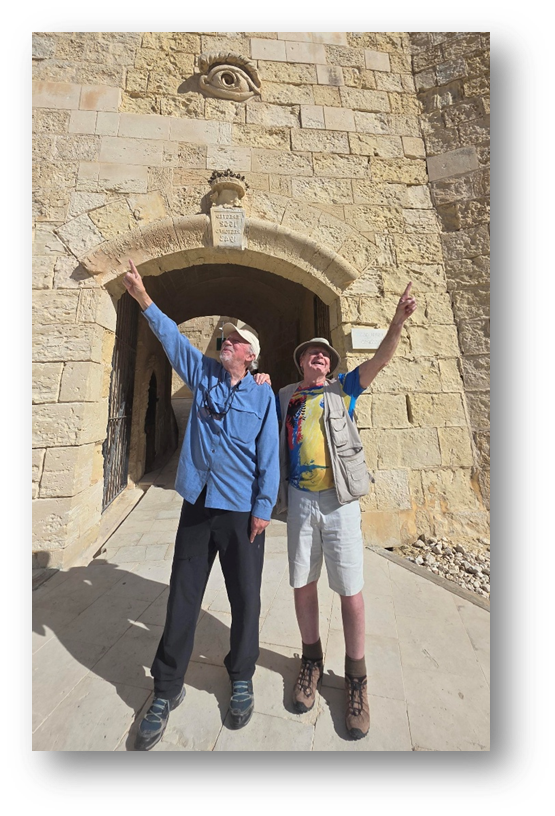
Richard Bangs, Dr. Jack Wheeler, and the all-knowing Eye outside Fort St. Elmo. Photo by Rebel Holiday
That night we toasted Jack Wheeler’s birthday at The Dubliner, an Irish pub tucked across from our hotel, where laughter bubbled like stout. Jack, master of historical digressions, wove stories of Malta’s layered past but never once mentioned the falcon. I didn’t prompt him. Some quests flourish in the unspoken.
The next morning, with time to spare before my flight, I wandered to the Wignacourt Museum in Rabat. There, in a quiet side room, a small Egyptian faience falcon rested under glass. The placard claimed that Phoenician traders brought such objects from Egypt to Malta—a spiritual passenger on their mercantile routes. It was found in an ossuary in the St. Paul’s Catacombs nearby.

The Maltese Falcon? Photo by Richard Bangs
Was this the seed? A tiny relic that germinated into legend? Perhaps. Or perhaps not. Myths, like falcons, prefer to fly free.
But as I stood before that diminutive bird, shimmering faintly in its glass aerie, I felt a shiver of connection—a link across continents, centuries, imaginations. A single object, real or imagined, had launched one of cinema’s greatest masterpieces and lured me halfway across the world in pursuit of its shadow.
And that, truly, is the stuff that dreams are made of.
Photo by Richard Bangs
##