A More Radiant Form
It came as a surprise when my parents began to age. Dad and Mom had always been healthy and robust—eager to travel with us around the world. Dad performed on stage with Santana twice, once when Salvador was just a baby and Carlos introduced him at the Budokan in Tokyo to sing “Stardust,” the same song he had performed with the Aristocrats of Swing in Oakland. Chester Thompson and Tom Coster made the keyboards swing, and the audience clapped and screamed. Dad was still a “cool cat” as jazz musicians say, and although his voice was not as strong as it had been in his early years, it was full with vibrato and emotional resonance. Seeing the performance made up for all the years I had missed seeing Dad play. I adored my parents and spent hours engaged in conversations and enjoyed the children with them.
When Dad suffered a stroke, we were all shaken. My sister, Kitsaun and I helped drive him to physical therapy and doctor’s appointments, and Mom called me often to run up the hill to help. The saddest part was that Dad wouldn’t pick up his guitar. Mom would lift it and ask, “Saunders, won’t you please try?” He shook his head. “No, Jo.” He suffered from aphasia, and his digital dexterity was slow. I could only imagine how his brain might jumble our conversation, or how the songs he once played without thinking were now sitting in some strange waiting room of his mind.
Mom was the last living member of the Willis clan; all four of her sisters had died. She was the youngest and perhaps the bravest, having weathered society’s ostracization when she and Dad married in 1947 and the inevitable questions they would get when she was on Dad’s arm entering restaurants in Chicago where they first met: “Are you together?”
Mom downplayed the rejection and hatred they experienced, “Oh, it was nothing.” But I know she internalized her pain, putting on a strong face and praying for healing at our family church to help her cope.
Yet even throughout Dad’s illness, Mom said, “Saunders and I are very blessed, and God has been gracious to us, for which we give thanks.”
When Dad played his last physical notes, Kitsaun and I were at his bedside, our heads bent to hear any last words. Dad’s breathing stopped and our weeping began. Kitsaun laid her head on Dad’s chest, while I had a sense of being sent off into the unknown, like a child who lets go of the string of her red balloon, and it sails far away, out of sight.
After Dad’s death, Mom lived by herself in the house they had built. Her days were spent reading, praying, and writing in her journal. Later, I saw one of her journal entries:
“It has been a year living without your physical presence, Saunders. In all the years, I never thought of this possibility; it now seems odd to me that I did not. It has been a lonely journey without you. God sustains me each day. I am grateful.”
Mom was always the person I told my life’s concerns to. After work, I would tell her about the shenanigans at the office or where the band was on tour and when I might go meet them. She listened intently and gave me advice when appropriate.
“Remember to let go of the small irritations, Deb. Don’t be so focused on perfection.”
Mom often told me I worried too much.
Without Dad in their house, Kitsaun and I knew Mom was lonely. After all, she and Dad were married for fifty-three years. Dad’s death was the gravest loss of Mom’s life. Each day her soft face grew thinner and more haggard, and she looked physically weak. She was also diagnosed with emphysema, even though she had never smoked.
Then in January 2006, she called me.
“Deb, can you take me to the doctor? I can’t seem to get rid of this cold.”
She held onto my arm as we walked from my car to the doctor’s office; her body was frail. We sat with her pulmonologist for what we thought would be an examination ending with a prescription of antibiotics for bronchitis.
Instead, the doctor said, “If she were my mother, I would take her right to the hospital.”
“Mom, I think we should do as Dr. Livnat said.” She was too weak to disagree.
That day was the beginning of my Zen experience with my darling mother’s last five months on earth.
Dr. Livnat called me into the hallway.
“Your mother could live a year, two years, or die tomorrow. She is at the end stage of her disease.”
Any lingering idea I had of control was stripped away.
No push or pull, Mom and I just looked into each other’s eyes with knowing and peace that we would go through it together. It was a time to learn and experience life changing into a more radiant form. Weakness became strength. All changed inside of me. It was all love.
Two months later, her friend and caregiver, Ginette, arrived to help her with breakfast, and she found Mom unconscious.
That afternoon, with Kitsaun, Stella, and Angelica around the bed, Mom regained consciousness for an hour. She looked around at her daughters and granddaughters and said,
“You all go home; I’m going home.”
Loving the Fire
I wish my mother had not died before I found my way
through a burning forest, flames crawling up bark and
branch, singeing my legs as I ran.
She would have feared for my life despite her faith in the Divine.
She would have angered when people who were not strangers
did not offer their hands
to pull me from the astounding heat.
My trials would have been easier with her arms around me,
as her womb had enfolded my beginning.
From her perch in the beyond, I felt her blessing,
and out of the ashes my courage rose,
like notes of violins, flutes, and cellos.
I wish my mother had told me how she survived
the burning of her life.
Looking upward, toward a patriarchal God in cumulus clouds,
she wore rose-colored glasses on her thin nose,
porcelain skin radiant from her fire.
My fears breathed in shadows outside my windows,
and doubts that I was enough to be loved
were incinerated by clarinets and violas
whose round full notes carry the refreshing wind of this new day.
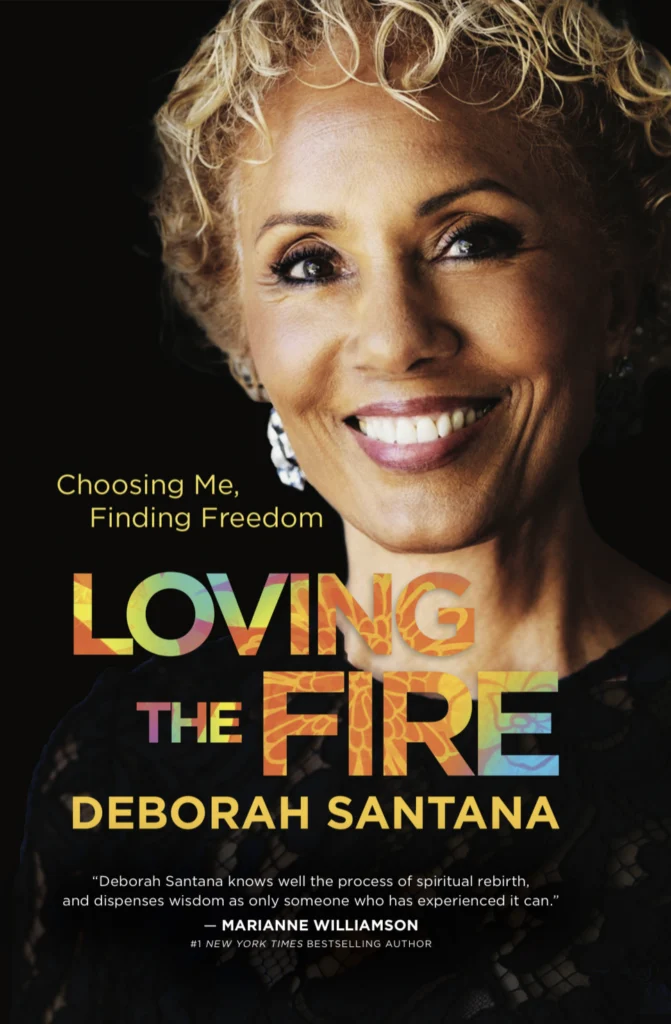
Adapted excerpt from Loving the Fire: Choosing Me, Finding Freedom by Deborah Santana. Reprinted with permission from the author and publisher.