


It’s 1:47 a.m. Maya is staring at a cursor that hasn’t moved in twenty minutes. Her laptop screen is the brightest thing in the room, and she feels lonely. Earlier that day, her toddler had a fever, her advisor sent back a chapter covered in track changes, and her mother called to ask, yet again, when she’ll be “Dr. Maya.” That question used to feel like encouragement. Tonight it feels like judgment, a countdown clock she cannot stop.
Maya is not failing. She is a graduate student. And if you’re reading this in your own version of that 1:47 a.m., I want you to know something before we go any further: what you’re carrying has a name, and it is not weakness.
Let’s name it.
The dissertation season is unlike anything you’ve done before, and that unfamiliarity is exactly the problem. You are navigating new terrain with no map, because no one in your circle, maybe no one in your family, has walked this exact path ahead of you. That lack of a roadmap does not mean you are lost. It means you are a pioneer, and pioneers move slower because they are building the trail as they go.
Building a trail takes energy, and that energy gets pulled in a dozen directions by the parts of life that refuse to pause for your research or studies. Life keeps life-ing. Kids get sick. Jobs demand more. Bills pile up. Relationships need tending. And somewhere underneath all of it, you are quietly wondering whether you have what it takes to finish, while making sure nobody sees you cry, stress, or wonder.
That hidden wondering has a name too. Researchers call it self-doubt, and self-doubt left unchecked writes a script for you, usually a harsh one. That script says things like “I’m behind,” “I’m not smart enough for this,” or “everyone else has it figured out.” Once that script starts playing, it plays on repeat, and repetition is how doubt becomes belief. Belief, even a false one, shapes behavior. So if the script is running your behavior, it’s time to rewrite the script.
Now let’s tame it.
Rewriting your script starts with catching the sentence before it finishes forming. The next time you hear “I’m behind,” pause and ask, “behind according to whose timeline?” Most doctoral timelines are invented pressure, not necessarily fact. Swap “I’m behind” with “I’m building,” because building is what you’re actually doing, one messy draft at a time. This swap is called cognitive reframing, and reframing works because your brain believes what you tell it most often. Tell it a truer story, and it will start looking for evidence to support that truer story instead of hunting for reasons to confirm your fear.
Evidence, by the way, is easier to find than you think. Self-efficacy, your belief in your own capability, grows from small proof points stacked over time, not from one dramatic breakthrough. So stack them. Finished a paragraph today? That’s proof. Got useful feedback and didn’t quit? That’s proof. Annotated an article for your literature review? That’s proof. Asked a question in your cohort group chat instead of silently spiraling? That’s proof. Proof accumulates into confidence, and confidence, even a little, is fuel for the next page, the next chapter.
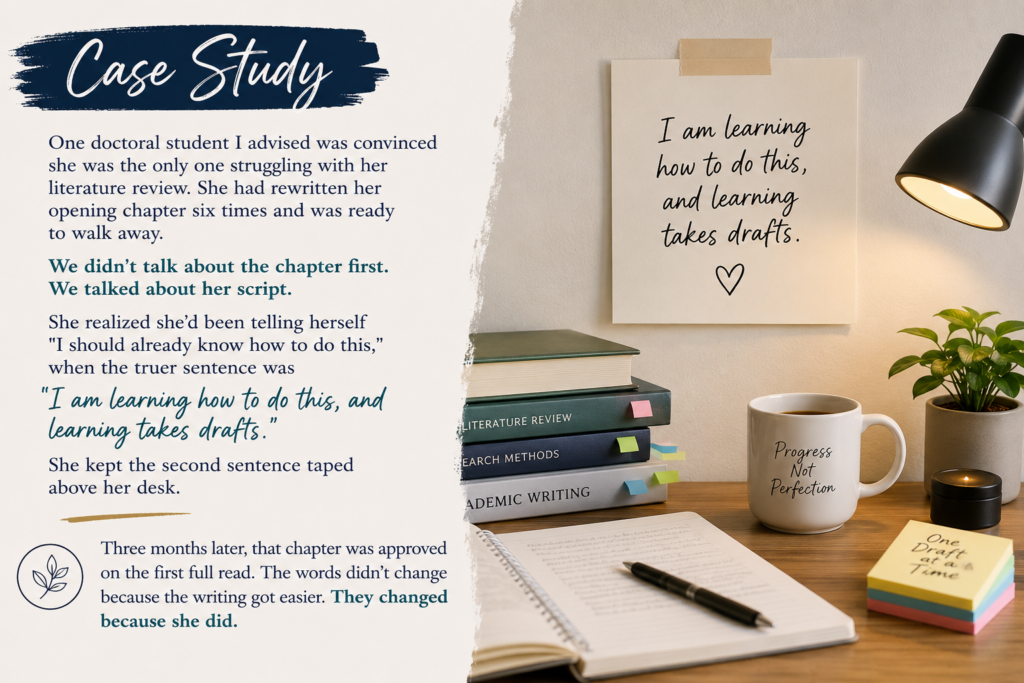
That shift, from should to learning, is available to you right now. Learning requires permission to be imperfect, and permission to be imperfect requires you to stop hiding your struggle from the people who could actually help you carry it. Read that again. Carrying it alone is the fastest way to sink. Carrying it in community, your advisor, your cohort, your family, even a single accountability partner, is how doctoral students actually finish. Finishing is not a solo sport…it takes a village.
So here is what I want you to do. Write down the negative script you keep repeating. Cross it out. Write the truer sentence next to it. Then do one small, concrete task toward your dissertation, not the whole chapter, just one task, and let that task be your proof for the day. Proof builds self-efficacy. Self-efficacy builds momentum. Momentum builds a finished dissertation.
Back to Maya. No, she didn’t finish that chapter at 1:47 a.m. But she wrote one sentence, crossed out “I’ll never get this right,” and wrote “I’m building this, one draft at a time.” Then she closed her laptop and went to sleep (Psalm 3:5). That single sentence didn’t fix everything. It just gave her enough ground to stand on for tomorrow and the days ahead.
You have that same ground under you right now. Stand on it. Sleep on it. Then take the next step. I’m rooting for you! ✨