


Everyone remembers the kid in school who was too cool to try. Perhaps that kid was you. In reality, that kid lived in a combination of insecurity and fear. It was easier not to care than to care and risk failure. Many adults have yet to outgrow this tendency. Hence all the nonchalance and too-cool-to-care attitudes.
The biggest barrier to caring is fear.
Fear of failure. Fear of heartbreak. Fear of loss.
Things don’t always go your way, and even when they do, they always change. The project you dedicated yourself to for over a year gets killed at the twenty-fifth hour, for reasons outside of your control. After months of preparation, blood, sweat, and tears, you lose the race. Your body ages, leaving no question that it’s time to retire from the career that defined you. The movement to which you devoted your time, energy, and attention fails to accomplish its aim. The child you poured everything into raising moves out.
“Heartbreak is unpreventable,” explains the poet David Whyte, “the natural outcome of caring for people and things over which we have no control. Heartbreak is an indication of our sincerity: in a love relationship, in a life’s work, in trying to learn a musical instrument, in an attempt to shape a better and more generous self.”
A common defense is to move through life like the cool kid in school, to adopt an attitude of nonchalance, to prevent ourselves from caring by coasting or phoning it in, by keeping everything at arm’s length instead of giving it our all. An attitude of nonchalance is akin to going through life with Bubble Wrap on. You make yourself safe, you protect yourself from scratches and bruises, from becoming worn in. But you never grow into who you really are, let alone express your true potential. The hurt isn’t as bad this way, but neither are the joys. You end up missing out on the fullness of life. You sacrifice the pursuit of excellence—and the deep satisfaction it brings—for short-term safety and comfort instead.
If you want to have a rich and meaningful life then you have to expose yourself. You have to make yourself vulnerable. You have to care. There is no way around it.
The best athletes care deeply. The best artists care deeply. The best leaders care deeply. The best coaches care deeply. The best teachers care deeply. The best healers care deeply. The best parents care deeply. You are not going to be the best anything with an attitude of nonchalance—including the best version of yourself.
How do you care deeply in a way that is sustainable? How do you make yourself vulnerable without it becoming overwhelming or burning yourself out?
You set boundaries. You maintain a sense of humor. You surround yourself with good art, good books, and most of all, good people. They remind you that caring is hard but worth it, and they offer crucial support on your path. You cultivate a sense of self that is larger than your ego, larger than the part of you who wants everything to go a certain way. You hold your care, ambition, and drive in a container of self-kindness, because if you cannot be kind to yourself when you suffer inevitable heartbreaks and failures, then you would never come back and risk putting it on the line again. You learn to tell yourself, Caring deeply is hard, but we can do hard things. This is what it looks like to have your own back, and it is only when you have your own back that you can truly become a badass.
You come to appreciate that you can either go through the motions and be superficially cool (but actually boring), or you can step into the arena, lay it on the line, and care deeply.
You come to appreciate that the things you care about are the things that break your heart are the things that give rise to excellence and fill your life with meaning and joy.
Identification and Identity
Caring deeply about something means beginning to identify with it. You start saying, I am an artist or I am a chef or I am an athlete or I am a musician or I am a doctor or I am a parent. It goes from being something you do to being part of who you are. This is to be expected. It is a sign of full engagement and intensifying care, a wonderful feeling. But it isn’t without risk.
That’s because when an activity becomes the entirety of who you are and something goes wrong, it upends your sense of self. Just knowing this could happen creates a source of unnecessary tension.
I’ve come to think about identity like a house: If you live in a house that only has one room, and it floods, then you have to move out of the house. It is a disorienting experience. But if you live in a house with multiple rooms, and one room floods, you can seek refuge in the other rooms while you repair the damage. The goal is to build an identity house with at least a few rooms, because you never know when one is going to flood and you’ll need to find strength and stability in the others.
Example rooms include artist, athlete, bookworm, neighbor, leader, parent, musician, partner, chef, physician, nurse, teacher, writer, and so on. The rooms need not be the same size, and you don’t need to spend the same amount of time in each. When you are pursuing excellence, you won’t. The goal is not to be “balanced.” You’ll inevitably give your primary pursuit significantly more of your time, energy, and attention. You just want to make sure it’s not the only room in your identity house. If it is, it makes you fragile.
It’s good to be all in, you just don’t want to be all in all the time.
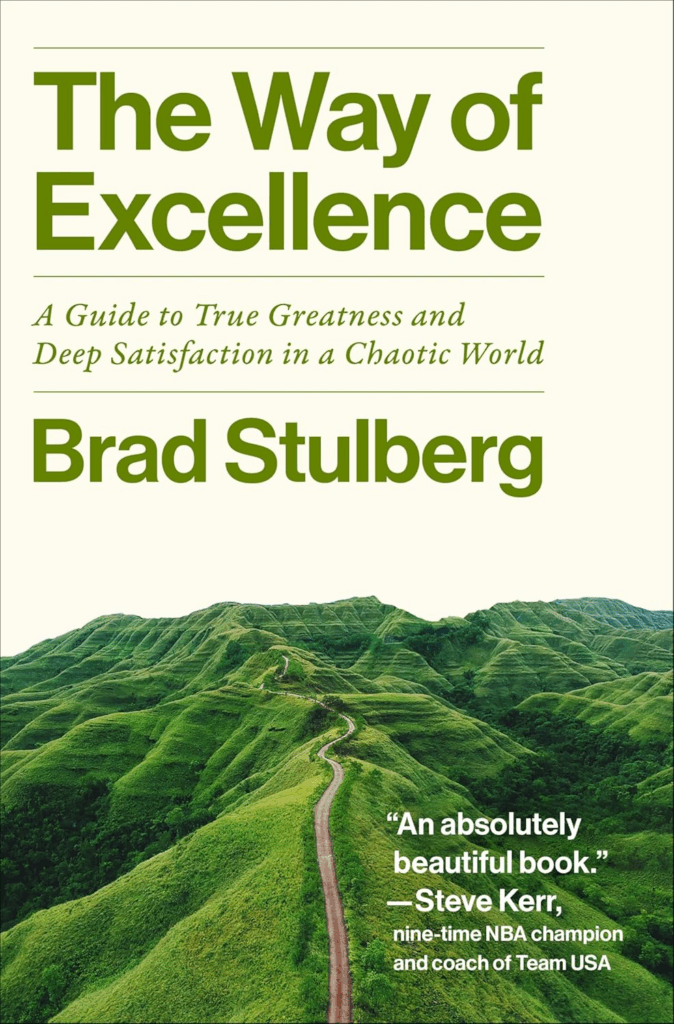
Excerpted from The Way of Excellence by Brad Stulberg and reprinted with permission from HarperOne, an imprint of HarperCollins Publishers. Copyright 2026.