
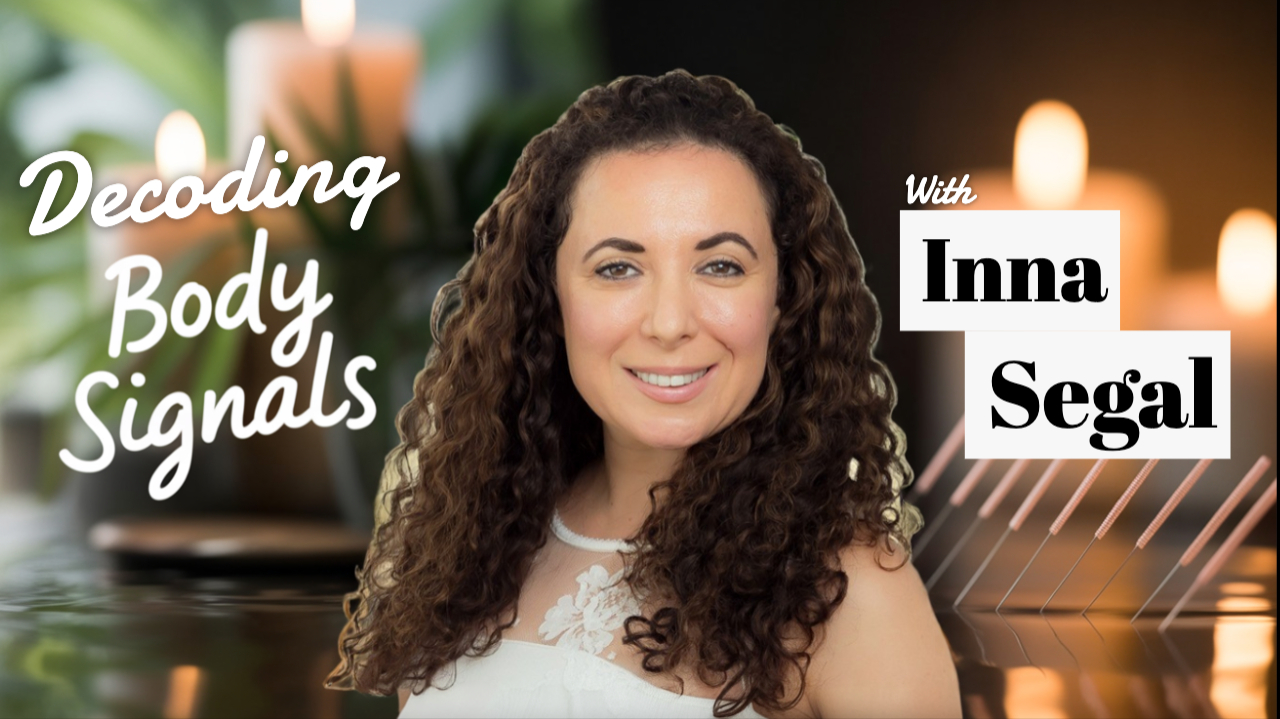
Where a person has pain is not necessarily where the starting point is.

– Inna Segal

What if pain isn’t the real problem, but simply a messenger? In this intimate Q&A, interviewer Stacey Chillemi sits down with Inna Segal—an internationally acclaimed intuitive healer and best‑selling author of The Secret Language of Your Body (translated into 26 languages and embraced in more than 100 countries)—to explore how the body’s wisdom communicates through sensation, symptoms, and memory. With clarity and compassion, Inna frames pain as guidance, inviting readers to listen beneath discomfort to the stories the body has been trying to tell.

Grounded in her own awakening after years of physical pain, emotional turmoil, and profound loss, Inna shares practical pathways for self‑healing through visualization, color therapy, breath work, chakra awareness, and ancestral clearing. This conversation offers a gentle, structured approach to decoding pain’s messages… so we can move toward greater freedom, balance, and vitality.

Thank you so much for joining us! Our readers would love to get to know you a bit better. Can you tell us a bit about your backstory?

I reached a point where I was in constant agony, and nothing in my life seemed to work. I was stuck in survival mode, repeating old patterns I wasn’t even fully aware of, and I had a crisis of faith… being open to the idea of the divine yet uncertain. After becoming pregnant at 19, I sensed late in the pregnancy that something was wrong; my baby died at birth, and in that moment, I saw an angelic being who said everything would be okay and that I would have two children soon. The grief amplified my physical pain—severe back issues, psoriasis, and digestive problems—and I fell into depression. A chiropractor finally reflected a hard truth: “Your body wants to be stuck,” and that sparked a decision in me to find a way to heal.

What was the inner turning point that moved you from despair to self-healing?

Leaving that appointment, I felt rage instead of helplessness, and I used that energy to act. At home, I placed my hands on my back, breathed into the pain, and realized I had been barely breathing for years. Fear rose as I finally felt what I’d avoided, so I counted backward from 30 and quietly asked for divine help. Warmth moved through me, I saw golden light with my eyes closed, and suddenly it was as if a light switch flipped, and I could “see” into my spine. For the first time, my thinking, feeling, and will aligned, and I asked to be shown why my body was hurting.

What did those first visions reveal about the roots of your pain?

I was shown vivid, layered images—memories and awareness. I had immigrated from Eastern Europe, spent time in Italy, where I felt deeply loved, and then was bullied at school in Australia, after which psoriasis appeared on my elbows and knees. Later, in a private school surrounded by great wealth, I carried a protective energy, and my lower back pain and sciatica worsened. At home, there were constant money struggles, and I recognized that the lower back often reflects survival and finances. Those pieces formed a map of how my body had been speaking all along.

How did ancestry and sensitivity factor into that map?

My grandmother lost all her brothers and sisters—she was one of eight—and much of that grief was suppressed. When I lost my child, those ancestral patterns surfaced for everyone, and she began to speak about the losses. I had also been a “sponge,” taking on others’ pain and energy from an early age, which contributed to digestive issues. Seeing this, I understood that my body held stories from family, culture, and my own experiences, and I needed to unwind them.

What changed physically after that first experience?

I fell into the most restorative sleep, my body finally unwinding. By morning, about 70% of the pain was gone, and I noticed my twisted back had released. Over the next three weeks, I kept connecting the pieces; the psoriasis I had for about 11 years disappeared and never returned, and the back pain resolved. Digestive issues took longer, as they were deeply intertwined with ancestry, and the anxiety and depression dissolved over time.

When did you realize you could “see” and support healing in others?

Not long after, I noticed I could perceive into other people’s energy fields, both body and emotions, to help connect their inner pieces too. The capacity felt natural and exciting even as I learned how to trust it. I recognized that this was a doorway to serving others with clarity and care. I committed to honoring what I was shown and to letting the work guide the next steps.

How did you refine your approach and discern what truly works?

I began interviewing teachers and authors, attending their courses, and spending time with them. Some teachings felt like powerful keys; others didn’t look healthy when I tuned into the person’s reaction. I chose to remain teachable yet discerning and to trust what I was shown. I practiced with people who didn’t know me, validated specifics, supported family members, and built a system from many observations across ages and backgrounds.

For someone new to your work, how do you begin a session?

I always create a map. I connect to a person’s soul and ask, “Show me the starting point,” because where pain shows up is often the result, not the origin. I ask clients to share as little as possible at first and then answer focused questions so we don’t waste time guessing. As images or sensations appear, I follow them step by step and let the map unfold.

Can you share an example—say the right knee is speaking?

The right knee often relates to moving forward, and there may be stuckness involving work or someone very close, like a family member. As the person acknowledges what resonates, the image can shift—perhaps to the lower back—linking survival and finances. From there, I might ask about the father or a significant masculine figure in childhood to connect the pieces. It is a precise, relational map in which each honest acknowledgment reveals the next layer.

You mention “etheric hands.” What does that look like in practice?

We have chakras in the hands, and I work with etheric hands; energetic hands that can engage the etheric copy of the physical body and, through it, the physical. I also use them to explore timelines, past and sometimes future, around a theme such as health, self-love, or confidence. I am often shown distinct ages that are most relevant to the pattern we are addressing. This helps us see where the imprint began, intensified, or now needs attention.

Once the map is clear, how do you guide someone through change?

We look at the big picture and set realistic expectations; instant shifts can happen, but may not hold without integration. We break the work into sub-themes and combine guided processes with energetic work I have developed over many years. Rather than “cutting cords,” I focus on understanding, clearing, and transforming what is within the cord, then bringing in healing energy. I also use archetypal work to reveal specific timelines and parts so we are not generalizing.

Why do you caution against saying “I am” when describing symptoms?

Phrases like “I am afraid” or “I am sick” make the pattern rigid. When we shift to “a part of me feels afraid,” we can meet that part without becoming it. We can also connect to the wise, happy, and healed parts that already exist. Healing then becomes an intimate exploration rather than a fixed identity, and release follows.

Many people reach for quick fixes. What perspective would you offer them?

Pain is not an enemy; it is a messenger. Quick fixes can silence the signal, but the body keeps asking us to listen. My work is about getting to the root by connecting the experiences, emotions, and ancestry that shaped the pattern. When we honor the message, the body can reorganize and exhale.

Your book, The Secret Language of Your Body, is beloved worldwide. What can readers expect inside?

It begins with guidance on how to use the book and the layered processes, plus ten keys to healing… starting there matters. There is a comprehensive section on body parts; the wisdom each holds, why they may degenerate, and a process under each entry so you can work directly. I also cover diseases, color healing as a fast way to shift state (wonderful for children), and emotions with their layers. The final section explores the body’s systems and the lessons they are here to teach.

Where can readers find the book?

Readers can easily find it online; Amazon carries it. I also encourage people to support local bookshops. If it is not on the shelf, they can order it in for you. The title continues to be reprinted and available in many languages.

Can you give another simple example—say, pain in the left big toe?

The left big toe often connects to communication and the feminine. It can point to difficulties communicating with a feminine figure—mother, sister, or a friend—or to ignoring your own feminine side. Because it is in the feet, it also relates to moving forward; something may be holding you back. The body is saying, “Address this first so you can move ahead with ease.”

What first steps can someone take today to start listening to their body?

I offer a free master class on the Secret Language of Your Body, where I explain what different parts of the body represent and guide exercises to release pain and gather wisdom. Watching it with a journal helps you connect the dots for yourself. Begin to notice, breathe into the first sensation asking for attention, and write down what emerges. Once you start, you will not look back.

Any closing reflection for readers sitting with pain right now?

Begin by being honest with yourself and curious. Ask your body to show you the first thread, breathe into it, and listen softly. When you engage with the message rather than fight it, alignment and relief can follow. Your body carries wisdom and wants to guide you.

How can our readers further follow your work online?

Visit my website, innasegal.com, where you can access a free master class and additional resources. The book is available online and can also be ordered through local bookstores, which I encourage people to support. You can also stay updated by following along on Facebook. Be sure to keep a journal to capture insights from your body… small reflections create meaningful change.

Inna, thank you so much for being here and for sharing your wisdom today.

Thank you, Stacey. It was wonderful to be here.

Inna Segal is an internationally acclaimed intuitive healer, speaker, and best‑selling author of The Secret Language of Your Body, translated into 26 languages and embraced in more than 100 countries. Grounded in her own awakening from years of physical pain and emotional turmoil, her work makes healing accessible through visualization, color therapy, breath work, chakra awareness, and ancestral clearing… guiding people to decode the body’s messages and move toward greater balance and vitality.

Author(s)

  • Speaker, Podcaster, and 20-Time Best-Selling Author

    Independent Media Creator & Writer

    Stacey Chillemi is a speaker, coach, podcaster, and 20-time best-selling author whose work focuses on wellbeing, resilience, and personal growth. She hosts The Advisor with Stacey Chillemi, where she shares practical strategies for navigating stress, burnout, mindset shifts, and meaningful life change through grounded conversations and real-world tools. Her writing explores emotional well-being, stress regulation, habit change, and sustainable self-improvement.

    Stacey has been featured across major media outlets, including ABC, NBC, CBS, Psychology Today, Insider, Business Insider, and Yahoo News. She has appeared multiple times on The Dr. Oz Show and has collaborated with leaders such as Arianna Huffington. She began her career at NBC, contributing to Dateline, News 4, and The Morning Show, before transitioning into full-time writing, speaking, and media.