


Phrases like “please advise” and “hope my email finds you well” are still prevalent in corporate communication, even as AI tools become more common in everyday writing.
Email deliverability company ZeroBounce examined more than one million work emails to find out which phrases professionals just can’t quit. Familiar buzzwords continue to dominate workplace communication, revealing how deeply ingrained they are in professional writing.
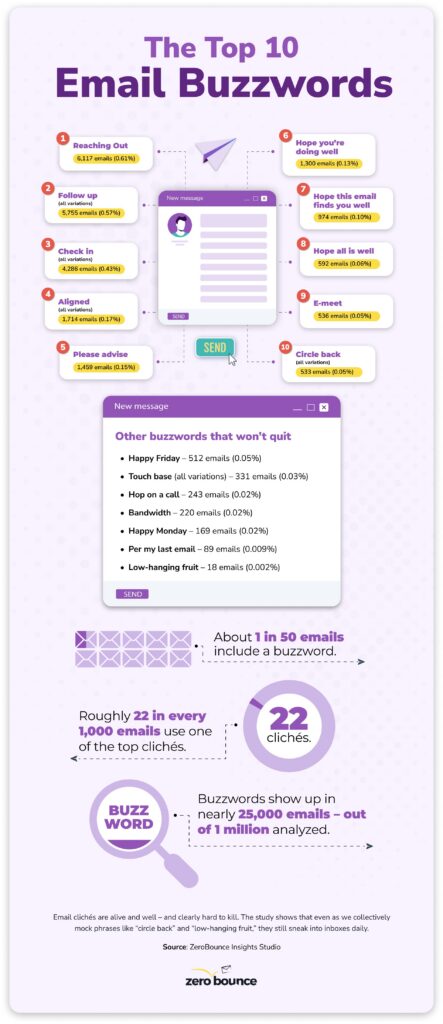
Here are the top 10 email buzzwords, according to ZeroBounce:
- Reaching out – 6,117 emails
- Follow up (all variations) – 5,755 emails
- Check in (all variations) – 4,286 emails
- Aligned (all variations) – 1,714 emails
- Please advise – 1,459 emails
- Hope you’re doing well – 1,300 emails
- Hope this email finds you well – 974 emails
- Hope all is well – 592 emails
- E-meet – 536 emails
- Circle back (all variations) – 533 emails
The study offers a peek into workplace psychology and how politeness, hesitation, and the fear of sounding “too direct” continue to shape office language. For instance, nearly 3,000 emails started with a version of “hope”, including “hope you’re doing well,” “hope this finds you well,” or “hope all is well.”
“I’m circling back”: AI tools are picking up corporate jargon
Despite nearly one in four employees now using AI to help write emails, the language hasn’t evolved much. “The same buzzwords keep sneaking back into our inboxes – and even AI has picked up on our bad habits,” says ZeroBounce CEO Liviu Tanase.
“The bots are ‘reaching out’ and ‘circling back.’ We laugh at corporate jargon, but we keep using it, and we’ve trained machines to sound just like us. Understanding which phrases persist can help people write with more clarity and connect better.”
Other overused phrases include “touch base,” “hop on a call,” “bandwidth,” and “low-hanging fruit.” Even expressions many thought extinct made an appearance: “per my last email” showed up in 89 emails, despite being widely mocked in workplace culture.
“The findings reveal an opportunity for people to stand out at work and in business. Emails that skip the clichés tend to sound more confident and persuasive,” says ZeroBounce Chief Marketing Officer Anne Ghaltchi.