
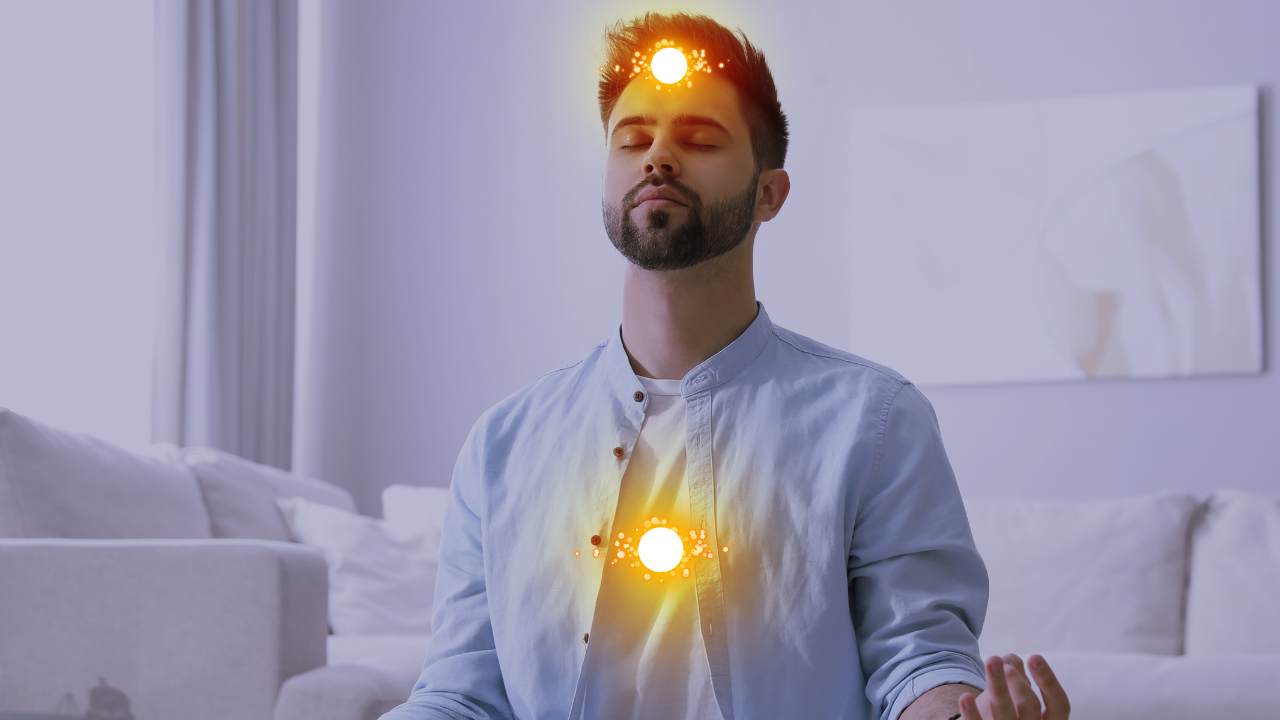
The body will tell you everything you need to know…if you know how to listen.
– Mike Wood
In this enlightening conversation, coach and author Mike Wood kept returning to a deceptively simple idea: your body is not just carrying you through life—it’s constantly communicating with you. The problem, he argued, isn’t that the signals aren’t there. It’s that modern life makes it hard to hear them.
Wood’s framing lands in familiar territory for anyone who has tried to separate mental health from physical health and failed. But it also brushes up against a growing body of research around interoception: the brain’s ability to sense and interpret internal bodily signals (like hunger, tension, heartbeat, breath, and gut sensations), which is increasingly linked to emotion regulation and mental health.
What follows is a clear-eyed look at what Wood shared—where his experiences align with established physiology, where he leans into the mystical, and what’s broadly useful regardless of anyone’s spiritual framework.
“My body screamed at me”: When habits stop working
Wood described a pattern many people recognize: a long-standing habit suddenly becomes intolerable.
Over the last several years, he said caffeine began triggering crashes that felt “much bigger” than a normal afternoon dip—enough that he quit entirely. The surprise wasn’t just the withdrawal; it was what came after. “All of a sudden I was far more awake than I had been in a very long time,” he recalled, estimating it took about a week and a half to feel fully on the other side.
Clinically, caffeine withdrawal often starts within 12–24 hours of stopping, peaks in the first couple of days, and typically resolves within about a week, though individual timelines vary. Wood’s “week and a half” sits well within the range of real-world experience, especially for people coming off heavy daily use.
His deeper point was less about caffeine itself than what it did to his internal environment: he felt stimulants amplified mental “noise,” making it harder to access calm or clarity. That’s not a moral argument; it’s a nervous-system argument.
Use food as feedback, not willpower
Wood offered another abrupt shift: he stopped eating meat “instantly” after a moment of revulsion, then noticed his back pain eased. Personal anecdotes aren’t proof of causation, and nutrition is notoriously individual. But his description illustrates a phenomenon that is consistent with interoception: when you start attending to internal cues, your relationship to food can change from external rules (“clean,” “bad,” “earned”) to internal data (“this makes me feel inflamed,” “this steadies me,” “this leaves me foggy”).
His interviewer shared a parallel story: after a week of heavy drinking and poorer eating choices in April 2025, her sleep deteriorated, mood dropped, and she felt “out of sorts,” then later noticed similar effects after holiday overindulgence—especially sugar and rich foods. That arc is familiar to clinicians: alcohol disrupts sleep architecture, blood sugar swings can affect mood and energy, and ultra-processed foods are easy to overconsume because they’re engineered for palatability.
Wood’s language—“your body is your temple”—leans spiritual, but the mechanism he points to is practical: treat your physiology with basic respect, and your baseline signal-to-noise ratio improves. Even without invoking “downloads,” people often report that better sleep, steadier blood sugar, and reduced alcohol use make it easier to notice what’s happening inside them.
The physiology of stress: why movement changes the mind
One of the most grounded parts of the conversation was Wood’s insistence that mental and physical health aren’t separate systems. He described exercise as a way to “burn off” stress physiology, naming cortisol and endorphins in everyday language.
The science supports the direction of his claim: regular physical activity is consistently associated with fewer symptoms of anxiety and depression, and exercise may influence mood through multiple pathways—endorphins, neurotransmitters, neurotrophic factors like BDNF, improved sleep, and stress regulation.
What’s notable is how Wood described adherence: many people don’t exercise because they should; they exercise because their body demands it. Miss a few days, and they feel mentally worse. That’s not a character flaw. It’s feedback.
Fasting, focus, and the risk of overgeneralizing
Wood also highlighted fasting, particularly 18–20 hours, as a practice that can make meditation and “quiet” feel more accessible, because “your body is literally using all of its energy to digest.”
Digestion indeed requires metabolic work, and many people report feeling sharper when they’re not in a post-meal slump. But fasting research is mixed and context-dependent. Some reviews suggest time-restricted eating or intermittent fasting may support aspects of cognitive function or mental well-being in certain populations, while other analyses note potential cognitive tradeoffs depending on severity, duration, and individual vulnerability.
In simple terms, fasting can be a meaningful tool for some people—and a destabilizing one for others (especially those with a history of eating disorders, blood sugar issues, pregnancy, or certain medications). If someone experiments, it’s worth doing thoughtfully, and ideally with clinical guidance.
The “mystical”: intuition, coincidence, and what quiet can do
The conversation widened into territory that isn’t easily testable: clair-senses, “smelling” a baby’s diaper from across town, past-life memories, and the sense that the universe delivers guidance when the mind quiets.
A measured read here is not to argue metaphysics, but to observe what changes when people reduce mental noise:
- When attention isn’t consumed by rumination, people notice more cues—subtle bodily shifts, environmental patterns, and interpersonal signals.
- Interoception is not a one-way street; brain and body form a loop, and perception can be shaped by expectation, stress state, and focus.
- Humans are also pattern-makers by nature. “Coincidence” can be meaningful psychologically even when it’s not provable cosmically.
Wood’s most constructive advice in this section wasn’t “believe.” It was: create more silence and observe what happens. Turn off the radio. Notice the road. Pay attention to what your body does when you’re not numbing, rushing, or bracing.
The hardest part isn’t the habit, It’s the social pressure
Late in the interview, the focus shifted to a real obstacle: other people.
Wood described how difficult it can be to fast when your partner eats three meals a day, or to skip alcohol in a group where drinking is the social glue. He also named the larger environment—advertising, billboards, cultural norms—that treats constant eating as default.
This is one of the most under-discussed truths in behavior change: “discipline” is often less about internal motivation and more about navigating friction—politely, repeatedly, without turning self-care into a performance or a fight.
Wood’s suggestion was simple and quietly radical: don’t sacrifice your peace to make other people comfortable.
What to take from this conversation
Wood’s worldview blends physiology, personal experience, and spirituality. Not everyone will follow him into the mystical. But the science-forward throughline is sturdy:
- Signal improves when stress drops. Interoception gets easier when the brain isn’t saturated by threat-monitoring.
- Exercise is a mental health infrastructure. It’s not just “fitness”; it’s nervous-system regulation.
- Substances and sleep matter more than we admit. Caffeine, alcohol, and heavy meals can each change mood, energy, and attention—sometimes dramatically.
- Your environment is part of the intervention. Social norms can either support change or quietly sabotage it.
The goal isn’t to “push through” harder. It’s to get honest about what your body has been saying—then respond with care, not force.
** NOTE: Nothing in this conversation replaces medical care. If you’re dealing with anxiety, depression, chronic pain, or disordered eating, experimentation should be paired with support from a qualified clinician.