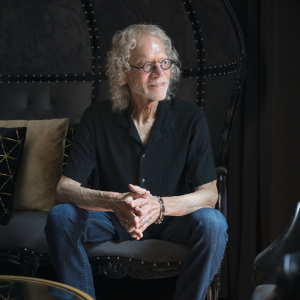

He was sitting in his car in a parking lot, having just been told he had six months to live, and he looked at himself in the rearview mirror and started talking to the virus. “If you want to come to my party, you’re welcome to come play,” he said. “If you think you’re going to take me out, you’re in the fight of your life.” Then he drove back to work. Years later, told by his doctors that a small disability check and a small apartment in San Francisco were as good as his life was going to get, he heard the same voice he had heard as a curious five-year-old on a dirt road. It said, “Watch this.” He went back to work with nine T cells in his body, a number most people never come close to seeing, and he did not stop climbing.
That man is Tom LeNoble, a confidential advisor, speaker, author, and podcast host whose memoir, My Life in Business Suits, Hospital Gowns, and High Heels, has won six book awards since launching last November. He grew up in a one-bedroom house his grandfather built, a place his family actually called the shack, with no hot water and no refrigerator and a pecking order for the bath. He went on to hold executive roles at MCI, Walmart.com, Palm, and Facebook, where he was employee 57 and was called the adult in the room. He has also lived through a terminal diagnosis and a cancer that metastasized. Through his practice, Opening Pathways Collective, Tom LeNoble now works with private clients, leaders, and teams, designs retreats and workshops, and coaches entrepreneurs in underserved countries on a pro bono basis through the Miller Center for Social Entrepreneurship at Santa Clara University. What he teaches is not motivation. It is method.
Why the Present Tense Is Where the Work Actually Happens
When people ask Tom LeNoble what kept him moving through decades of illness and reinvention, he does not describe willpower. He describes a location. “I don’t give in to the past,” he says. “I work with so many people that live in the past.” His argument is mechanical rather than sentimental. Our phones let us scrub back ten seconds on a video, and something in us starts to believe life offers the same function. It does not. The energy spent replaying an old conversation is energy that is not available for the one happening in front of you.
The future gets the same treatment. Worrying forward is a way of leaving the room. “Remember, we got up this morning, some people didn’t,” Tom LeNoble says. “Right here is where the magic happens.” His own line for it is that if you are not present, you might miss the butterfly that flies by, and you can substitute the butterfly for anything you want in your life. The practical value of this became clearest during his illness. Rather than living in the presence of thinking he might die, he was, in his words, engaged in living. The shift did not change his prognosis. It changed what he was able to do with the days the prognosis did not take.
If you want a single place to start, notice the next time your mind reaches for a rewind button that does not exist, and name what is actually in front of you instead.
Resilience Is a Muscle, and It Grows the Way Muscles Do
The most useful thing Tom LeNoble teaches is also the most misunderstood word in personal development. Most people treat resilience as a temperament. He treats it as tissue. “I see resilience being like a muscle,” he says. “Just like we exercise our bicep or triceps to look good in our t-shirt. Resilience, when you exercise it, gets stronger and it’s more available to you.”
That word available is the key. Resilience is not only about standing back up. It is about how quickly you can reach for the response you need. And it is not about skipping the hard part. When Tom LeNoble gets a bad scan today, he sets a timer on his phone. “Tom, you got 30 minutes,” he tells himself. Cry, scream, stomp your feet, complain, do whatever the moment requires. Then move. He is careful to say that everyone processes differently and he does not want to take that processing away from anyone. But he is equally clear about the cost of staying: until you are willing to move forward with the reality of what happened, you are stuck in a place where nothing else can happen either.
The repetition is the exercise. Look at what happened, ask what it has to teach you, then move. Do that enough times and the recovery gets faster, which is what he means when he calls resilience a currency rather than a mood.
“Your job can end, the stock market can crash, you can lose your title, you can lose your house, you can lose lots of things, but no one can take away your resilience.”
Tom LeNoble, confidential advisor, speaker, and author of My Life in Business Suits, Hospital Gowns, and High Heels
The Healing Wheel and the Case for Staying at the Center
During his first illness, Tom LeNoble built a tool he still uses. He calls it the healing wheel. Picture a wheel with spokes, and picture each spoke as a source of care and support: Western medicine, Eastern medicine, acupuncture, massage, chiropractic, whatever the situation calls for. The design detail that matters is the hub. “I was at the center,” he says. “I was in charge.”
When cancer arrived and later metastasized, he pulled the wheel out again. The reasoning behind it is worth understanding, because it is not about rejecting expertise. It is about the difference between receiving care and participating in it. “When we stay focused and in charge, we keep our power,” Tom LeNoble says. His instruction is to take the information in, learn as much as you can, and listen to your own inner voice alongside it rather than handing your life over wholesale to someone else. His oncologist calls him a clinical trial of one, in part because he asks about the reasoning behind every protocol he is offered and questions whether a one-size-fits-all recommendation fits him.
For a reader, the takeaway is not that you should manage your own treatment. It is that you can show up to your care as a participant. Draw your own wheel. Name the spokes you already have and the ones you are missing. Write down the questions you have been too polite to ask, and ask them at your next appointment.
Fear, and the Trick of Turning It Outward
Hospital gowns taught Tom LeNoble something no boardroom could. “When you’re in the hospital being treated for something serious, it doesn’t care what your title is, doesn’t care how many people report to you. It doesn’t care how much money you make,” he says. “Everything suddenly is leveled, and you’re having discussions about your life.”
He also discovered a way to handle waiting rooms that anyone can borrow. Sitting among other patients, he learned to spot the people for whom all of this was brand new, the ones who did not yet know what was about to happen to them. He could sit in his own fear, or he could start a conversation. So he would tell them what the doctors tend to leave out. Radiation does not hurt. You do not have to take your clothes off. It takes about fifteen minutes. He watched the fear come down in the other person, and in the process his own anxiety had nowhere to sit. Service was not a nice gesture layered on top of the fear. It was what displaced it. As Tom LeNoble puts it, fear is nothing more than an opportunity for growth.
The Haystack Method, and Why Advice Usually Fails
Anyone who has watched a friend struggle knows the feeling of seeing their answer clearly while they cannot see it at all. Tom LeNoble’s response to that is a discipline he calls the haystack method, and it explains why so much well-meant advice bounces off. “I think your answers are the needle,” he says. “I don’t know your answer; you do. But sometimes it’s like finding a needle in a haystack. My job is to hold the space to help you clear the hay so you can find that needle.”
He pairs this with what he calls the energy of support, one of six energies he names alongside time, physical vitality, and relationship. His observation is a subtle one. The people who love us want everything to be good for us, and that very wish can keep them from telling us the thing we actually need to hear. That is why an outside perspective is sometimes not a luxury but the missing piece.
He is also direct about the limits of self-management. When something is spinning in your head, get it out. Write it on paper so you can look at it and organize it. Record yourself and play it back, so the thought leaves your mouth and returns through your ears where you can examine it. And when that is not enough, reach for a coach, or for someone with more credentials than a coach. “This is not a sign of weakness,” Tom LeNoble says. “This is a sign of strength.”
The Philanthropic Mindset Has Nothing to Do With the Size of the Check
People tell Tom LeNoble all the time that they want to be philanthropists once they have money. He built an entire keynote and workshop to take that idea apart. Most of us picture a name on a building, a gala, a large check. He argues the mindset is available today, for free. “Your smile, a hello, sitting with someone in need, is coming from the philanthropic mindset,” he says.
There is one condition, and it is the whole test. “When we step out of it is when we expect something in return.” The moment a gift comes with an invoice attached, even an unspoken one, it stops being philanthropy and becomes a transaction. He puts the same point to the nonprofits he works with, who often assume a thousand-dollar check carries more weight than four quarters from someone with little to spare. It comes from the same wealth and the same intention, he tells them, and a lot of quarters add up fast.
The proof, for him, is not in the amounts. He donates to a youth program at a community theater on Maui that funds scholarships for kids who could not otherwise take part. One day an odd envelope arrived in his mail. Inside were handwritten thank you notes, every one of them in crayon. That, he says, was worth more than any check he wrote.
Every Storm Runs Out of Rain
The first thing you see when you open Tom LeNoble’s memoir is a line from Maya Angelou: every storm runs out of rain. He has a particular reading of it. Storms pass, and the sun is shining behind them the entire time, but the part that interests him is what a storm leaves behind. It leaves the ground fertile. “What I’m interested in is those storms in our life that leave the ground fertile,” he says. “What are you gonna plant?”
He calls these terrible gifts, and he is careful not to romanticize them. A relationship ends. Someone we love dies. We get sick. Nobody would wish any of it on anyone. But a year later, or five, or ten, something can come from it. He tells the story of a woman who lost a leg to an infection after a minor hospital procedure and hated the ugly cane she was handed. She shaped an acrylic cane in her own oven, forming the handle around a wine bottle. Today she runs a global business selling beautiful canes and walking sticks, the kind people compliment instead of politely ignore. The storm did not become a gift on its own. She planted something in the ground it left.
Here is the one thing to carry into your day, straight from him. If you are living in the past, come back to the present, because there are no do-overs and no ten-second rewind. If you have a chance to smile at someone or say hello, take it, because that is the philanthropic mindset in motion. And if it is all swirling and will not settle, get it out of your head and reach for support. Tom LeNoble has been given a final answer more than once and outlived every one of them, and what he believes carried him through was not just access or luck. “I believed I could be,” he says. That belief, and the resilience he built one recovery at a time, is what he now spends his life helping other people find.