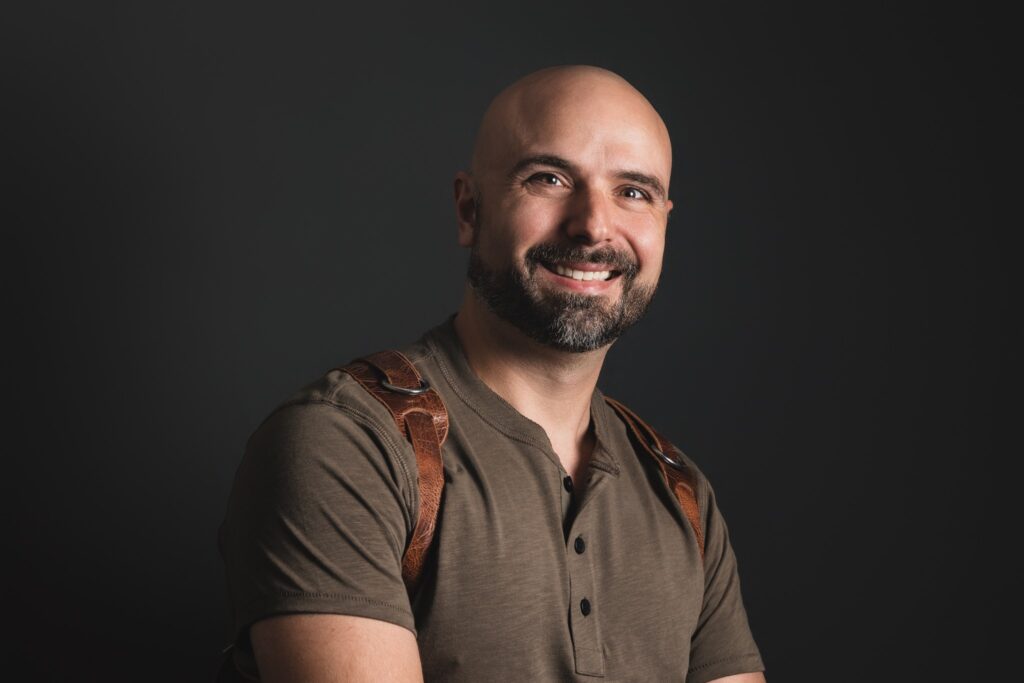

“The portraits aren’t just pictures—they’re proof. They’re evidence of who you really are beneath the fear, the doubt, and the stories you’ve been told. When you finally see that version of yourself, everything in your life begins to change.”
— Gregory James Thelian
In a culture that constantly assigns roles—parent, partner, professional—it can be surprisingly easy to lose sight of the person beneath them. For photographer Gregory James Thelian, that loss of self isn’t just common; it’s central to much of the emotional pain people carry.
Over the past decade, Thelian has observed how deeply self-perception shapes behavior, relationships, and life choices. His work centers on a simple but often overlooked idea: meaningful change rarely begins with fixing habits. It begins with how a person sees themselves.
Photography, he believes, can serve as more than documentation. When approached with care, structure, and intention, it can become a reflective process—one that helps people reconnect with parts of themselves that have been buried under shame, trauma, or long-standing self-doubt.
From image-making to self-recognition
Early in his career, Thelian explored many genres of photography, from commercial work to weddings and portraits. None felt fully aligned until he encountered boudoir photography—not as a stylized aesthetic, but as a relational experience.
A turning point came during a workshop environment that felt impersonal and chaotic. Instead of treating the subject as an object to capture, he slowed down, built rapport, and guided her through the process. The resulting portrait carried emotional weight, not because of lighting or styling, but because the subject recognized herself in it.
That moment reframed his understanding of the medium. The camera, when used intentionally, could act as a mirror rather than a performance stage.
Rethinking confidence and vulnerability
One of the most persistent myths Thelian challenges is the idea that confidence requires the absence of fear. In his experience, confidence often emerges alongside fear—when people feel safe enough to remain present despite it.
Many clients arrive anxious about being seen, posed, or vulnerable. The shift happens not through pressure, but through structure: clear expectations, respectful pacing, and an environment designed to reduce self-consciousness. When the nervous system settles, performance gives way to authenticity.
Confidence, in this sense, is not something people summon. It’s something that surfaces when self-protection is no longer required.
Being “fully seen” without performance
For Thelian, being fully seen has little to do with clothing or styling. It’s about removing the usual buffers—roles, costumes, and narratives—and encountering the self beneath them.
His process begins with guided reflection designed to surface personality, values, and internal identity. By the time images are created, they are rooted in something more durable than appearance. When people later view those images, the response is often recognition rather than surprise.
They are not seeing an idealized version of themselves. They are seeing evidence of who they already are.
When healing is remembering
Rather than framing healing as repair, Thelian often describes it as remembrance. Life accumulates layers—responsibility, expectation, survival—that can obscure identity. Reconnection involves gently peeling those layers back.
Moments of clarity don’t always arrive dramatically. Sometimes they appear quietly, as realizations about what matters or what no longer fits. When those insights are paired with tangible images, they can anchor new self-understanding in a way words alone often cannot.
Why self-perception matters more than tactics
Thelian has noticed that many self-help approaches focus on behavior change without addressing self-perception. When someone carries a deeply held belief of unworthiness, even well-designed tools tend to fail.
When self-perception shifts, however, the same tools suddenly work. Habits stick. Boundaries hold. Choices align.
In that sense, self-perception isn’t a soft concept—it’s a foundational one.
Small practices that support belief change
One practice Thelian often shares is what he calls evidence-based affirmation. Instead of repeating statements that feel untrue, people gather real-world proof that supports a kinder narrative: compliments received, moments of competence, signs of connection.
By pairing affirmation with evidence, the brain is more willing to revise its internal story.
Over time, belief follows experience.
The quiet impact of being witnessed
Some of the most significant changes Thelian has witnessed didn’t happen in the studio, but afterward—when people made different choices because they no longer saw themselves through a lens of shame.
The images didn’t create worth. They reflected it.
And once seen, it became harder to ignore.