


The following is an excerpt from The Compass Within, a new book from award-winning CEO and #1 WSJ and USA Today bestselling author Robert Glazer. Thrive Global readers can get the book’s companion course for free if they order a hardcover copy of the book. Learn more.
We all aspire to live as our most authentic selves in every space that we are in—in our relationships, our work, and our communities. But we often feel a disconnect or tension between who we are and the people around us.
Like most people, you’ve probably experienced times when you and your partner just weren’t on the same page. These moments can feel jarring and unsettling. While you don’t want to turn minor disagreements into major problems, you occasionally worry that the two of you have fundamentally different worldviews. The question is how to distinguish between a normal source of tension, which can be resolved through communication and compromise, and a deeper, potentially irresolvable conflict.
Similarly, you may find yourself adapting your personality or lifestyle to fit into your community in a way that feels inauthentic and draining. This can lead to engaging in activities, conversations, or debates that feel superficial or forced. For instance, you might often go out to bars, shop at expensive boutiques, or eat at the latest trendy places when you’d rather be hiking with friends, discussing books, cooking and entertaining at home, or spending time on creative projects. Or maybe it is the other way around. If the people in your social group show no interest in exploring new music and culinary sensations, you might find yourself stuck in a routine that drains your energy and stifles your enthusiasm. Consider whether the community where you live makes it easier to be yourself or if you are regularly pulled into activities and opinions that don’t feel authentic to the person you are.
This dissonance isn’t limited to our personal lives. Have you ever received a request from a superior that makes you wince, and you perform the task requested of you only reluctantly? Perhaps you have been part of a corporate initiative filled with jargon or a coldly executed layoff in which you participated only with a heavy heart. You may not be able to articulate why you felt so uncomfortable; you just know that something didn’t sit right. Maybe you went along to avoid conflict but frequently find yourself dwelling on it later, trying to make sense of your discomfort. This is natural. Today, the expectation that we will simply toe the company line is dated. Security and salary are no longer the only defining factors of a good job; we crave roles that feel meaningful.
All these examples point to a larger issue: a misalignment between the roles expected of us and our core values. Most of us are fortunate to live in a world where we are free to express our deepest values. When we succeed in aligning our lives with those values, we feel a sense of peace and enthusiasm, as if we’re truly living our ideal lives. In contrast, the discomfort caused by a misalignment of values is deep and painful and rarely fades with time, and if it does fade, it’s usually due to self-abandonment, giving up on the belief that we will ever be able to forge a life in accordance with those values.
Defining these elusive core values is challenging for both people and organizations. Many corporations proudly display company values that look good on the wall but may be hard to reconcile with the behavior of employees. Or they may espouse values that are so vague that they apply universally without defining any specific behaviors. Who doesn’t want to “strive for excellence” or “be a great team member”?
With more mobility and choice than ever, we want to walk into work feeling that the job we do and the people we work with are aligned with our values on a fundamental level. The same is true of the communities we choose to live in and the people we select as partners. Aligning our lives with our values is the key to any healthy long-lasting relationship, at work, in a romantic context, or in our social lives.
To live by our core values, we need to understand them. The question is how can we do this? How can we be sure exactly what we value and then articulate those values clearly enough to guide both the important decisions in our lives and our day-to-day choices?
For many, it’s at these questions where the search ends because they simply don’t know how to find these answers. This book offers the guide you need to get clarity on your core values and start aligning your life to them.
The journey of uncovering and living core values is exceptionally worthwhile, though often filled with complication and uncertainty. After years of trial and error, I believe that I have established a system to help people do this definitively, zeroing in on the previously hidden drives and motivations that form the foundation of our deepest fulfillment or that cause us the greatest pain.
We all have an internal compass that guides our behavior and shapes the decisions we make: where we choose to make our home, how we construct our careers, and who we share our lives with. Clarifying the messages of this inner compass is one of the most powerful methods I know for determining the answers to the biggest questions we face in life.
I speak from experience here. In my own life, figuring out what matters most to me and shaping those insights into defined values that I can consistently reference has been the very foundation of my personal and professional development. I even divide my life into “before” and “after” my core values discovery. I went from attaining a modest degree of success in my early career to discovering a leadership style that felt authentic and uniquely mine and from where I was able to communicate exactly what mattered most to me and why. This not only enabled me to make better decisions for myself, my family, and my career, it allowed me to reach my innate personal and professional potential for the first time. I embarked on this journey largely on my own initiative, which made the process longer and more difficult than I hope it will be for you. Nonetheless, it was worth it.
Determining our core values is not an exercise in deciding what we aspire to achieve. It’s a matter of uncovering patterns that have existed for years, even if we haven’t been able to see them clearly. In many cases, closely held values are forged through formative life experiences, often in childhood or adolescence. We naturally gravitate toward emulating the values we resonated with when we were young while striving at all costs to avoid and counteract those past experiences that created pain or went against our sense of self.
In the coming pages, I will share the process for living in alignment with your core values. You’ll follow the story of a fictional manager, Jamie Hynes, as he goes through his own journey of core values discovery and compare his experience with your own. As he navigates big choices about his career, his partner, and where to make his home, you may recognize some of your own values in him or be prompted to a similar revelation about what matters most to you.
I chose to offer a framework for your own personal inquiry in the form of a parable because it’s more effective and memorable to show this process than to tell it. The purpose of Jamie’s story is not to endorse particular values but to illuminate the process of discovery. The pages ahead will not make any judgment about what your values should be nor promote specific right or wrong answers to the questions posed in this book. You may disagree with some of Jamie’s conclusions and decisions, and that disagreement may very well reveal something about your own values. In the conclusion to this book, I will recap Jamie’s journey and explicitly share the process and the tools he follows in the story, which you can use to recreate his experience for yourself.
As you read along, I hope you’ll find yourself empathizing with Jamie’s journey and reflecting on what you would do in his situation. While I hope you will enjoy the story on its own merits, my greater ambition is that by the time you finish it, you’ll gain a new perspective on what brings you enjoyment and fulfillment, igniting a curiosity to discover and live by your own core values and be guided by the compass within.
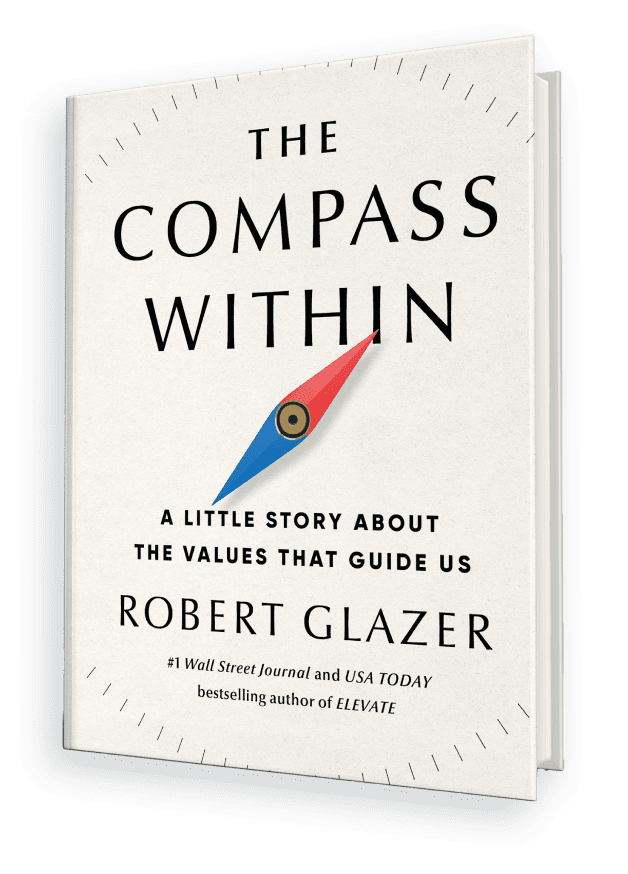
Thrive Global readers can get the companion course to The Compass Within for free if they order a hardcover copy of the book. Learn more.