

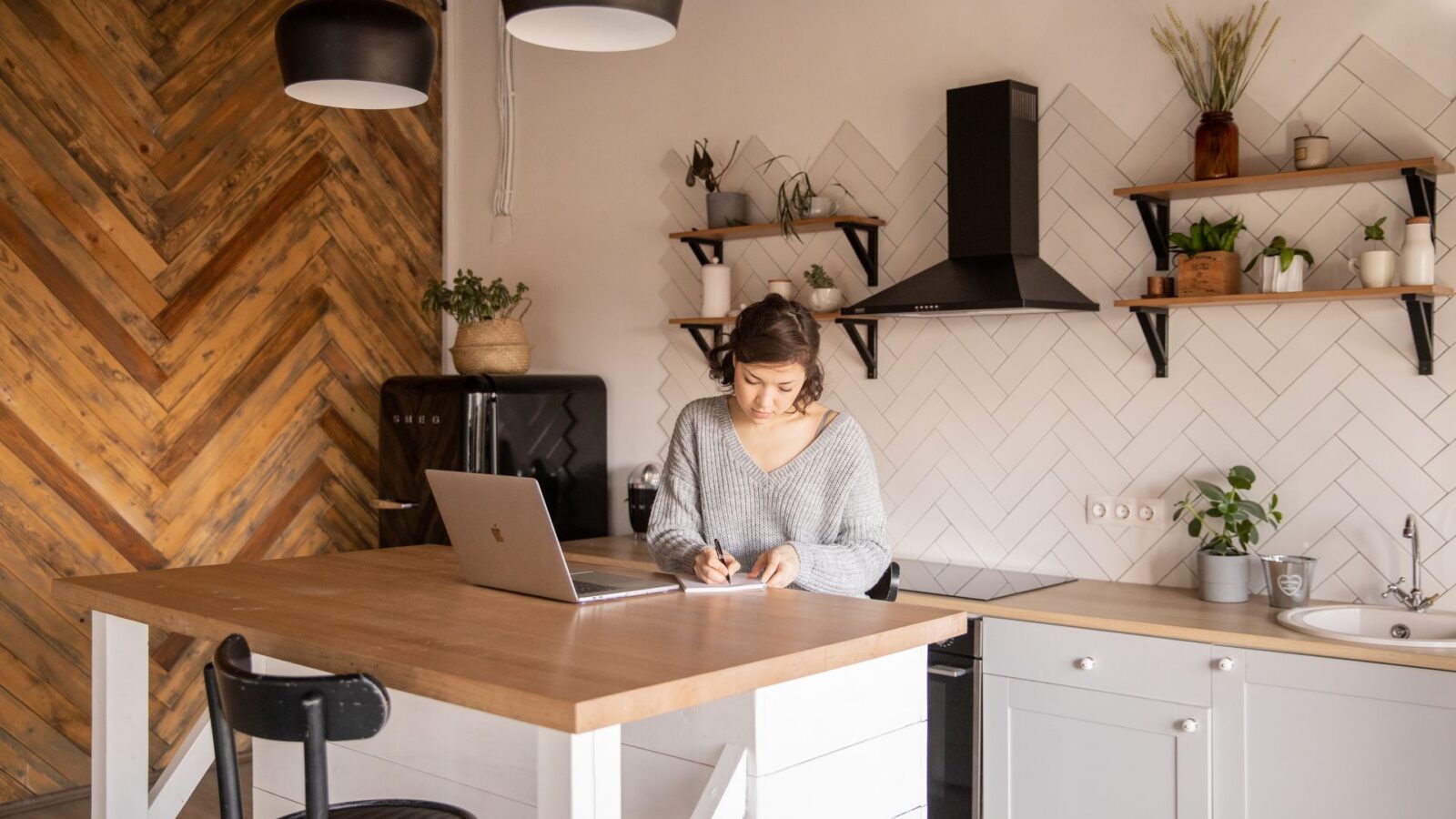
This morning, I ran a standup meeting from the same six inches of counter where I made my lunch an hour earlier. By six tonight, that same surface will hold a cutting board, a stack of mail, and whatever laptop I forgot to put away. If you work hybrid, you already know this rhythm. The kitchen island has quietly become the most-used desk in America, and almost nobody planned for it.
We talk about hybrid work’s challenges as calendar problems: too many meetings, not enough focus time. But for a lot of us, the harder problem is spatial. It’s not that we can’t manage our schedules. It’s that we never got a room of our own, so we borrowed one, and never gave it back.
Hybrid work isn’t a transition phase anymore. As of May 2026, 52% of remote-capable U.S. employees work in a hybrid arrangement, according to Gallup. That’s more than any other work setup, and a share that’s held steady for nearly three years. The setup you improvised in 2020 — laptop propped on cookbooks, phone charger tangled in the fruit bowl — is now permanent infrastructure. Most of us never made a real decision about it. We just kept using what was already there.
That matters more than it sounds like it should. A 2025 review in the Journal of Management pulled together decades of workplace research showing that a room’s layout and design measurably shape attention, satisfaction, and how much control people feel over their day. These findings were drawn mostly from office settings, but the researchers themselves note the same questions are wide open for the home workspaces that hybrid work created. A February 2026 study also found that people worked faster in a decorated room than in a bare one, with no drop in accuracy, even when they weren’t told the room’s look was part of the test. As the researchers put it, people in developed countries spend 90% of their time indoors, reason enough to treat the condition of those spaces as a working condition.
We already accept this logic everywhere but at home. A nicer lobby is a business expense, so why is the room where we actually work still an afterthought?
I don’t think the answer is a bigger house or a dedicated office nobody has room for. But research on remote workers backs up something simpler: Having any consistently designated workspace — even a modest one — measurably softens how much interruptions from family or household distractions erode people’s sense of work-life balance. Scale that down to one person and one counter, and the lesson holds. You don’t need a door to create a boundary. You need something that reliably signals a switch, a ritual that does the door’s job.
Here’s what’s actually helped, and none of it costs much:
- Incorporate a closing ritual. Something as simple as putting the laptop away, wiping the counter, and setting out a placemat works. You need a physical signal that the workspace has become the dinner space again.
- Use a visible ‘off’ object. One person I know flips a small sign over on the counter at 5:30. Nothing fancy. It just makes the switch real instead of assumed.
- Designate ‘protected’ zones. Even one drawer or shelf that’s never allowed to hold work materials keeps a small piece of the kitchen fully off-limits to the job.
- Don’t overlook the surface itself. I’ve noticed more people investing in their counters the way they’d invest in any other piece of daily infrastructure. Recent renovation data shows countertops now top the list of kitchen upgrades homeowners are prioritizing, ahead of backsplashes, sinks, and cabinets. I came across Stone Coat Countertops recently, refinishing kitchen surfaces for exactly this kind of dual-purpose life, and it struck me as a small but telling sign of where this is headed: People are starting to treat the surface itself as part of the job, not just the backdrop to it.
This won’t fix hybrid work’s bigger questions, but it turns an accident into a choice. Your kitchen wasn’t designed to run your workday and your dinner table off the same six feet of counter. It’s been improvised for years now — one corner doing double duty because nobody decided otherwise. Giving that counter, and the kitchen around it, a real boundary instead of a leftover habit might be the smallest, most overdue call most of us have left to make.