

By Amina Zamani
Your Brain on the Creator Economy: What a New Study Reveals About Mental Health
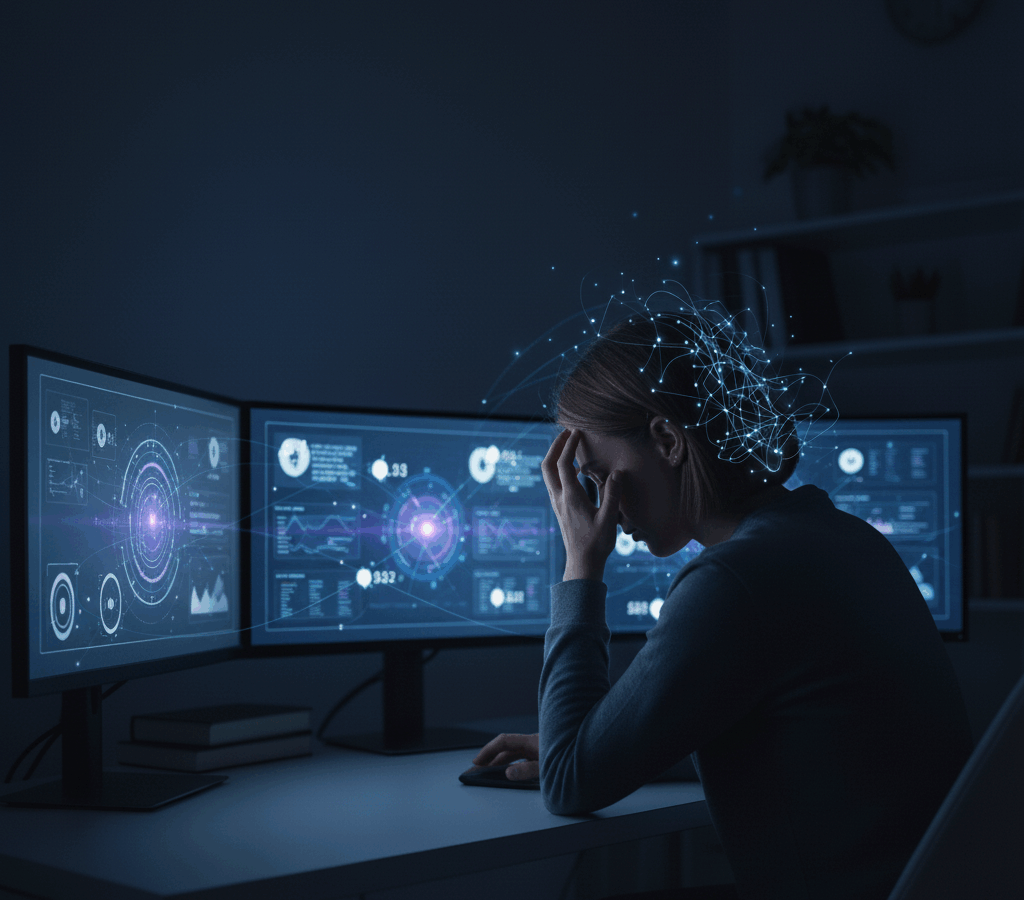
We often talk about “creator burnout,” but rarely do we talk about what is happening in the brain that makes this work so emotionally taxing. A new landmark report — the Content Creator Mental Health Study conducted by Creators for Mental Health with Lupiani Insights & Strategies — surveyed 542 creators and uncovered a profound misalignment between the demands of the creator economy and how the human brain is designed to function.
As a neuroscientist, I see the findings not just as statistics, but as a map of chronic stress activation, emotional dysregulation, and reward-system overload — all conditions known to impair wellbeing.
And as Shira Lazar, founder of Creators for Mental Health, told me:
“Creators are the emotional labor force of the internet — and yet they’re treated like they’re endlessly resilient. They’re not. No one is.” — Shira Lazar
Here’s what the data shows — and what the brain science tells us about it.
1. The Brain Craves Predictability — Algorithms Create the Opposite
The study revealed that 77% of creators frequently experience algorithm changes and 69% experience financial instability.
From a neuroscience perspective, unpredictability is one of the fastest ways to activate the amygdala — the brain’s threat center. When creators rely on algorithmic behavior for income, identity, and worth, they end up living in a near-constant “uncertainty loop.”
Chronic unpredictability triggers:
- elevated cortisol
- impaired problem-solving
- reduced creativity
- sleep disruption
- hypervigilance
As Shira explains:
“When your livelihood depends on an invisible system that can change overnight, it keeps your nervous system switched on all the time.”
This mirrors what researchers see in chronic stress populations — except here, it’s happening at scale, digitally, and silently.
2. Metrics Hijack the Brain’s Reward System
According to the study, 65% of creators obsess over content performance, and 1 in 3 check analytics on every post. These behaviors correlate strongly with negative emotional wellbeing scores.
This is classic dopamine dysregulation.
Social media metrics act like tiny, unpredictable rewards — the same mechanism that drives slot machines. The dopamine system loves novelty and unpredictability, but when pushed too hard:
- baseline dopamine drops
- motivation collapses
- mood becomes unstable
- self-worth becomes externally sourced
Over time, creators develop conditioned reward loops, where their brain ties validation to numbers rather than intrinsic satisfaction.
Or, as one creator said in the study:
“The likes dropped and I immediately questioned everything — even my personality.”
3. Burnout Isn’t Just Emotional — It’s Neurological
The study shows that 62% of creators experience burnout sometimes or often.
But burnout isn’t “being tired.” It’s a neurobiological collapse that involves:
- depleted dopamine and serotonin
- reduced prefrontal cortex activity
- impaired emotional regulation
- memory and attention problems
- inflammation
Creators also report extreme levels of unpaid labor: those with poor mental health scores often work 21+ hours of unpaid labor weekly, compounding stress.
Shira articulated the structural issue:
“Creators aren’t just creating — they’re an entire team in one body. Editor, marketer, accountant, salesperson, on-camera performer. That workload breaks people.”
4. Constant Interaction Without True Connection Creates Isolation
Despite millions of followers, 43% of creators report isolation and 38% report an identity crisis.
The neuroscience is clear:
Digital engagement does not activate the same bonding circuitry as real human interaction.
Parasocial interaction gives the illusion of connection, but without:
- oxytocin release
- co-regulation
- emotional safety
…the brain remains in social deficit. Chronic social deficit is one of the strongest predictors of anxiety and depression.
5. The Most Alarming Data Point: Suicidal Ideation
The study found that 1 in 10 creators experience suicidal thoughts tied to their work, nearly double the rate of the general U.S. adult population.
From a neuroscience lens, this tells us the brain is being taxed beyond its resilience capacity.
This is not a “creator problem.” This is a public mental health issue.
What Creators Say They Need (and the Brain Agrees)
The report highlights exactly what would help regulate the nervous system and reduce long-term burnout. Creators want:
- income stability (66%)
- brand pricing transparency (59%)
- peer support and community (54%)
- creator-specialized therapy (48%)
These are not luxuries — they are interventions that support the prefrontal cortex, emotional regulation, resilience, and physiological safety.
Shira captured it best:
“Creators want to feel safe, supported, and human again. None of that should be too much to ask.”
A Call for Systemic Change
The neuroscience is clear:
The creator economy runs on mechanisms that exhaust the human brain — unpredictability, inconsistent rewards, chronic comparison, public scrutiny, and lack of rest.
If platforms, brands, and the broader industry want creators to thrive, they must:
- stabilize income
- provide transparent systems
- support mental health
- reduce algorithmic volatility
- create communities and care pathways
Because without creators, the internet collapses — and without mental health support, creators collapse first.
About the author
Amina Zamani is a neuroplasticity specialist, executive coach, writer, and global speaker who helps individuals and organizations rewire limiting beliefs, unlock emotional resilience, and step into visionary leadership. Born in Pakistan and raised across cultures, she bridges neuroscience, soul, and systems thinking to catalyze both personal and generational transformation.
Amina has worked with Fortune 500 executives, award-winning creatives, and founders across venture-backed startups. Her upcoming book—rooted in her passion for financial literacy and equity for women—explores the neuroscience and spirituality of money: how early emotional trauma shapes our financial behaviors, beliefs, and capacity to receive. She has been featured on CBS, USA Today, and Lifestyle Magazine, among others. Through her writing, media, and workshops, she champions a future where visibility becomes medicine and belief becomes biology.