
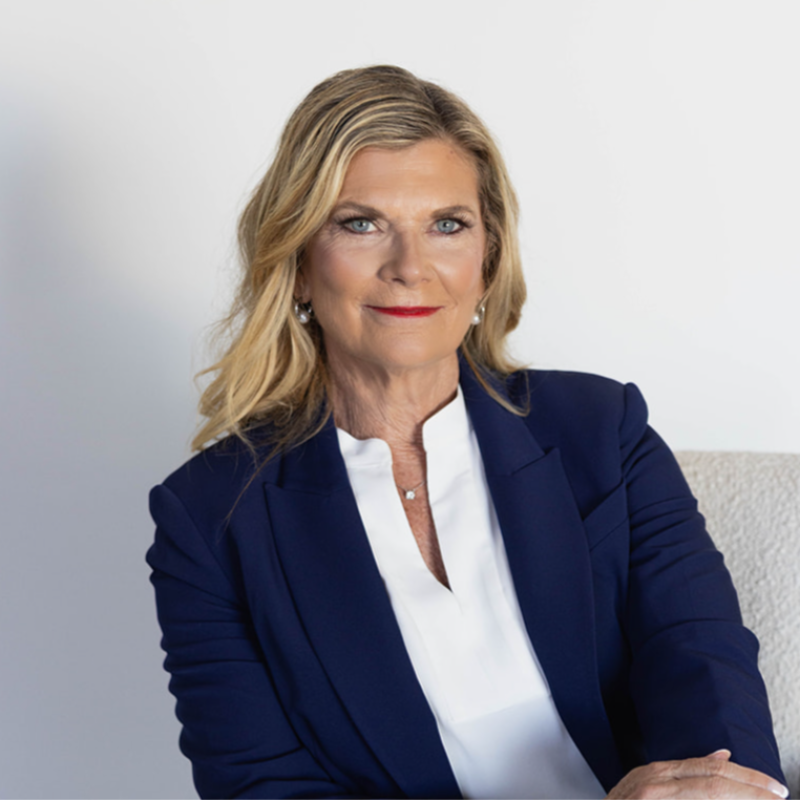

I’ve spent nearly forty years walking into rooms and doing the math before I even sat down. Dress blues in one building, tailored suits in the next, government badges and blazers in another — different sectors, different uniforms, the same identical certainty every time and me, quietly calculating whether anyone else had noticed the visual problem I’d just walked into. I’ve spent most of my career inside large, complex organisations, often in roles where I was responsible for technology, people, and decisions that affected far more than systems or strategy. Over the years, I served as a Chief Information Officer across the Department of Defence, academia, healthcare, and the Fortune 500. In nearly all of them, I was often the only woman in the room. In fact, when I wasn’t the only woman in the room, it usually warranted recognition. Even if it was just eye contact and an invisible high five with the other female soul who was probably just as relieved and refreshed as I was to finally not be in a 100% male-dominated meeting.
What nobody warns you about that kind of solitude is that it doesn’t just cost you loneliness. It costs you a specific, invisible, compounding kind of energy that has nothing to do with the actual job you were hired to do. I’ve come to think of it as a tax. Not one anyone bills you for outright, and not one you can deduct. You just pay it, meeting after meeting, year after year, usually without noticing how much of your day it’s quietly consumed.
Here’s the distinction that took me decades to name. There is the work, and there is the work of managing how you’re perceived while you do the work. Two separate full-time jobs, running in parallel, and only one of them shows up on your calendar.
The actual job was the technology strategy, the P&L, the turnaround, the team. The other job, the one nobody put in my offer letter, was managing how I spoke, how I dressed, how I reacted when someone tested me, how I disagreed without being labelled difficult, how I asserted authority without being called something worse, how I recovered from a bad interaction, and how I kept demonstrating, again and again, that I deserved to be sitting where I was sitting.
That second job is the tax and it’s exhausting in a way that has very little to do with hours worked.
For most of my thirties and forties, I would walk out of a meeting and immediately start replaying it. Was I too strong? Too direct? Too much? I’d lie awake running a mental audit of my tone, my word choice, my facial expressions, like there was a hidden scorecard somewhere determining whether I actually belonged in that room. I filtered myself before I ever opened my mouth. I’d soften a fully-formed opinion into “Maybe we should consider…” or “Have we thought about…” — not because I was uncertain, but because directness from me read differently than directness from the man next to me. I’d watched enough women get labelled “too emotional” or “aggressive” for saying the exact same sentence a male colleague said five minutes earlier to know the standard wasn’t identical, no matter what anyone claimed on paper.
That calibration, done well, so it looks effortless, is genuinely exhausting. It is a second full-time cognitive load layered on top of the actual thinking your job requires. Every ounce of energy spent managing perception is energy that isn’t available for strategy, for creativity, for the work you were actually put in the room to do.
There’s a myth I want to dismantle here, because I think it does real damage: the idea that when a woman is in the room, some standard must have been softened to let her in. In my experience, the opposite was almost always true. No one hands you the seat. You claw your way to it, and then you keep clawing to hold it. That meant showing up more prepared than I needed to be, because a single misstep wouldn’t just be a misstep. It would be treated as evidence, confirmation of whatever quiet doubt already existed about whether I belonged there in the first place. My male peers got to walk into a room and be assumed competent until proven otherwise. I walked in and had to prove competence before I was extended the same assumption. That’s not paranoia. That’s just what it feels like to operate with a different margin for error than the person sitting next to you. The exhausting part isn’t the preparation itself, it’s the belief, quietly carried for years, that you don’t have the luxury of walking in at eighty percent like everyone else does.
Exceptional isn’t a bonus when you’re the only one; for a long time, it feels like the entry fee just to be considered equally competent.
Here’s a version of exhaustion that surprises people: I have spent my career reaching senior levels, and I have still felt my credibility reset to zero the moment I walked into a new room. I remember being told the CIO succession path at a major tech company was essentially mine, only to watch the company hire externally instead. I remember the sting of that, the second-guessing, the temptation to let it define the whole experience. What struck me even more, over the following years in different rooms and different roles, was how often I had to rebuild trust and credibility from scratch, not because my track record disappeared, but because a new room didn’t know it yet, and I couldn’t simply assume it would take my word for it.
I’ve watched male colleagues walk into new rooms carrying their authority with them, assumed capable until something proves otherwise. I’ve walked into new rooms carrying my resume in one hand and my proof in the other, because authority isn’t always assumed on my behalf — it’s something I have to reestablish, room by room, sometimes year after year.
There’s a particular contradiction to being the only woman in the room that I don’t think gets talked about enough: you are, in one sense, the most visible person there. Everyone clocks it. And in another sense, you can be nearly invisible, your idea gets a shrug until a man repeats it back ten minutes later and suddenly it’s brilliant, your objection gets talked over, your name gets left off the recap email. Standing out and being overlooked, at the same time, in the same meeting.
That contradiction alone will drain you because you can’t resolve it with a single strategy. Speaking up more doesn’t fix the being-talked-over problem. Speaking up less doesn’t fix the being-overlooked problem. You’re left constantly recalibrating between two failure modes that have nothing to do with the quality of your thinking.
Then there’s the labor that never appears in anyone’s job description. Reading the room before you speak. Deciding, in real time, whether a comment someone just made is worth calling out or better left alone today. Smoothing tension after someone else created it. Mentoring the younger woman two levels down who just got interrupted for the third time this quarter, because you remember exactly what that felt like and you’re not going to let her think it’s normal. None of these are large decisions on their own. Each one, in isolation, seems manageable. But they accumulate across a single day into a second, unpaid shift, done quietly, constantly, and almost entirely by the same people, usually women, usually without anyone else in the room realizing it happened at all.
This is the part of the tax that took me the longest to admit, even to myself: it doesn’t clock out when the meeting ends. I have driven home replaying an exchange from three hours earlier, rehearsing what I should have said instead. I have lain in bed running the same conversation on a loop, auditing my own tone as if there were a jury still deliberating. The mental load doesn’t stay in the building. It rides home with you, sits at the dinner table with you, and shows up again at four in the morning when you’d rather be asleep.
For many women, ‘home’ isn’t where the tax gets paid off, it’s where the next shift clocks in: school pickup, homework, dinner, an aging parent’s doctor appointments, the household admin nobody sees. Our career model was built around the assumption that someone could work without limit because someone else, unpaid, largely invisible, was handling the rest of life for them. For most of working history, that someone else was expected to be a woman. The difference between rest being possible and rest being theoretical often comes down to one thing: a genuine partner or support network sharing that second shift. Without it, the math simply doesn’t work, no matter how much discipline you bring to it. That’s not a scheduling problem. It’s a structural one, rest and recovery are a function of the support system around you, not just your own resolve. Women without that support don’t fail at managing their exhaustion; they’re absorbing what the system refused to account for.
That’s the piece I most want leaders and honestly, wellness programs to understand. The cost of navigating rooms built around someone else’s norms doesn’t stay contained to business hours, and it doesn’t stay contained to the mental replay either. It bleeds into sleep, into relationships, into the actual second job waiting at home, into the mental bandwidth people need for everything else in their lives. You cannot address this kind of exhaustion with a meditation app if the thing causing it is happening in every 9 a.m. meeting and every 6 p.m. pickup line.
And here is the cruellest twist of the whole system: after doing all of this — the calibration, the over-preparation, the credibility-rebuilding, the invisible shift work, the replaying at 2 a.m. — you’re not supposed to admit any of it costs you anything. Because acknowledging the toll can itself read as evidence that you can’t handle the room. So, you succeed, visibly, and you carry the cost of that success privately, because the two truths aren’t allowed to coexist in most workplace cultures. You’re expected to be resilient, but not tired. Strong, but never depleted. Grateful for the seat, never honest about what it took to keep it.
I spent a long-time glorifying exhaustion as proof of my own commitment, until my body forced the conversation I’d been avoiding, and I ended up on an operating table having open heart surgery. I came out of that surgery with a different understanding: exhaustion is not a badge of honor, and you don’t lose credibility by honoring your limits. You lose credibility by pretending you don’t have any.
I won’t pretend the tax disappeared with age or seniority. But I did get better at recognizing when I was paying it, and more discerning about when it was actually worth paying.
I stopped hedging. I traded “Maybe we should consider…” for “Here’s what I recommend, and here’s why.” I stopped auditing every meeting on the drive home, most nights, anyway. I found allies, men included, who noticed when my idea got credited to someone else and said so out loud, so I didn’t have to be the one to say it every time. I got more comfortable taking up space I used to apologize for occupying. I stopped believing that walking in at eighty percent prepared, like everyone else got to do, made me a fraud.
None of that happened because I found a better coping mechanism. It happened because I got tired of paying for admission to rooms I had already, several times over, earned the right to be in.
Here’s where I want to turn this around, because I don’t think the answer is another article teaching women how to manage the tax more efficiently. Women don’t need a smarter way to carry a second, invisible job. They need workplaces that stop issuing that job in the first place.
If your most talented people are spending part of every day figuring out how to belong in the room, calibrating their tone, overpreparing to offset assumptions, quietly absorbing tension and mentoring and morale, that is energy diverted away from the actual work of creativity, strategy, and leadership. It is not a personal productivity problem. It’s an organizational design problem, and it belongs on the same balance sheet as any other inefficiency a serious leader would fix.
Leaders set the permission structure, whether they mean to or not. If you notice whose ideas get credited and whose get repeated back as someone else’s, say something in the room, in real time. If someone is the only one of their kind at your table, notice it, and don’t make them do the noticing and the explaining. Build advancement paths that don’t require women to prove themselves twice as often for the same trust a man is extended by default. And understand that this isn’t a women’s issue to be handed off to an affinity group, it’s a leadership issue, because who sits at your table shapes every decision that table makes.
I’ve succeeded in a great many rooms where I was the only woman. I’d do it again. But succeeding in those rooms was never free, and I think it’s time we stopped pretending otherwise and stopped treating the silence about that cost as professionalism.
The goal for the next generation of women walking into rooms like the ones I’ve spent my career in shouldn’t be to teach them how to pay the tax more gracefully than I did. The goal should be building workplaces where they never have to open their wallet in the first place.
That room is possible. I’ve seen glimpses of it. But it isn’t going to build itself, and it’s not the job of the women inside it to build it while they’re still the ones paying to get in. That work belongs to the leaders who have a seat at the table today, and to the boards who are ready to support the change. If that’s you, the invitation is straightforward: stop waiting for the room to evolve on its own and start building the one where no one has to pay admission at all.
Lisa Davis is a bestselling author, Fortune 500 executive, and keynote speaker who spent four decades leading in rooms where she was often the only woman at the table. Her book, The Only Woman in the Room: How to Win In A Workplace (Still!) Built For Men, is available now.