
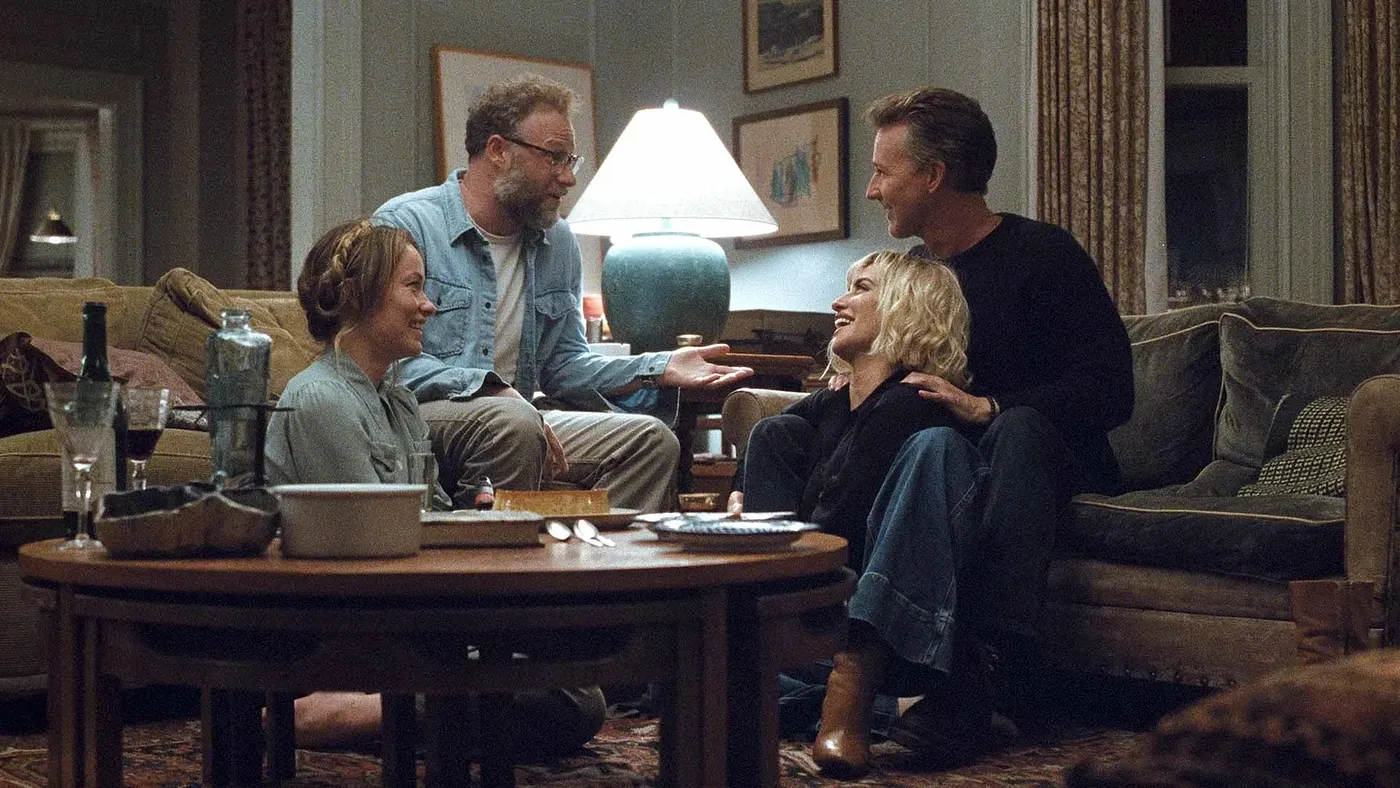
When I go to the movies the first things that I notice are the pacing, the movement of the plot, and the plot twists. Happily, I was not disappointed by Olivia Wilde’s film “The Invite” and its masterful screenplay by Will McCormack and Rashida Jones based on the Spanish film “The People Upstairs” by Cesc Gay.
I lived in France for many years and fell in love with the contained dramas of Yasmina Reza who often takes a somewhat trivial discrepancy and lets it organically explode like a grenade of authenticity spewing hitherto unspoken resentments in all directions. In “Art,” a friend’s mild objection to a buddy’s art purchase functions like a petri dish that releases into the ether decades of envy, aesthetic condescension, and status anxiety. “God of Carnage” runs a similar experiment at a higher temperature: a playground scuffle between two boys, sprinkled by an afternoon of rum, acts like a Bunsen burner slowly distilling the seething anger within two marriages — contempt, disappointment, and the private verdicts each spouse has been withholding from the other for years. Nobody engineers organic authenticity with comic precision like Yasmina Reza.
Or at least that’s what I thought until I saw what Will McCormack and Rashida Jones’ script does with the same recipe, taking brutal honesty to new heights with the help of brilliant acting and, I imagine, some dastardly improv by Penélope Cruz, Edward Norton, Olivia Wilde, and Seth Rogen.
The premise may sound slight on paper — a husband and wife in an atrophied marriage host an impromptu dinner party for their upstairs neighbors — and what unfolds is hysterical authenticity, funnier than anything I’ve heard couples level at each other during 17 years as a marriage counselor. And believe me, I’ve heard things that would make Dave Chappelle blush.
Obviously my esteemed colleague and the film’s consultant Esther Perel has her fingerprints all over the movie, especially Penélope Cruz’s therapist character, who seems to directly channel Esther for the third act. One of Esther’s most practical ideas is that marriages must occasionally be reborn and reincarnated. Unfortunately, the situation often must get worse before it gets better, and that is what “The Invite” is all about — the death of a marriage and its rebirth. Lucky for us, we get to witness the funeral.
Esther stated in “Mating in Captivity” and in her TED talk that as adults we have to choose between security and novelty — or as I heard her rhetorically ask at one conference, “How can you desire what you already have?” In the film, Ed Norton and Penélope Cruz are the rare couple who have found security and novelty in consensual polyamory, swinging, orgies.
As previously discussed in my review of “Obsession,” Denis de Rougemont posited in “L’Amour et l’Occident” that romance was never designed for domestic longevity because the whole myth — from Tristan and Iseult onward — is fueled by external and internal obstacles, interdictions, and prohibitions. Overcoming these obstacles is what many people mistake today for intimacy. Joe and Angela have built themselves a very tidy, domestic life completely devoid of passion. Hawk and Piña show them a path back to the dark side of the moon where unbridled lust exists.
What makes “The Invite” as exhilarating as the almost-real therapy in “Group: The Schopenhauer Effect” is the organic unfolding of disappointment and despair engendered by the institution of marriage itself. What makes this film more than a therapy session is that the confessions, admissions and revelations themselves are as startling and titilating to the audience as they are to Joe and Angela. Four adults sit in a room prompted by nothing more than wine and a slight remark about late-night noise complaints – thereafter Joe and Angela’s egregious curiosity undoes the myths about marriage they’ve been maintaining for years.
Yasmina Reza taught us that the pettiest possible pretexts can get exacerbated into total war… in fact it’s the pettiness that lets people pretend, until the very last second, that they are incapable of saying the unsayable. The dinner (that never actually takes place) was never about the neighbors’ sex noises. It was, like every good funeral, an excuse to finally say what nobody had been willing to say while the interred was above ground.
“The Invite” is an incisive and insightful physical and psychological comedy performed by four gifted actors, all of whom shine under Olivia Wilde’s provocative direction. I’m certain that Esther laughed as hard as I did.