
A quiet revolution is underway.
It’s happening in leadership.
The command-and-control style that once defined effective leadership is losing its grip, not because it failed in the past, but because it no longer fits the world we live in. The pace of change, the complexity of our problems, and the diversity of our workplaces demand a different kind of power—not rooted in authority but in collaboration.
Yet many leaders continue to rely on a playbook written for another era.
For decades, organizations celebrated the “hero” leaders. They were a decisive strategist, a charismatic visionary who expected others to implement. This model assumed leadership belonged to the smartest person in the room – the individual expected to have the answers and the authority to direct everyone else. The CEO’s role was to gather information, analyze the situation, and determine the best course of action.
That approach worked in a world where problems were more predictable and information moved more slowly.
Today’s challenges are different. They are multidimensional, muddled, interconnected, and continually evolving. They require multiple people with different kinds of expertise and the ability to work together to create novel solutions. No one can possibly “know it all.”
Leadership rooted in control simply can’t keep up. Command-and-control leaders tend to respond to volatility with rigidity, to uncertainty with defensiveness, and to complexity with oversimplification. Ironically in trying to gain control they “tighten the reins” and lose their grip. Decisions slow to a crawl, information stops flowing, and innovation stalls. Their organization becomes less adaptable just when it is most critical.
Collaborative leaders respond differently. They replace certainty with intellectual curiosity, rigidity with flexibility, and individual know-how with shared intelligence. They distribute power rather than hoard it, speed up problem-solving, and strengthen resilience across the organization.
Companies led by leaders who emphasize participation, inclusion, and shared accountability—characteristics of collaborative leadership—outperform those that rely on top-down management. Research by McKinsey and others consistently shows that companies embracing collaborative leadership surpass their peers and experience greater innovation, higher employee engagement, and long-term profitability.
One of the clearest examples of this shift to collaborative leadership is when Satya Nadella became CEO of Microsoft. He faced a legacy organization that prized competitiveness internally as well as externally, was functionally siloed and had an identity as a “know-it-all” culture. Rather than making every critical decision himself, Nadella changed the way decisions were made.
He brought together cross-functional “response teams” from engineering, HR, supply chain, and customer success to solve problems together. Information flowed faster and decisions happened closer to the work. During the pandemic, Microsoft scaled its cloud capacity by 700 percent, while rapidly expanding “Teams” to support a world that suddenly was working remotely.
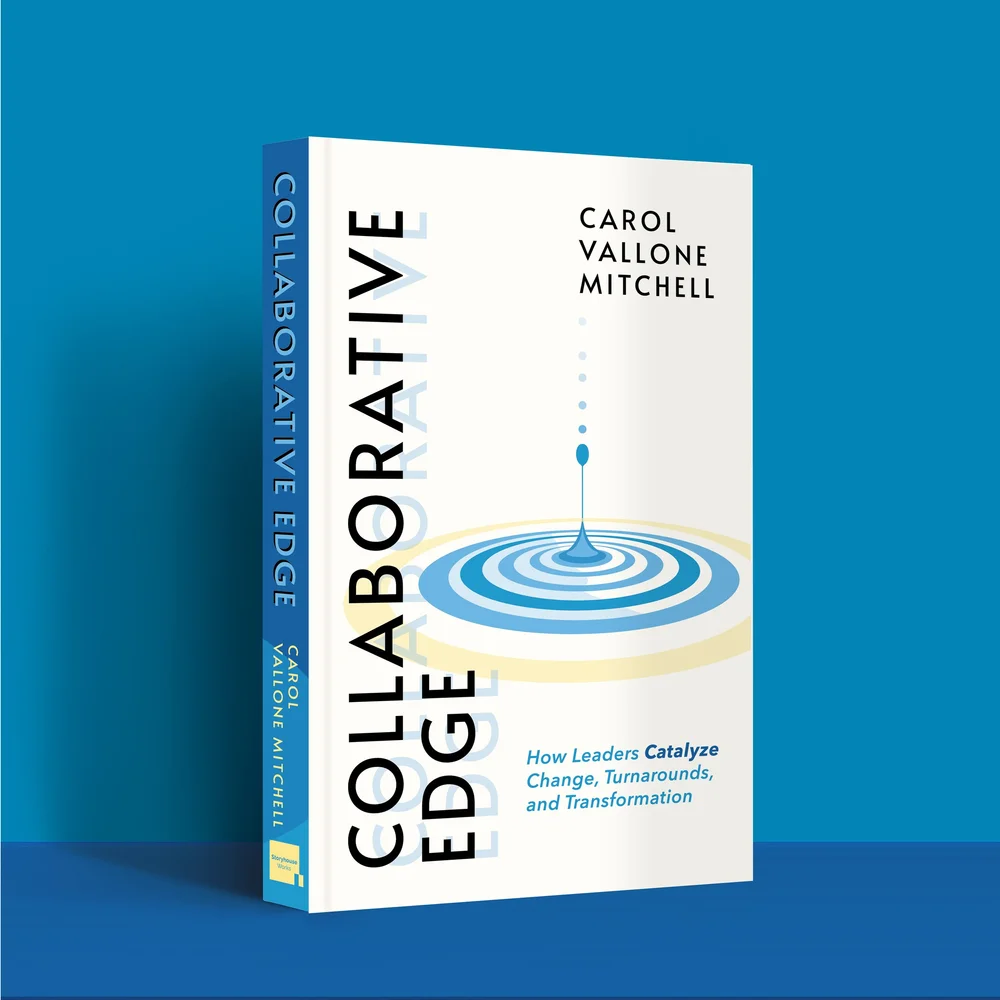
Over the past twenty-five years, I found the same three capabilities that transformational leaders share. It is a pattern that I eventually organized into a framework I call Collaborative Edge. In essence, I discovered that leadership excellence isn’t rooted in authority. It’s rooted in the ability to perceive more clearly, include more broadly and unlock collective intelligence.
But another pattern emerged – one I hadn’t expected!
The leaders who demonstrated these collaborative behaviors most consistently were executive women. For years, many of these same behaviors were dismissed as “soft.” They were undervalued, viewed as interpersonal strengths rather than leadership strengths. Today they have become the hardest leadership qualities to replicate. The leadership traits once underestimated have become the very qualities that organizations need most.
Leadership itself has evolved.
Not because of a fundamental change in human nature. It is because the problems we ask leaders to solve have changed.
This shift is also being accelerated by a new generation of employees.
Millennials and Gen Zer’s now make up more than half of the global workforce and they view leadership through a radically different lens than their predecessors. They are more diverse and live in a constantly connected world where influence is horizontal, not vertical. They have been exposed to different lifestyles and viewpoints, and as a result, they have a higher propensity to see the world through someone else’s eyes. They expect to contribute rather than comply. They value authenticity over status. They want purpose over position, flexibility and inclusion over hierarchy. Collaborative leadership aligns naturally with these expectations.
The leaders who thrive in the years ahead will understand that collaboration is not the opposite of power—it’s an evolution of it. They won’t measure leadership by the authority they hold, but by how much capacity they unlock in others.
The future belongs to leaders who don’t simply direct change.
They catalyze it.