

At 7:30 am we slip from the mud-brick embrace of Khiva, a walled caravan city in Uzbekistan’s far west where slave markets once did brisk trade and where, legend says, Shem, son of Noah, dug the first well. Ninety minutes later we reach the Turkmenistan border, expecting another painless crossing. Over the last two weeks our group of ten Silk Road seekers has threaded in and out of Kazakhstan, Tajikistan, Kyrgyzstan and Uzbekistan with barely a stamp-thump of friction.
But this is Turkmenistan. Things are different here.
At the approach to the Immigration Hall stands a locked gate with a queue of some 30 wilted travelers before it. I ask why it is shut. A man at the front shrugs and says the authorities are “pacing” the numbers, allowing people inside in carefully controlled batches, like cattle into a chute. Two cycles pass before the gate yawns open for us. Then we join another queue at the portico, and broil for an hour under a sun that seems to have a personal grudge. At last, we are admitted into a room even hotter than the outdoors, spacious as a sardine can, 6,000 pounds of passport holders stuffed into a 3,000-pound bag.
In a side chamber a couple in medical whites wave everyone in for a $35 “Advanced Covid Test.” It is a three-second nasal swab with no results, ever. Turkmenistan has, officially, never had a single case of Covid. Early in the pandemic the word “coronavirus” itself reportedly became unwelcome in state media, as though the virus might be defeated by refusing to name it. Yet here we are, years later, paying to be tested for a disease that does not exist in a country that does not acknowledge it. Add the $85 visa fee, and one begins to suspect the reclusive republic is less worried about microbes than about cash flow.
Once duly swabbed, we surrender our passports, which vanish into a back room. Another hour passes in this sudorific holding pen. Several in our group announce this is not worth it and they’d like to go back to Khiva. A fine idea, except our passports are now hostages, and there is no going back. You can check out, but you can never leave. Kafka, meet Turkmenistan.
By hour two, the crowd’s patience has evaporated faster than sweat. Shouting starts, then shoving. Officials bark and shove back, and the hall has the pre-brawl electricity of a frontier saloon. “Why is this happening?” I ask the air. Someone answers: it’s Independence Day. Most of the staff are on holiday, leaving a skeleton crew to process the flood. Then one of our group, a woman in her eighties, slumps as though about to faint. I push to the front and bellow, “We have an ill woman. You need to let her through now. She could die in here.” It works. They let her through, and then, one by one, the rest of us.
Outside, we have the privilege to pay $1 each for an old school bus to transport us across the no-man’s-land between the borders. It takes thirty minutes to appear and fifteen more to trundle to the final gate. Four hours of torment and fees have purchased the right to cross an imaginary line in the desert to arrive in Turkmenistan.
The day, however, is not finished with us. Five spanking-white Toyota Land Cruisers await. We climb aboard for a five-hour drive over roads distinguished mainly by the quality of their ruts, across the Karakum Desert to Darvaza, the gas crater known as the Gates of Hell, a blackened wound in the earth illuminated by flickering orange flames.
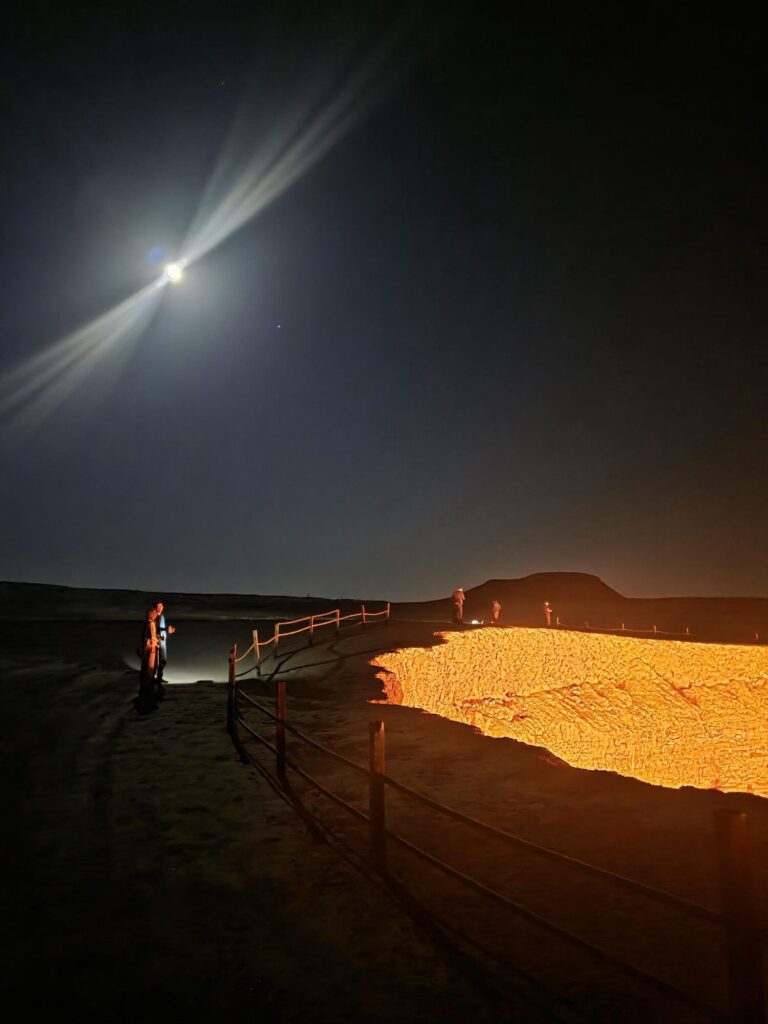
Gates of Hell, Turkmenistan. Photo by Richard Bangs
The story goes that in 1971 Soviet drillers punched into a pocket of natural gas, the ground collapsed, and engineers set the methane alight, expecting it to burn off in a few weeks. History is murkier than the legend, but the fire is still burning over half a century later. In 2022 President Gurbanguly Berdimuhamedov went on television and ordered the flames extinguished. Hell, apparently, did not get the memo, though it has since dimmed considerably. Today the pit, about the size of a theater in the round, is pocked with fewer and smaller fires than in its glory days. Still, it is a sight, and we each get our fifteen minutes of flame.
At a late dinner at the nearby yurt camp, the consensus is that ten and a half tortuous hours is a steep cover charge for a campfire, even a unique geological one. Nobody mentions the four-hour drive to Ashgabat, capital of Turkmenistan, waiting for us in the morning.
That drive is an extreme Swedish full-body massage across the Karakum, until at last the potholes surrender to a wide paved road that pours into the capital. At the city limits our Land Cruisers slow to a crawl. Speed laws here are strict, our guide explains. Cameras are everywhere, fines arrive by text message, and failure to pay promptly may come with a side of jail.
Then, as we near the center, eyes widen.
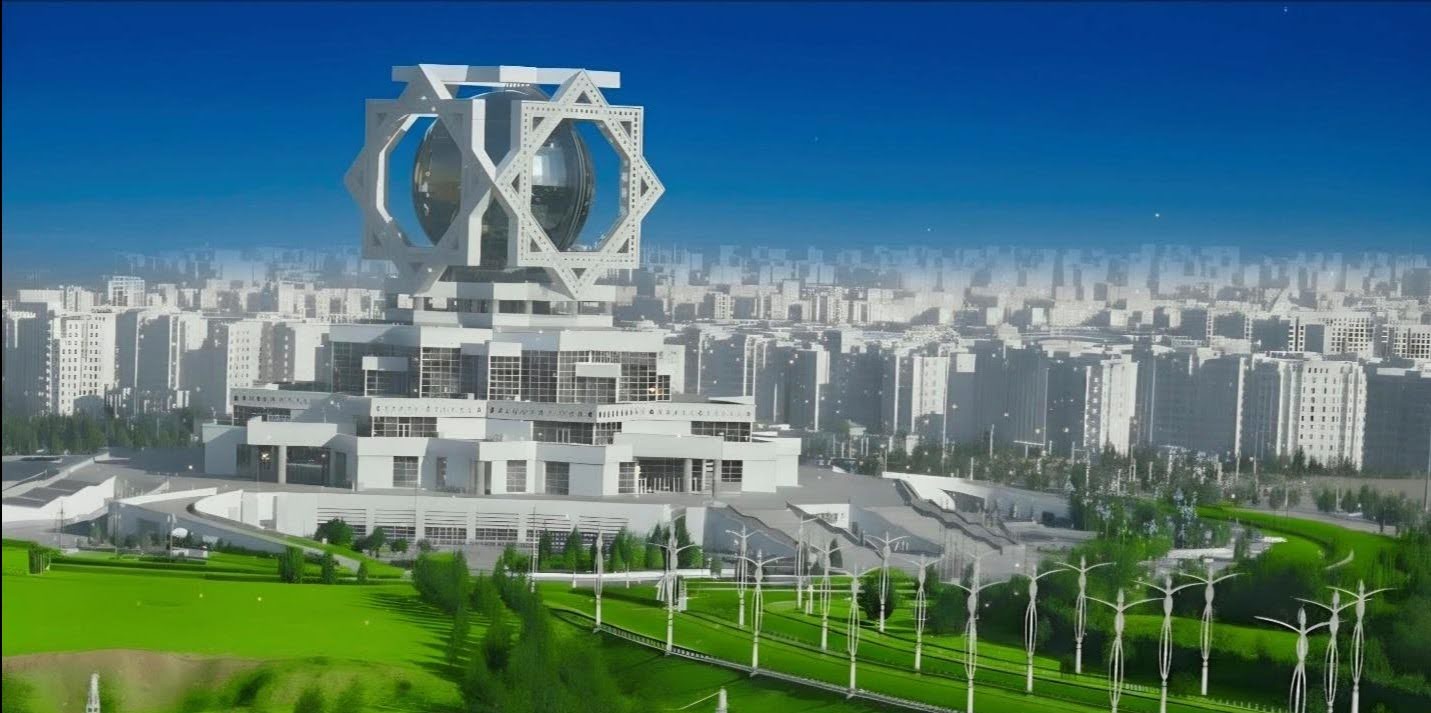
A dazzling white apparition rises from the desert — a marmoreal mirage. We are entering an achromatic Oz. The boulevards are broad and spotless as airport runways, and nearly empty. No motorbikes, no scooters. No one walks the sidewalks or the parks. There are no shoppers, no street vendors, no homeless. No apparent signs of commerce, recreation, or spontaneous human existence. The official census puts the population at over a million, a figure, I am told, widely doubted and possibly double the truth. Instead, there are forests of towers clad in white Carrara marble: apartment blocks and offices gleaming like enormous wedding cakes, palatial ministries, and glaring monuments punctuating intersections. Ashgabat seems a city designed to be admired, not used.
Guinness certified Ashgabat as having the world’s greatest density of white marble buildings, more than 500 of them. It also holds titles for the most fountain pools in a public place, the largest architectural star (on the television tower), and the largest handwoven carpet. The city collects records.
The few cars we see are white too. Cars of color are banned, our guide says. If a vehicle of an unfortunate hue arrives at the border, it is swapped out or painted on the spot. Even the lampposts are white. Ashgabat may be the only city on earth that worships the spiritual benefits of monochrome.
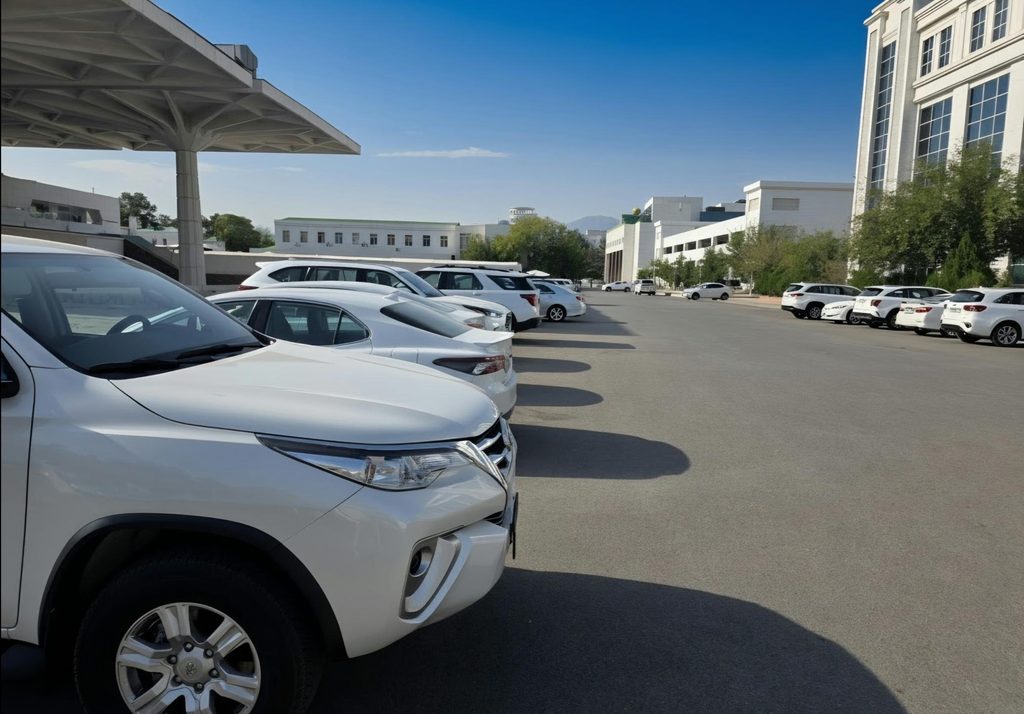
All cars are white. Photo by Richard Bangs
The backstory is a tragedy. In 1948 a magnitude-7.3 earthquake leveled the city and killed, by many estimates, two-thirds or more of its people. Among the dead were the mother and brothers of a young boy named Saparmurat Niyazov. The West barely heard of it. Moscow buried bad news as efficiently as the earthquake buried Ashgabat. The city was rebuilt in drab Soviet concrete. After independence in 1991, the orphan boy, now president, decided to raise it again, this time in marble, funded by the world’s fourth-largest natural gas reserves.
There is a cultural logic to it. In Turkmen, ak, white, is the color of purity, good fortune and honor. Travelers are wished ak ýol, “a white road,” a safe journey. The regime presents the White City as the emblem of a blessed nation.
Some compare Turkmenistan to North Korea. Having spent time in Pyongyang, I can report that color, at least, is not a shared quality. Pyongyang is a kaleidoscope. Ashgabat is bleach.
As we glide toward the Ýyldyz Hotel, our five-star perch for the night, our guide lays out the four commandments for visitors:
- No smoking. All our drivers smoke, and every eatery has ashtrays. The right hand not knowing what the right hand is doing.
- No jaywalking. Cars rule the eight-lane boulevards.
- No photographs of government buildings, bridges, the airport, soldiers or police. In a city made almost entirely of government buildings, this narrows the frame considerably.
- No foreign currency. Every other Stan embraced the US dollar with alacrity. Here it is forbidden. Payments are in manat only, exchanged at select banks or through guides. There are no ATMs, and credit cards are not accepted, a policy whose upside escapes me. There is no cell service compatible with our phones and little Wi-Fi outside the hotel and a few fine restaurants, and that Wi-Fi sits behind one of the most heavily censored internets on the planet. So, I cannot tip the guides with Venmo.
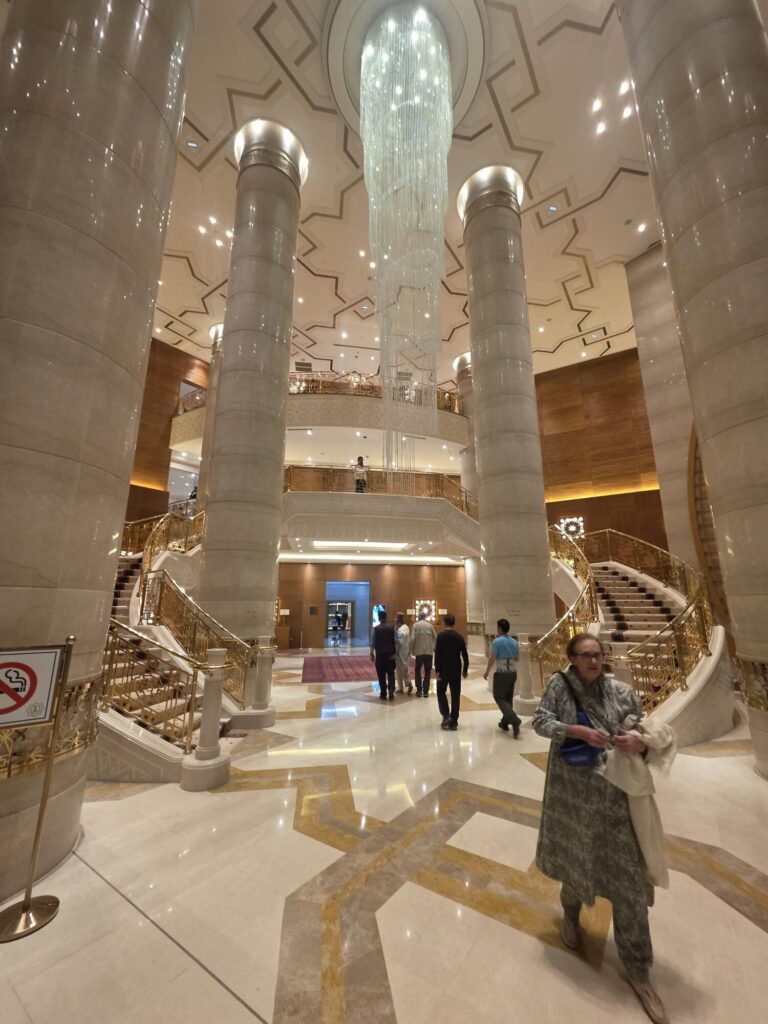
The Ýyldyz Hotel lobby. Photo by Richard Bangs
The Ýyldyz is shaped like a giant gas flame flaring over the skyline, with a lobby that soars like an iwan, the monumental, vaulted entrance familiar from Persian and Central Asian architecture. We confirm the bad news (no cards, no dollars, no signal) and head out to explore.
First comes the National Museum of Turkmenistan, propped on Greek columns and crowned with two gold-winged horses beneath a blue onion dome. Inside, a state-of-the-art collection runs from prehistory through the Parthians and the Middle Ages to modern times. Out front stands a 436-foot flagpole, briefly the tallest in the world, with a turbo-powered wind machine at the top to keep the flag waving during important events.
Entry is free, but there is a fee to take photographs. For so rich a realm, the photo toll, like the Covid swab, seems a touch miserly.
The exhibits are stunning. What we notice most, though, is that we are the only patrons. Young women in long national dress stand every few yards, watching our every movement.
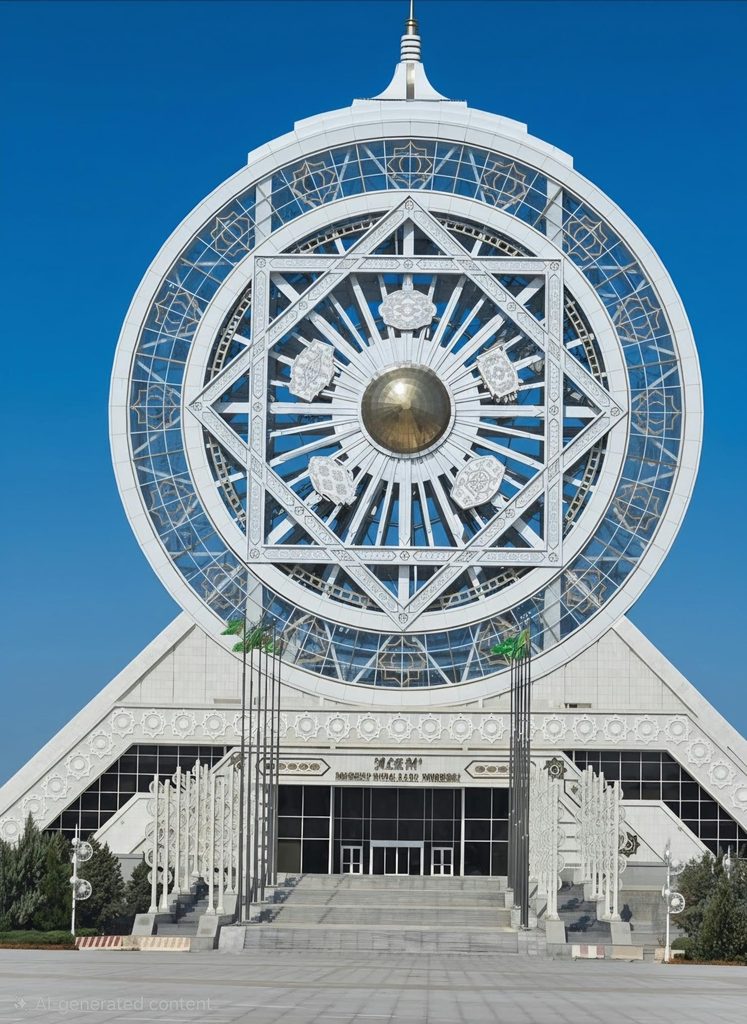
Next is the Alem Cultural Center, home to the world’s largest indoor Ferris wheel, some 187 feet across, sealed inside a white building like a ship in a bottle. A Ferris wheel is an instrument of communal pleasure. It exists to lift people into the air, allow them to gaze upon their surroundings, and return them safely to the ground with the mild exhilaration of having briefly escaped gravity.
This wheel is not turning, and it is empty. Where is everyone?
Then there is the “Walk of Health,” a concrete pathway snaking some 22 miles up into the Kopet Dag foothills, butting the Iran border. Niyazov built it after his German doctor diagnosed health issues, and recommended he quit smoking and exercise. So, Niyazov banned smoking in-country, and decreed that government ministers hike the path annually. He did not join them; he flew to the finish by helicopter. Not long after he died, at age 66 in 2006, officially, though never verified, by cardiac arrest.
Back at the hotel we gather on the top floor for drinks (which cannot be charged to the room and must be paid in manat on the spot) and for the view. Below us the boulevards are empty, the city sparkling like Las Vegas with Bellagio-style fountains dancing for nobody, in a country more than 80 percent desert.
The name Ashgabat comes from Persian: eshq, “love,” plus ābād, “city.” So, the name is usually translated as “City of Love.” One of our group, looking out the 19th-floor window, says it looks like the aftermath of a neutron bomb, the weapon designed to kill people and leave buildings and infrastructure standing. The barkeep, overhearing, says the locals have their own name for it: “City of the Dead.”
At 11 pm sharp he kills the music. Music after eleven, he says, is not allowed. Then, warming to his subject, he recites a partial list of things banned at various points since independence: lip-syncing, gold teeth, ballet, opera, long hair and beards on men. Niyazov also shut hospitals outside the capital, reasoning that the sick could come to Ashgabat, and closed rural libraries on the theory that villagers don’t read.
He renamed the months of the year. January became Turkmenbashi, his self-awarded title, “Father of All Turkmen.” April became Gurbansoltan, after his mother. For good measure, he renamed the word for “bread” after her too. For years a 40-foot gilded statue of the Father of All Turkmen rotated atop the Neutrality Arch so that it always faced the sun, which presumably needed the guidance. His successors have since moved it to the outskirts, where it still shines.
Niyazov also wrote a book, the Ruhnama, the “Book of the Soul,” a stew of moral instruction, revisionist history and poetry. He made it mandatory reading in schools, universities and government offices, and driving tests included questions on it. He had it translated into dozens of languages and once declared that anyone who read it three times would go straight to heaven. In 2005 a copy was launched into orbit aboard a Russian rocket, in case the cosmos needs guidance too.
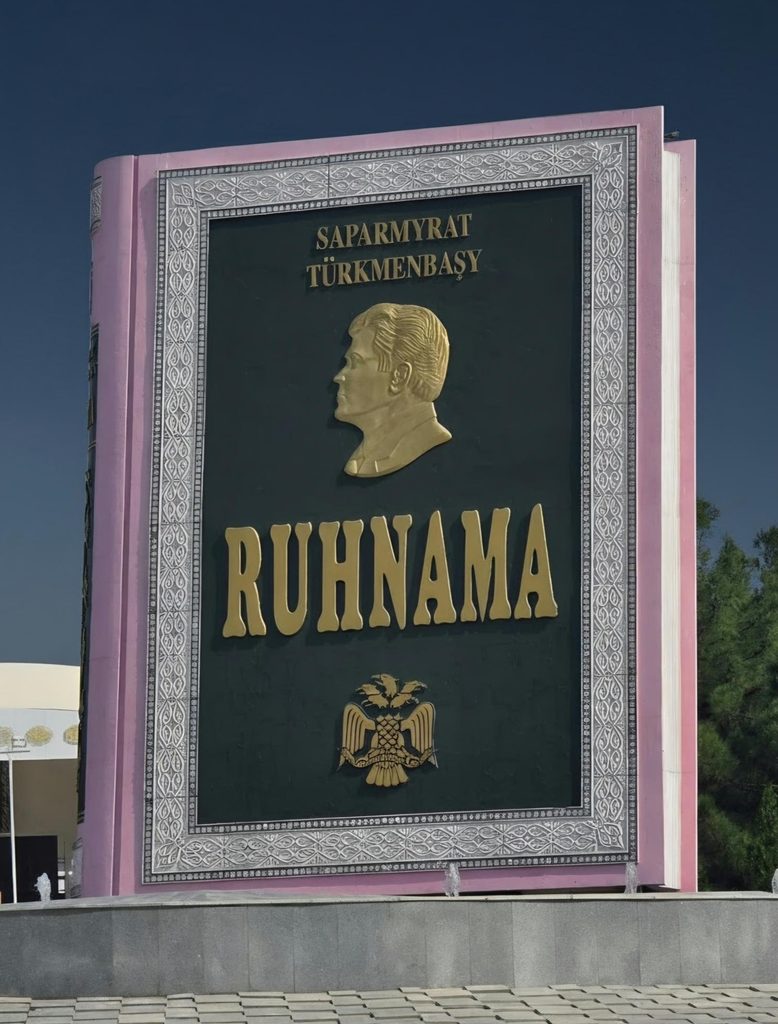
The Book of the Soul. Photo by Richard Bangs
We pass the state publishing house, shaped like a half-open book, then stop at the Ruhnama Monument, a giant book sculpture whose covers once swung open each evening to project passages onto the night. The mechanism broke. Nobody fixed it. The Book of the Soul now keeps its own counsel.
The wonders keep coming. At the Carpet Museum hangs the world’s largest handwoven carpet, about 3,200 square feet. The Foreign Ministry wears a giant globe on its head. The Central Bank is built to look like a gold bar, and a dentistry center like a bleached molar. In Ashgabat, architecture is not a language so much as a game of charades.
Niyazov’s successor, Gurbanguly Berdimuhamedov, a former dentist who styled himself Arkadag, “the Protector,” did not abandon the tradition. He simply redirected it. He immortalized himself with a 70-foot monument: a gold-leafed figure of himself astride an Akhal-Teke stallion atop a white marble cliff. He released rap songs (one recorded with his grandson) and spun as a DJ on state television. In 2020 he unveiled a gilded statue of the Alabai, the Turkmen shepherd dog, roughly fifty feet tall with its pedestal, presiding over a roundabout. He then decreed a national holiday for the breed. In 2022 he handed the presidency to his son, Serdar, and stepped back to the role of national elder.
On our final night I ask our guide, quietly, why the city feels so deserted. Perhaps at some risk, he answers candidly.
The marble center, he says, was built to be looked at, not lived in. It is a stage set of ministries, monuments, fountains and parks, and the older, denser neighborhoods were bulldozed to make room for it. Real life happens elsewhere: in the Soviet-era districts and in the sprawling bazaars on the edge of town, where you will find the crowds. The boulevards are for motorcades. There isn’t a single pedestrian-activated crossing in the whole city.
And people keep a low profile. Police, uniformed and plainclothes, are everywhere. “People are afraid of walking in the streets,” he says. “Lingering in the showcase zone gains you nothing and could cost you something.”
The museums, he adds, are for official delegations and the trickle of foreign tourists, perhaps ten thousand a year, fewer than visit Disneyland on a slow Tuesday. The grand mosques, like the Gypjak mosque beside Niyazov’s mausoleum, are monuments as much as houses of worship. They fill for Friday prayers and state occasions. The neighborhood mosques are where the faithful go.
So, the Twilight Zone mystery is deciphered, perhaps. The city reveals itself as a kind of Potemkin metropolis, a place constructed to impress the visitor while keeping the messier realities of daily life safely out of sight. But a city requires more than marble. It requires the untidy business of human beings: people walking somewhere for no particular reason, sitting in cafés, arguing over prices, making mistakes, falling in love, missing buses, buying things they don’t need, and occasionally jaywalking.
It requires life.
The next morning, I head to the airport, the terminal a giant white falcon frozen mid-flight. I am a bit nervous, for several reasons. We are a stone’s throw from the Iranian border, though our flight path wisely takes the long way around. And I know too well how plans at airports can unravel. If there is a cancellation, there is no way to call my travel agent, a colleague or a loved one. I cannot buy a new ticket with a credit card. And I am out of manat, having been warned the currency cannot be exchanged anywhere beyond these borders. I am, for the length of a boarding call, a man without a country, a currency or a connection.
But, as more often than not, I make the flight. Four hours later I am in Dubai, which has its own appetite for the world’s tallest and largest, but where the cars come in every color, the credit cards work, and the people are out walking the streets. It has Noise. Hassles. Hustles. Movement. And the ordinary human clutter that makes a place feel inhabited and alive.
Another world altogether.
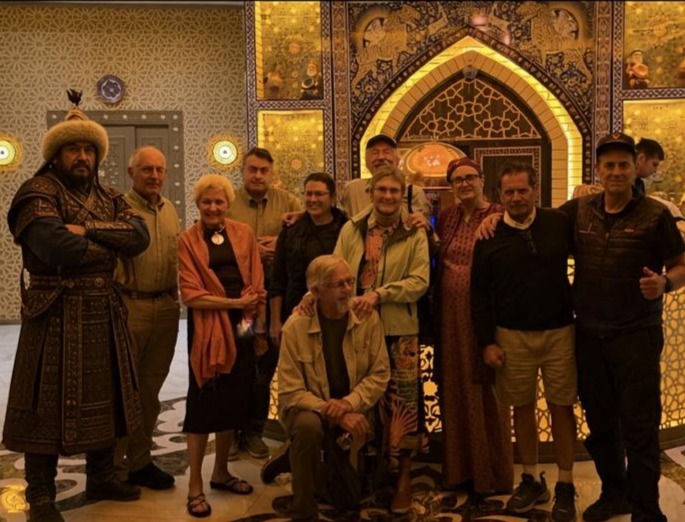
Final night dinner in Ashgabat, Chayhana Restaurant. Photo by Richard Bangs
##