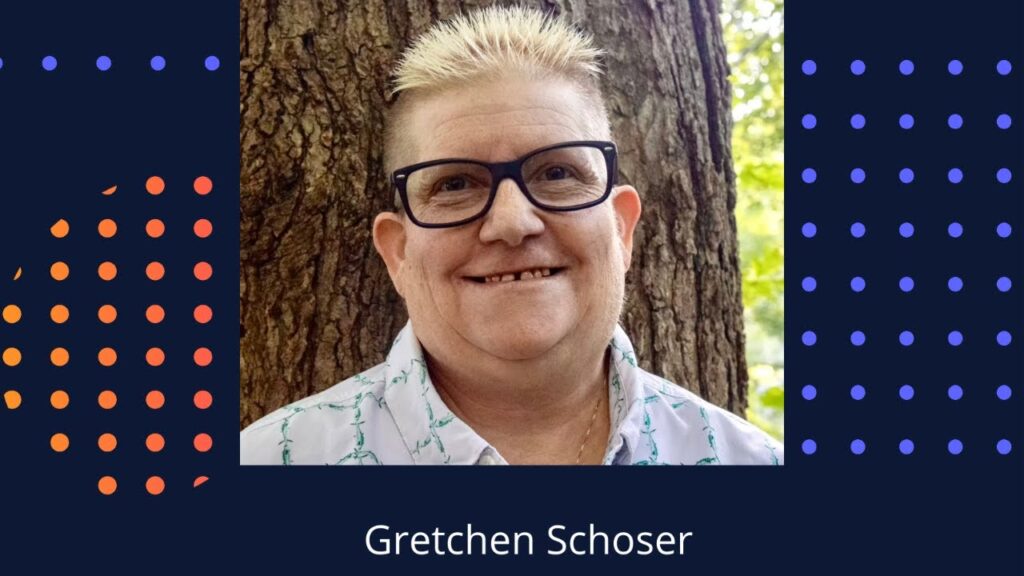

Vulnerability isn’t weakness; it’s the doorway to every honest conversation that saves a life—including my own.
– Gretchen Schoser
Gretchen Schoser has worn many hats — corporate HR technologist, empath, wife, accidental comedian — but none more impactful than mental-health trailblazer. After a relentless string of setbacks in 2022 pushed her to the brink, a single call to 988 became her lifeline and turning point. Instead of hiding the experience, Gretchen harnessed it — launching the award-winning podcast “Sh!t That Goes On In Our Heads,” co-hosting raw, laughter-laced conversations with survivors and experts, and founding Schoser Talent & Wellness Solutions to help organizations weave genuine well-being into their culture. Her story proves that hope can be engineered, boundaries can be learned, and humor can be as healing as any prescription.
In today’s candid interview, host Stacey Chillemi digs into the moments that shaped Gretchen’s mission: the negative 22°F Christmas that nearly ended her life, the 90-minute crisis-line call that rewired her future, and the million-download movement that followed. Expect hard-won insights on setting compassionate boundaries, building workplace resilience, and using laughter as a biochemical power tool — served with Gretchen’s signature blend of professional savvy and down-to-earth warmth. Whether you’re battling burnout yourself or leading a team through turbulent times, Gretchen’s journey offers a roadmap from breakdown to breakthrough — and a reminder that the world is better with you in it.
Thank you so much for joining us! Our readers would love to get to know you a bit better. Can you tell us a bit about your backstory?
I’m delighted to be here, Stacey. Picture a high-energy people person who thrived on solving problems and cheering on colleagues for 45 years in corporate HR tech. In 2022, that steady rhythm shattered. Within weeks, I was offered “early retirement,” my wife was incapacitated with shingles, I totaled my car hitting a deer, got catfished out of thousands, and lost two close family friends. The hits kept coming, and because I’d always been “the strong one,” I felt obligated to power through with a smile. Instead, the weight of everyone else’s needs plus my own grief pushed me into a silent freefall I never saw coming.
What made that cascade of events uniquely hard for you as an empath?
Empaths process emotion like surround-sound — everything is louder and closer. When my wife cried from shingles pain, my body ached too. When colleagues feared layoffs, I carried their anxiety. Layer that on top of personal tragedies, and it’s like adding bricks to an already-overloaded backpack. I kept thinking, “Others have it worse — who am I to complain?” That self-silencing amplified my distress until it felt as though a fog had swallowed every piece of joy.
Take us to Christmas Day 2022 — the moment everything came to a head.
It was –22°F in upstate New York, the kind of cold that stings your lungs. I planned a final drive to clear my head before ending my life, but the car wouldn’t start. That tiny inconvenience cracked the dam: I stomped inside, bottle of pills in hand, absolutely convinced the universe was mocking me. Then the smallest spark — call it faith, intuition, or sheer survival instinct — whispered, “Dial 988.” My hands trembled so badly I hit the wrong number twice. When the counselor answered, her voice was steady and warm, like someone handing me a blanket after I’d been in a blizzard. Ninety minutes later, I hadn’t solved a single problem, but I could finally breathe.
What did that crisis counselor do that shifted your perspective?
First, she slowed my spiraling thoughts with grounding questions: “Where are you sitting? What can you see in front of you?” Then she named emotions I couldn’t: disenfranchised grief, burnout, moral injury. Hearing clinical words for my chaos validated that I wasn’t “weak” — I was injured. She mapped next steps: schedule therapy, tell one trusted person tonight, and jot down three reasons to stay alive, even if they seemed trivial. By the call’s end, I felt like someone had flicked on a porch light after stumbling in the dark.
You later shared your story on social media. How did that help your recovery?
Pressing “publish” on that post was scarier than the 988 call. I wrote, “I almost took my life yesterday.” Within hours, 200 messages rolled in: old coworkers, distant cousins, complete strangers. People said my honesty yanked them back from their ledge. Their stories created a feedback loop of hope — I gave them courage, they gave it back. That exchange reframed my ordeal from personal failure to shared human experience. It also anchored a daily accountability practice: if I wanted others to keep fighting, I had to model it myself.
Humor is woven through your journey. Why is laughter such a powerful tool?
Biochemically, laughter lowers cortisol and boosts serotonin and endorphins, but beyond the science, it’s a bridge back to normalcy. When Dirty Skittles phoned me just to recount some absurd TikTok raccoon clip, for thirty seconds I remembered what unburdened joy felt like. Humor doesn’t erase trauma; it creates micro-breaks so your nervous system can reset. Think of it as emotional interval training: sprint through the hard feelings, then rest with laughter so you can sprint again when life demands it.
How did that friendship blossom into the podcast Goes On Our Heads?
Our “laugh-therapy” calls were so cathartic that one day she blurted, “Let’s record this chaos!” We hit “publish” on Valentine’s Day 2023 to reclaim a date that once symbolized grief (my mother’s burial). The premise was radical transparency: no scripted questions, no polished personas — just real talk about mental health. Listeners sensed the authenticity and flocked to it. By April, 10k downloads; by December 2024, one million and two industry awards. The real victory is the weekly inbox full of “Your show kept me alive last night” notes.
You faced another depressive dip in late 2024. What lesson did Round Two teach you?
Depression isn’t a one-and-done villain; it’s more like seasonal allergies — manage, don’t ignore. I joined a boutique consulting firm that got swallowed by a Big 5 giant. Corporate red tape reignited my burnout. This time, I announced on LinkedIn, “I have permanent resting-bitch-face and I’m not okay.” The response was overwhelming: daily check-ins from colleagues, coffee gift cards from podcast listeners, and permission from my wife to quit. Transparency transformed what could’ve been a silent relapse into a community-supported pivot.
Boundaries were pivotal for you. How can readers start setting them?
Begin with micro-boundaries: mute Slack after 8 p.m., decline one favor that drains you, or take a 10-minute phone-free walk. Once you taste the relief, graduate to “bigger no’s”: outsourcing chores, renegotiating workload, or declining social events that feel obligatory. A boundary isn’t rejection; it’s an invitation for healthier interaction. Write a “compassionate script” so you’re ready: “I value our project, but I can’t respond after 6 p.m. — let’s pick this up tomorrow.” The script buffers anxiety until the habit sticks.
You “speed-dated” therapists before finding the right fit. Any advice for readers?
Think of therapy like shoe shopping — fit matters. After each first session, I asked myself: “Did I feel heard, challenged, and respected?” If not, I booked another consult. Bring questions: “How do you handle trauma disclosure?” “What’s your stance on medication?” Treat the process as data gathering, not personal failure. When I clicked with Therapist #3, sessions felt collaborative, not clinical. Two years later, that alliance remains my mental-health backbone.
What gave you the courage to leave corporate life and launch Schoser Talent & Wellness Solutions at 61?
Ironically, it started on a frozen runway. I opened ChatGPT, pasted my résumé, and asked: “What problem does my unique combo of HR tech and mental-health advocacy solve?” The AI spit out a business blueprint: train managers to weave well-being into change programs. Seeing decades of scattered experience crystallize into a service offering felt like fate tapping me on the shoulder. My wife said, “Leap, I’ve got the net,” and on January 2nd, I filed the LLC paperwork.
How do you help companies integrate mental-health thinking into change management?
I analyze the “messy middle” — the limbo between announcing a reorg and realizing its benefits. That’s where burnout festers. We run pulse surveys that flag emotional hotspots, train managers to spot behavioral shifts (camera-off fatigue, sudden absenteeism), and embed micro-check-ins at project milestones. Clients often report reduced turnover and a spike in engagement scores. Essentially, I translate well-being into business KPIs so leadership sees compassion as a competitive edge, not a cost center.
Your memoir is in progress. What can readers expect?
It’s equal parts survival guide and confessional, laced with salty humor because healing rarely feels tidy. Each chapter ends with a “toolkit”: boundary scripts, 5-minute gratitude rituals, therapist-finder checklists, even a playlist of “anxiety anthem” songs crowdsourced from listeners. Early beta readers say they laugh, cry, and underline practical tips on every page — exactly the blend I’m aiming for.
Someone reading this is silently struggling. What first steps would you urge?
- Name the beast — write down the exact thought loop keeping you up at 3 a.m.
- Disrupt it — watch a 5-minute comedy clip or splash cold water on your face.
- Connect — text “I’m overwhelmed” to one safe person or dial 988. You are not weak for needing help; you’re human for recognizing pain. Recovery isn’t linear; today’s call can unlock tomorrow’s possibility.
Friends often worry about saying the wrong thing. What’s the right way to show up?
Replace “Let me know if you need anything” with actionable offers: “Can I drop off dinner Tuesday?” or “Want company on a walk?” Open with curiosity — “How’s your headspace today?” — then practice intentional silence. If words fail, presence speaks louder. Consistent, judgment-free check-ins build a safety net that professional resources can’t replicate.
You tackle heavy topics yet keep episodes light. How do you strike that balance?
We schedule “bookends”: a goofy icebreaker upfront, a grounding breath exercise at the end. Mid-show, if a guest shares a traumatic detail, we pause, confirm consent to continue, and sprinkle in a playful question when appropriate. After recording, Dirty Skittles and I debrief over tea, rating our emotional load from 1–10 and prescribing ourselves care — bubble bath, gym, or Netflix. That deliberate structure lets us wade into deep waters without drowning.
What new projects excite you right now?
We’re crafting flip-books that distill each 10-episode season into illustrated guides — QR codes link to hotlines, worksheets, and the funniest blooper reels. On the corporate side, I’m piloting an AI-powered dashboard that flags early burnout signs and nudges managers with empathetic conversation prompts. The goal: make mental-health support as routine as checking quarterly revenue.
Where can people find your work online?
Here’s everywhere you can connect, follow, or slide into our DMs:
Schoser Talent & Wellness Solutions
- Website: https://schosersolutions.com
- LinkedIn (Gretchen): https://www.linkedin.com/in/gaschoser/
- Instagram: https://www.instagram.com/schoser_tw_solutions/
Sh!t That Goes On In Our Heads
- Website & Blog Hub: https://goesoninourheads.net
- LinkedIn Page: https://www.linkedin.com/company/sh-t-that-goes-on-in-our-heads/
- Instagram: https://www.instagram.com/grex_and_dirtyskittles/
- YouTube Channel: https://www.youtube.com/@sh1tthatgoesoninourheads
- Facebook: https://www.facebook.com/shltthatgoesoninourheads/
Whether you prefer reels, long-form videos, or a quick LinkedIn check-in, we’ve got a platform — and a conversation — waiting for you.
Gretchen, thank you for pouring out both strategy and soul today. Your journey proves that hope is a skill we can all practice.
Thank you, Stacey. If one reader feels touched by this or simply laughs a little louder today, this conversation was worth every word. Keep leading with kindness, everyone, and remember, the world genuinely needs the story only you can tell.one reader feel touched by this or simply laughs a little louder today, this conversation was worth every word. Keep leading with kindness, everyone—and remember, the world genuinely needs the story only you can tell.