A few years ago, after my wife, Linda, and I dropped our twin daughters off at college, I walked through our front door and felt homesick in my own home. And it wasn’t just my children. All my relationships felt asunder. I had just lost my dad, was losing my mom, my marriage needed to be renegotiated, my friendships remade.
I went looking for solutions and found a startling story hiding in plain sight: the renaissance of ritual.
I needed something to anchor me and went looking for solutions. What I found was a startling story hiding in plain sight: the renaissance of ritual.
A generation into the loneliness epidemic, Americans are devising astonishing new ways to gather in real life. Fed up with isolation, polarization and digital saturation, people are flocking to rituals — collective, elective activities that bring us together for recurring shared purpose. Eager participants are reimagining how to mark life, love, health and family — and forging thriving communities in the process.
This groundswell of collective meaning making may be our best shot to counter the divisive algorithms and artificial intimacies of Big Tech. And every person, regardless of background, can join in.
Rituals are the glue that holds society together. We have 300,000 thousand years of evidence that when humans go through collective transitions, they hold joint celebrations, from baby namings to weddings to funerals. Yet today, we’ve abandoned many of these rituals. Can this threat to society be reversed?
To find out, I spent the last three years attending—and joining in—life rituals in 16 countries on six continents: a mass baptism in the Vatican, an adolescent tooth filing in Bali, forest bathing in Chile, six weddings in Las Vegas, and ten funerals in Ireland.
Alongside this recession in traditional life rituals, I discovered an equally remarkable recovery in nontraditional life rituals: chemo bells, NICU graduations, cancerversaries, soberversaries, trauma release ceremonies, gotcha day ceremonies, end-of-life doulas, end-of-company doulas, bender reveals, daddy-daughter dances, friendsgiving, silent retreats, sound bathing, parole apologies, among many others.
Many of these new rituals involve hidden family pain. Missy Holliday, an Ohio nurse who lost her sister, DeeDee, in a car accident, was so horrified by the impersonal way doctors handled DeeDee’s organ donation that she invented a ritual called an honor walk to help families find purpose in a wrenching time. As loved ones push the deceased toward the operating room, accompanied by a favorite song, hospital workers silently line the hallways holding flameless candles. Today, all 50 donor support groups in the U.S. hold honor walks, which have 250 million views on YouTube.
Some new rituals involve reimagining longstanding celebrations, like the rise of microweddings, Instagram-ready engagements, or promposals. Others involve novel ways to mourn, like grieving and weaving circles, secular shivas, and pet funerals, a nearly $3 billion business.
My goal was to identify simple things that everyone can do to create gatherings that succeed, a blueprint of human togetherness. The most important step: give yourself permission to tend the groups you’re in. “Simply by virtue of being a human being, one is an authority on creating ritual,” writes the West African spiritual leader Malidoma Patrice Somé.
Once that confidence is secured, successful ritual gatherings need three things: boundaries, empathy, and hope.
- Rituals need sacred space. Games have fields, circuses have rings, plays have stages. Rituals, like relationships, need boundaries: fire, water, candles, crystals. Once people enter the group, your goal is to define your tension, then identify your intention. If the gathering is joyful, your purpose might be to celebrate and dance; if it’s sorrowful, mourn or grieve. At rituals of renewal I led recently at TED, I handed out candles and asked guests what brought them to this gathering.
- Rituals need empathy. The single most common phrase I heard in my travels was “holding space:” honoring the feelings of others without imposing solutions. In my rituals, I’ve broken people into pairs, handed out bitter pieces of chocolate and asked everyone to share with their partner what they’re going through, then handed out sweet pieces of chocolate and asked them to share what a sweet outcome would be. At the end, people express their wish for their partner to the group.
- Finally, rituals need to leave everyone with a moment of hope. One millennial ritual designer told me about a mastectomy ritual she led for a friend. “I’m always listening for two things,” the designer said. “The highest hope and the biggest fear. The purpose of the ritual is to turn fear into hope.” I asked people to write their hope for the future on a stone, then turn it upside down in the middle of the circle. Everyone then claims someone else’s stone, reads the hope out loud, then takes home the wish. This way we’ve created a web of hope for the future.
The ritual renaissance has become a global force because it bridges the religious, the irreligious, and the “I’m not religious but spiritual;” it spans old and young; it crosses genders. But mostly it provides the roadmap to counter the divisive algorithms and artificial intimacies that lives in our pockets everyday.
Increasingly, we face a choice: It’s virtual or ritual, URL or IRL. Ritual may not be our last hope, but it may be our best hope.
Choose ritual. The way home.
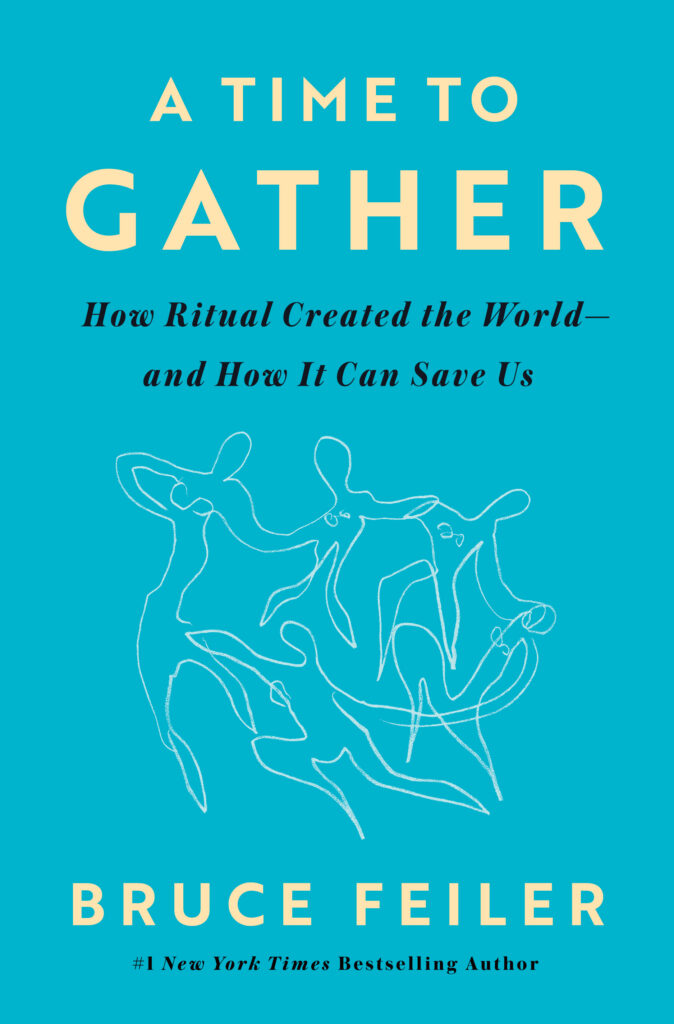
Excerpted from A Time to Gather by Bruce Feiler.