“When you walk through places where humanity once shattered, you realize that divinity isn’t the absence of darkness—it’s the light we choose to ignite in spite of it.”
—Deepak Parashar
Where Is Divinity When Humanity Collapses?
Some places do more than preserve history—they demand that we feel it.
For global energy industry veteran and spiritual author Deepak Parashar, visiting the Dachau and Auschwitz-Birkenau memorial sites was not simply an act of remembrance. It was part of a deeper inquiry that had been unfolding for years: where does divinity reside when humanity abandons its moral center?
Over a 14-year techno-spiritual journey spanning 38 countries, Deepak explored leadership, suffering, forgiveness, and the coexistence of good and evil through an unusual lens—one shaped equally by engineering precision and spiritual curiosity. His travels took him from mountaintop retreats to battlefields and memorials marked by unimaginable cruelty, challenging him to reconcile the darkest chapters of human history with the enduring capacity for conscience, courage, and compassion.
A Question Sparked by Experience, Not Theory
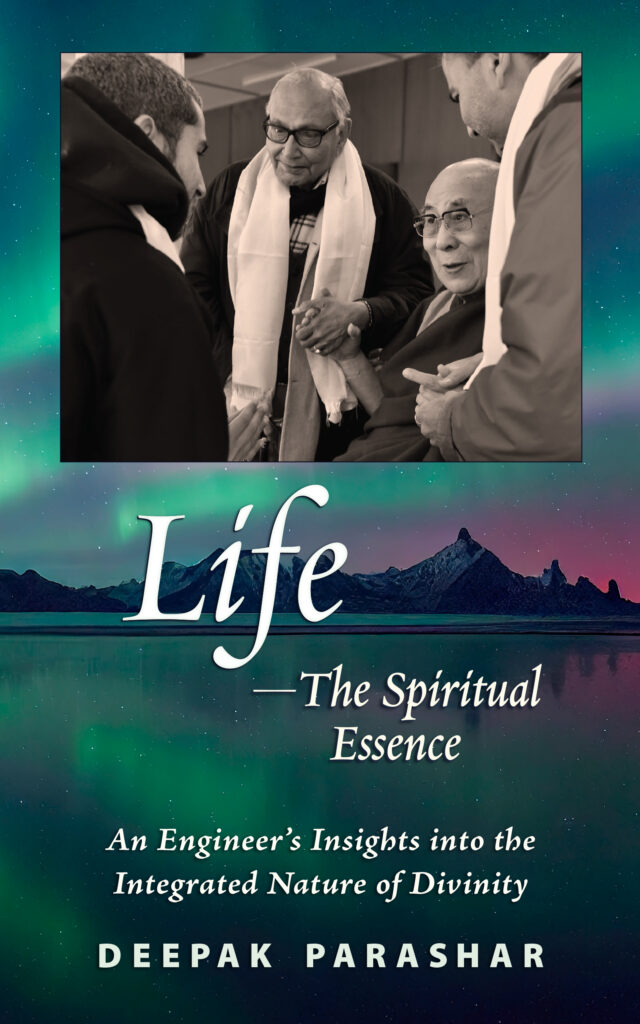
Deepak’s path toward spiritual inquiry did not begin in ashrams or monasteries. He is an engineer and MBA by training, educated in the United Kingdom, and has spent decades leading large-scale energy projects around the world. In 2009, however, a brief but impactful encounter with His Holiness the Dalai Lama during a flight to Tokyo ignited a question that would quietly reshape his life:
What does divinity look like in practical, lived terms—especially in leadership, decision-making, and moments of crisis?
Rather than abandoning his professional world, Deepak chose to study spirituality the way an engineer studies systems: through observation, experience, and pattern recognition. He began visiting sites shaped by war, leadership decisions, and human resilience, listening closely to the stories of those who had lived through extraordinary hardship.
Drawn Toward the Roots of Suffering
Over the years, Deepak developed deep respect for individuals who serve in extreme conditions—members of the armed forces, first responders, and humanitarian workers. Many of the veterans he met rarely spoke about their trauma, yet carried a profound gravity in their presence. He encountered former Royal Air Force pilots from World War II, a Korean War veteran from the Battle of Chosin Reservoir, and senior military leaders whose families had lived close to the epicenters of history.
As a lifelong student of history, he visited Normandy’s Omaha Beach and Hitler’s Eagle’s Nest—sites that revealed a sobering contrast between extraordinary courage and calculated cruelty. Those experiences created a growing pull to understand suffering at its source.
During a layover in Munich, while searching for places to visit, one name surfaced repeatedly: Dachau. The recognition felt immediate and unavoidable. Later, after a conversation with Benjamin Ferencz, one of the Nuremberg prosecutors, events aligned in a way that soon placed Deepak at the gates of Auschwitz-Birkenau as well. The journey felt less planned than guided.
Leadership as a Channel for Good—or Harm
What became increasingly clear to Deepak is that leadership itself is a subtle but powerful conduit. What a leader carries internally—fear, humility, compassion, ego—inevitably expresses itself externally, shaping systems, cultures, and lives.
History demonstrates this truth vividly. At Normandy, Deepak was struck by the sheer number of gravestones marked June 6 and June 7, 1944—silent testimony to the reality that the first waves of soldiers had little chance of survival. Yet leadership was present on those beaches. Officers and generals stood alongside their troops, embodying courage not through command alone, but through shared risk.
In contrast, the Eagle’s Nest offered breathtaking natural beauty—a setting where catastrophic decisions were shaped. That juxtaposition left a lasting impression: evil does not always appear monstrous. It often hides behind intelligence, charm, and aesthetics.
The Weight of Memory at Dachau and Auschwitz-Birkenau
If sacred sites carry the residual energy of spiritual awakening, the concentration camps carried something else entirely.
The atmosphere at Dachau and Auschwitz-Birkenau was heavy, dense, and oppressive—marked by the residue of suffering on an industrial scale. Many visitors were overcome with emotion. To remain present, Deepak entered a heightened state of awareness: grounded, observant, and centered. This was not emotional detachment, but spiritual steadiness—a way of bearing witness without collapsing under the enormity of what had occurred.
From a historical standpoint, the mechanics were chilling. Dachau, established in the early 1930s, became a training center for the SS and a model for more than 1,100 camps that followed. Auschwitz-Birkenau operated with logistical efficiency, strategically positioned along rail lines, resulting in the deaths of approximately 1.1 million people. From an engineering perspective, the precision was disturbing—not because it lacked intelligence, but because it lacked conscience.
Images That Do Not Leave You
Certain images remain etched in memory long after leaving the grounds. Behind a long glass display lay piles of human hair—later discovered to total over 15,000 pounds—collected and repurposed. Nearby were shoes, suitcases, and glasses, each representing a life interrupted. Just steps from the crematoria stood the home of Rudolf Höss, where family life continued as mass death unfolded nearby.
The contrast was unbearable in its ordinariness.
To process what he was witnessing, Deepak relied on a form of disciplined awareness described in ancient scriptures—a clear, detached attentiveness that allows logic to function without emotional paralysis. It was the only way to fully comprehend the magnitude of what had occurred without turning away. Tally, this heightened state is widely regarded as a hallmark of excellence in action in modern-day leadership.

When Beauty and Atrocity Share the Same Ground
After leaving Auschwitz-Birkenau, Deepak Parashar walked through the streets of Krakow—a city so visually striking that it felt almost surreal in contrast to what he had just witnessed. Its architecture, energy, and warmth made it difficult to reconcile the fact that this same city once held a Jewish ghetto where families were stripped of safety, dignity, and ultimately, their lives.
That contrast felt like another expression of life’s duality. Beauty and brutality existing side by side. Creation and destruction sharing the same geography.
As evening settled, Deepak wandered into Heroes Square, where rows of empty metal chairs stand as a quiet memorial. Each chair represents a life interrupted—a family separated, a future erased. Standing there in the stillness, surrounded by absence made visible, was one of the most sobering moments of his journey. There were no words to add meaning. The silence itself carried the weight.
The Quiet Danger of Becoming Numb
One of the most unsettling realizations during these visits was not only the scale of cruelty, but the role of ordinary people within it.
Beyond guards and commanders, there were clerks, accountants, and administrators who went abouttheir daily routines while mass suffering unfolded around them. Their presence raised a deeply uncomfortable question: what happens when cruelty becomes background noise?
The danger, Deepak realized, is desensitization. When suffering becomes normalized, compassion erodes quietly. This is not a historical problem alone—it is a human one. Across his travels, particularly in impoverished regions, he has seen how easy it is to become accustomed to pain that is not our own. Remaining sensitive requires intention. Compassion must be practiced, or it fades.
Searching for Divinity in the Midst of Darkness
After witnessing such profound darkness, Deepak sought answers from spiritual leaders across traditions, asking a question many wrestle with silently: where does divinity exist when humanity collapses?
Responses varied. A Christian minister explained that suffering arises from human choices, not divine intent. A Hindu swami described the inner qualities that drive human behavior—purity, passion, and dullness—and how unchecked passion fused with rigid ideology leads to destruction. Another insight emerged from ancient scripture: a realized observer witnessing a great battlefield perceived the divine essence present in every person, obscured only by ego.
The message was not that divinity causes violence—but that spiritual blindness allows it.
Forgiveness as a Transformational Act
Perhaps the most unexpected theme to emerge from these reflections was forgiveness.
Deepak learned that many survivors of unimaginable trauma chose not revenge, but forgiveness—not as denial of pain, but as liberation from it. Forgiveness, in this sense, was not weakness. It was transcendence.
Stories like that of Father Maximilian Kolbe, who volunteered to die in place of another prisoner at Auschwitz, or Louis Zamperini, who later forgave his wartime captors, revealed forgiveness as an act that elevates both the wounded and the world. These acts did not erase suffering—but they transformed it into something that could no longer imprison the soul.
Leadership, Compassion, and Moral Courage
These experiences clarified something essential about leadership.
True leadership does not begin with authority—it begins with inner alignment. Compassion is not softness; it is disciplined awareness. It is the refusal to normalize cruelty or look away when harm becomes inconvenient.
In this light, even the role of soldiers took on deeper meaning. Protection of the innocent sometimes requires confronting destructive forces directly. Many who serve carry lifelong emotional and spiritual weight. Their sacrifice is not about violence—it is about protection, responsibility, and moral burden.
Leadership, at its best, honors this complexity.
Honoring History Without Becoming Overwhelmed
Not everyone can visit these sites. But bearing witness takes many forms.
Reading survivor stories, sharing history, and refusing to forget are acts of quiet courage. In his own life, Deepak keeps a small shrine in his office honoring lives lost in the Holocaust. Each morning, he pauses—not to dwell in sorrow, but to cultivate gratitude and purpose.
Remembrance does not require grand gestures. It requires presence.
Turning Pain Into Purpose
Deepak’s book, Life—The Spiritual Essence, reflects this journey. It offers a framework for professionals and leaders seeking to integrate ethics, resilience, and inner clarity into high-pressure environments. It bridges engineering logic with spiritual insight, asking not how to escape suffering—but how to transform it.
For those who have suffered deeply, the first step is neither denial nor overwhelm. It is honesty. Facing pain without becoming consumed by it. Then ask a single, transformative question:
How can what I’ve been through help someone else?
When pain is met with service, it becomes light. When forgiveness enters the equation, suffering loses its grip. And when compassion is practiced deliberately, even history’s darkest chapters can guide humanity toward something better.
Follow Deepak Parashar’s work at https://www.parasharadvisory.com or reach him directly by email at [email protected].