For about two years before anything showed up on a scan, Brett Ashby was making paintings he could not fully explain. He had moved to a coastal town, bought a house on the waterfront, switched to vegetarian food, and started swimming and running every day. From the outside, it looked like a person who had figured out wellness. Inside his studio, something else was happening. He was working in oil paint and chemicals, putting down words and statements, making thirty or forty pieces he later described as dark, expressive, and almost cancer-like. Then the series was finished. He wired the paintings, bubble wrapped them, and stopped. That same night he lay down and told his fiancée he thought he had cancer. He went to his childhood doctor the next day and learned he was right.
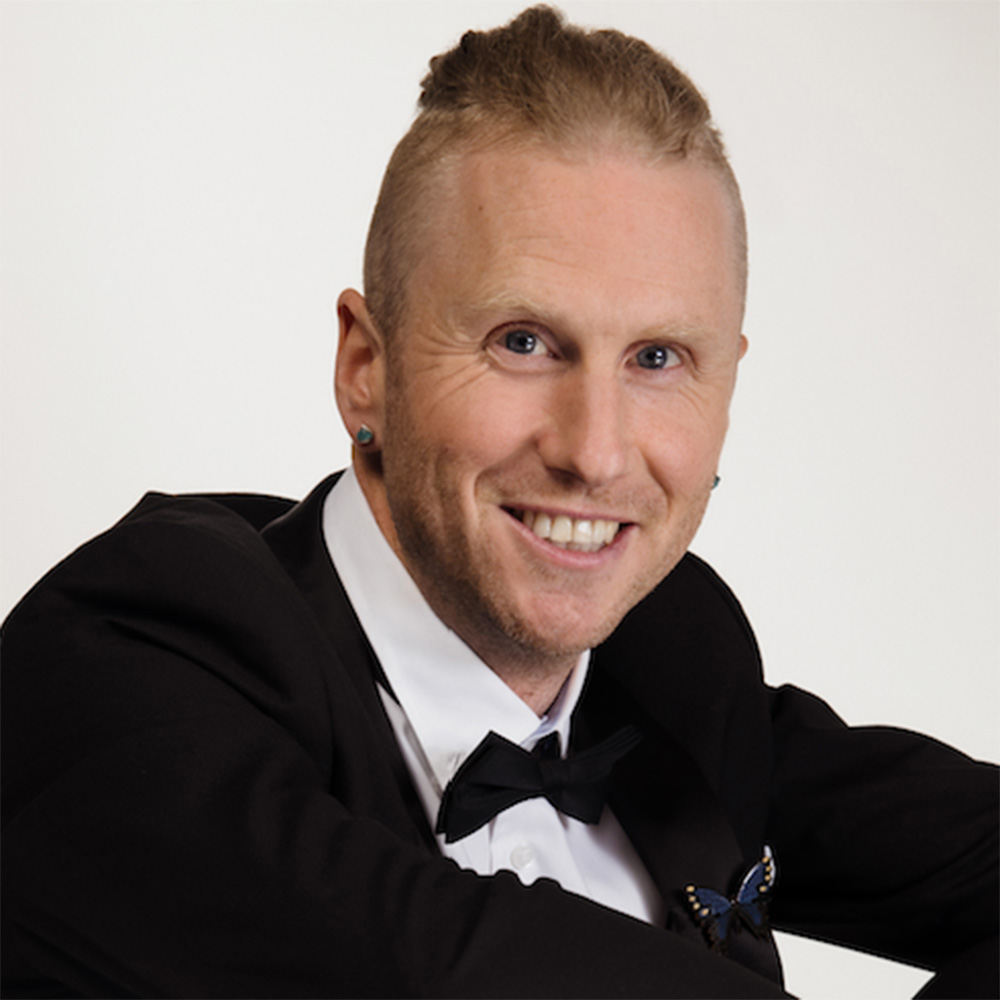
Brett Ashby is an Australian contemporary and performance artist whose work spans painting, photography, film, and live performance, and who studied fine art in London before building an international practice across two decades. In 2009, he traveled to America to work on a portrait of Barack Obama during the Hope campaign. He is best known now for painting portraits while riding a skateboard, a live one-hour format he has performed roughly fifty times a year, and for the bodies of work that followed his diagnosis: Energy, Frequency, and Sonic Flight. He ran a Melbourne gallery called Inner Essence for five years and directed a short film, The One I Love, that screened at sixty-seven festivals and won best experimental short. What makes him worth listening to on the subject of stress is not the résumé. It is that he has spent ten years paying close attention to what happens to a feeling when you put it somewhere outside your own body, and he is unusually specific about the mechanics.
Why the Studio Knew Before He Did
Ashby is careful about how he tells this part, and it is worth being equally careful reading it. He is not making a medical claim. He is describing a sequence he lived through and what it taught him to watch for. In his account, his body was expressing something before his mind agreed to look at it, and the paintings were where that expression landed. “So my body was expressing that there was something going on inside,” he said, describing the period when he was doing everything right on the outside and painting something very different in private.
The useful part for a reader is not the diagnosis. It is the gap. Ashby had two years of evidence in front of him, hanging on his own studio walls, and he did not read it. Most people have some version of that gap. The thing you keep writing in your notes app, the argument you rehearse in the shower, the subject you steer every conversation away from. Ashby’s suggestion is simply to treat what keeps coming out of you as information rather than noise, and to ask what it is pointing at before something louder makes you ask.
What Expression Moves That Talking Cannot
Ashby’s clearest idea is a plumbing metaphor, and it holds up. Think of a river running through you, he says. If there is a blockage, the water is not flowing. Expression is how you take those elements out of the river and set them down where you can look at them. The shift he keeps returning to is the shift in position: once the thing is outside you, you become the observer and the witness rather than the person carrying it.
“I think it saves lives. I think you can express the pain and the deepest challenges or traumas or experiences one’s had to that moment outside of yourself.”
Brett Ashby, contemporary and performance artist
He also draws a distinction between mediums that most people never think about, and it changes what you might reach for. Paint, he says, is liquid and then it sets and dries, which means the storytelling stays fixed inside it. Music behaves differently. Ashby has written five songs, had a vocalist sing the lyrics, and found that music tends to live like a living entity, one that does not dry or set. Neither is better. But if you want to put something down and leave it there, a fixed medium does that. If you want something to keep moving with you, sound does that instead. Knowing which one you are reaching for is the difference between processing something and rehearsing it.
The Weight You Are Carrying May Be Literal
Ashby describes stress as something with a location. The spine holds all the stories, he says, and the stresses placed on a person’s shoulders accumulate like carrying rock sacks up a mountain. What he did about it after surgery was more practical than most wellness advice ever gets.
He had built an international art business, which meant equipment, vehicles, trailers, warehouses, storage facilities, and more than two thousand artworks scattered around the world. Coming out of treatment, he let a great deal of it go. He donated equipment and materials to other artists. He cleared out the storage. “It was a huge letting go,” he said, “and it also made me lighter and I felt like I started getting my energy back.” For anyone who cannot make the leap from an emotional insight to an actual Tuesday, this is the most portable idea in the whole conversation. Find the version of the warehouse in your own life and give some of it away. The relief Ashby describes was not metaphorical.
Fear, Flow, and the Point of Painting on a Skateboard
The skateboarding is not a stunt, and Ashby is specific about what it is for. He was a semi-professional skateboarder as a teenager until an accident during high school injured his neck and cost him his teeth. When a Melbourne commission came up years later, he decided to return to the fear rather than route around it, and the resulting body of work became the start of painting while rolling.
What happens during the performance is the part he wants people to understand. He drops into a steel vert ramp, skates around an easel for an hour without stopping, with a sound bath playing, his back to the audience, his eyes on his subject. And the goal, he says, is to have no thoughts. It is about dissolving fear and letting the mind go quiet, a flow state held between the ramp and the canvas. His conclusion from ten years inside that state is blunt: you do not control everything, and if you listen only to your mind, you will miss what the body already knows. That is his experience rather than a clinical finding, but the practical version travels well. The activity that scares you slightly and demands your full attention is often the one that finally stops the thinking.
Where People Who Say They Are Not Creative Actually Start
Ashby has run workshops and public art projects with young people, many of whom arrive convinced they have nothing to express. His instruction to them is almost aggressively small: make one mark. Not a painting, not a plan, just one mark outside yourself. “If you just make a mark, one mark outside of yourself, it starts to grow,” he said. He points people toward old tools, a typewriter, a camera, whatever removes the pressure to produce something good, and he frames the whole thing as one percent daily changes rather than a breakthrough.
If art itself feels out of reach, Ashby’s alternative is to change the room you are standing in. Go to a gallery. Enroll in something. Put yourself in a community where you are the beginner. What he noticed doing exactly this is that nobody in the room assumes it is your first time; they treat you as an equal, and the exchange runs both ways. He also offers the ritual version for people who want something quieter, including meditation, bushwalking, forest bathing, or a hot spa at night, and he counts his own habit of sleeping directly on the timber floor during recovery, which he did because he wanted to feel his body again after losing his strength.
Be Kind to Yourself First, Then Make the Mark
The thing Ashby says he is still working out, at forty, is not how to push harder. It is the opposite. He grew up with what he calls a hard shell and a real addiction to succeed, and he reached the goals he was raised to reach. The lesson he has taken from the last decade is that he has been hard on himself for most of his life, and that doing nothing can turn into something worthwhile. He compares the gentler approach to swimming, which is low impact on the body and still leaves you fit and energized.
His closing advice was aimed at men in particular, though it is not only for them. “Take a small takeaway, be kind to yourself, hug yourself if no one else is,” he said, adding that as men he does not think we are doing that. Pair it with his other instruction and you have something you can act on today: be gentler with yourself than you were yesterday, and put one mark, one sentence, one photograph, one song outside your body where you can look at it.
Brett Ashby is not offering a cure for anything, and he is careful to say so. What he is offering is a decade of close observation of what expression does for the person doing it, from an artist who kept working through the hardest chapter of his life and came out the other side with a clearer sense of what the body was trying to say.