

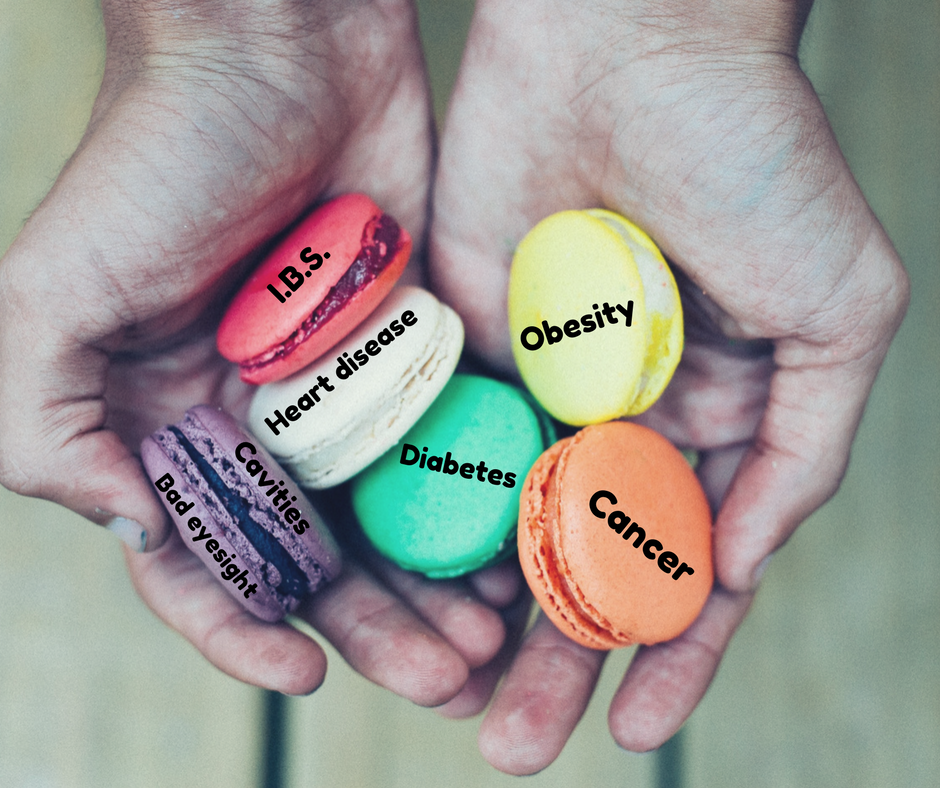
Many people say sugar is energy. They say the worst effect of sugar is eating empty calories that can make you fat. But it’s not energy. It’s a complex substance that affects everything in your body, from the brain to the liver to the colon and everything in between.
Sugar makes you fat and sick. Very sick.
Sugar is not pure energy. Sugar is the union of two substances: glucose (50%) and fructose (50%). Glucose is the fuel of all living cells. It is in all carbohydrates: sugar, fruits, potatoes, tomatoes, bread, etc. When you eat sugar, the glucose in it is distributed throughout the body and your cells use it for energy (by respiration or fermentation). In fact, blood sugar is a reserve of sugar circulating in the blood. Thus consuming glucose is harmless unless you eat much more than your energy needs. In which case it is transformed into fat.
Fructose is different. None of the cells in the human body can metabolize it. Thus it is sent to the liver. The liver is a giant processing plant that transforms all foreign substances into compounds the body can use. This includes poisons, alcohol, drugs. And fructose.
Why is fructose so difficult to metabolize?
We live in a world where we get our food from supermarket shelves and restaurant waiters. But our bodies evolved in a world where we foraged and hunted in wild nature. And in nature fructose is scarce. It is found in fruits. However, an apple has only 11 grams of fructose while a Snickers has 24 grams. And the apple has lots of fiber which slows down digestion and make you feel full. Primitive man also did not have greenhouses, he ate apples only when they were in season and he was lucky to find an apple tree. This meant very few apples overall. The other source of fructose is honey. This was not easy to obtain in the Stone Age. Bees are a strong deterrent when the most advanced technology consists of sharpened rocks.
What are the effects of sugar?
The effects of sugar are, in fact, the effects of fructose. Fructose has multiple ‘fun’ effects:
1. Liver damage
The liver transforms some of the fructose into glycogen. Unless you are doing intensive exercise when you ate it, only a small part of fructose becomes glycogen.
Fructose is one cause for fat in the liver. The other one is alcoholism.
The liver transforms the rest of the fructose into fat. Some of this fat is sent to enlarge existing fat cells and increase your waist size. However, this is not the most troubling part. The troubling part is that the rest of the fat stays in the liver (Sources 1, 2). There should not be fat in the liver because this fat suffocates the liver. The condition is called Non-Alcoholic Fatty Liver Disease. Sugar causes this (Source 1, 2). This condition often leads to cancer in the liver. The only other cause of fatty liver is severe alcoholism.
31% of American adults and 13% of kids suffer from non-alcoholic fatty liver disease. (Sources 1, 2, 3 ). This number has doubled in the past 20 years.

2. Obesity, diabetes and heart disease
Fructose reduces insulin sensitivity. Insulin is a hormone that regulates metabolism. It signals if you ate enough food and tells the body whether to store or use the calories. Reduced insulin sensitivity generates excessive eating. In time the body develops insulin resistance where it does not react to insulin anymore. This is a serious problem that creates diabetes (Sources: 1, 2, 3, 4, 5, 6), obesity (Sources: 1, 2, 3) heart disease (Sources: 1, 2, 3, 4) and hypertension (Source: 1, 2 ). People say that you only live once and sugar is one of life’s pleasures. Yet being fat from harms even your brain and thus ability to enjoy life: a recent study showed the brains of obese people are 10 years older than their leaner counterparts (Source).
You might wonder why a substance found in fruits has this harmful effect. There is a rational explanation. In nature, fruits were scarce and very rich in energy. When primitive man found them, it made sense to eat all that he could to build stores of energy for times of hunger. To do this, the body reduced insulin sensitivity so it could eat fruits in excess without feeling full. Now, when there is fructose in every packaged food, this mechanism has become harmful.
Bonus: Ever wonder why so many people wear glasses? Insulin insensitivity increases blood glucose which in time damages eyesight. Primitive man lived just fine without prescription glasses.
3. Indigestion, bloating, IBS
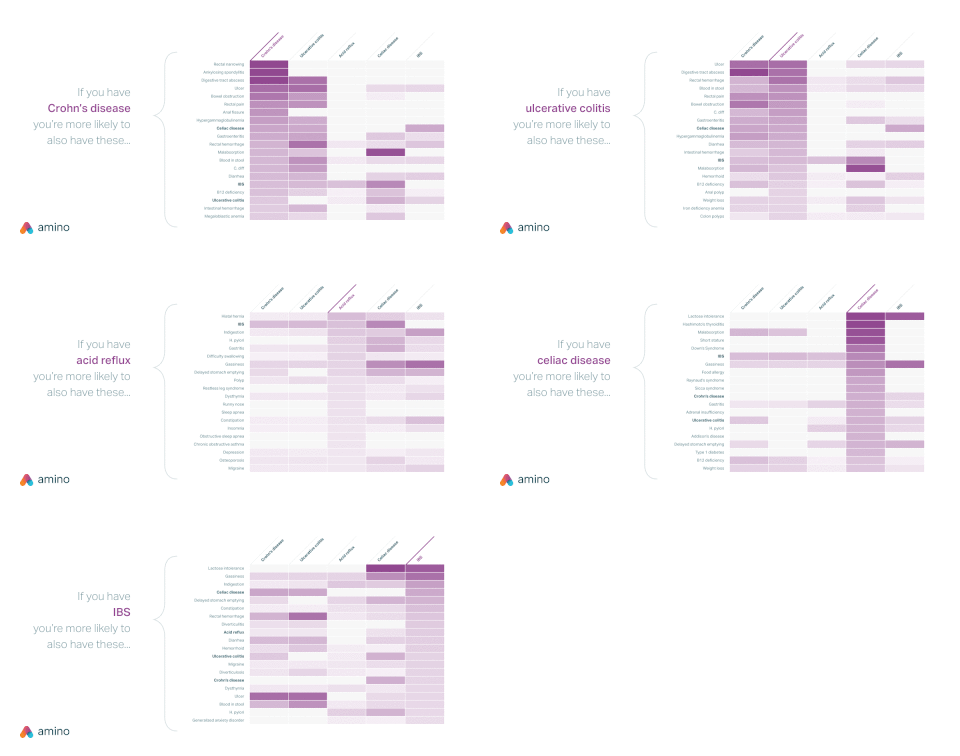
Much of our digestion is done by bacteria in the gut: the microbiome. Modern science shows we are a complex organism, integrated with our microbiome. The makeup of the microbiome affects our health and digestion. It is thought to be a critical factor for Colorectal cancer (CRC) which is the third most commonly diagnosed cancer in both men and women.
Around three-quarters of people suffer from fructose intolerance.
Sugar goes to the liver through the gut. Fructose cannot be processed by the human cells (Source). Some the bacteria in the gut can process it through. They eat the fructose and make gas. This gas bloats, exerts pressure and causes gastric reflux and discomfort. The fructose also makes these bacteria multiply (which leads to more gas). This upsets the equilibrium of the microbiome. Some feel the problem immediately. Around three-quarters of people suffer from fructose intolerance.(Sources 1, 2, 3, 4). Almost everybody suffers on the long term through bloating, diarrhea, flatulence, but even gastric reflux, ulcers, irritable bowel, even Crohn’s and colorectal cancer. Restricting carbohydrates, fructose in particular is shown to reduce such problems for over 80% of patients (Source).

4. Cancer and autoimmune diseases
Colorectal cancer is not the only cancer linked with fructose. When it transforms fructose into fat, the liver excretes waste products called free radicals. These continuously damage human cells until they become cancerous.
Sugar leads to cancer
The body has special scrubber cells in the bloodstream to catch and neutralize free radicals. However, average modern sugar consumption generates more free radicals than the scrubbers can handle (Sources 1, 2, 3). Thus sugar leads to cancer. Another modern food, vegetable oil, also creates free radicals.
5. Rotten teeth
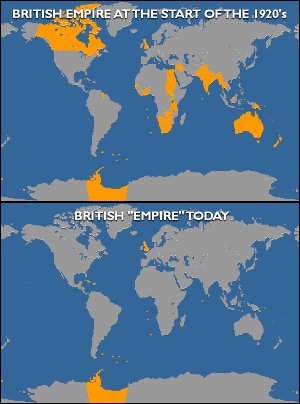
Fossil analysis shows cavities were practically nonexistent for primitive man. The colonial British Empire was the first society to introduce widespread consumption of sugar. The British then became known for their rotten teeth.
Cavity formation starts with plaque. Plaque forms on the teeth. It has bacteria. Specific bacteria in the plaque, such as Streptococcus mutans, secrete acid when they eat certain carbohydrates. This acid eats away at the tooth walls and slowly creates the cavity. The favorite food of such bacteria is dextran. Dextran appears in the mouth from sugar decomposition (Sources: 1, 2, 3)
Bonus: sugar makes food stick to teeth so it produces even more plaque.
The conclusion is simple: fructose from sugar makes you an unattractive fatty with rotten teeth and cancer.
History Post Script: How humans starting eating fructose
Queen Elizabeth the 1st was the first British monarch with easy access to large quantities of sugar. She took to eating it in quantities as big as her empire.
At court, sugar produced elaborate dishes. Chefs made sweets, made from sugar paste (a mix of egg, sugar, and gelatin), look like savory foods such as bacon, walnuts, and eggs. ‘Leach’ (or leech) was another popular dish. Leach was just milk, sugar and rosewater. However, possibly two of the most popular of these treats were march-pane and gingerbread. March-pane, like modern marzipan, was made of almond and sugar paste and could be molded into a variety of shapes and elaborately decorated.

What was the effect of all this sugar? A German traveler, Paul Hentzner, paints a descriptive picture: “[Elizabeth I is] in the sixty-fifth year of her age… her face oblong, fair, but wrinkled; eyes small, yet black and pleasant; nose a little hooked; lips narrow and her teeth black (a fault the English seem to suffer from because of their great use of sugar); she wore false hair and that red …”
If you enjoyed this…

About me: I am a psychologist/researcher/writer/communication-strategist/ chatbot-maker who made all the mistakes of modern lifestyle in his 20s and spend the last 5 years researching how to eat and live for optimal health and wellness. I just launched BodyWants where we use human history traditions plus latest research data to explore nutrition and lifestyle habits.