


You use the @ symbol every day.
It’s part of every email address and something you see across social media, yet most people rarely stop to think about it. It’s functional, familiar, and easy to overlook.
But ask a simple question – what do you call it? – and the answers quickly become more interesting.
In English, it’s simply “at.” In other languages, it takes on entirely different meanings. In Chinese, it’s a little mouse. In German, a spider monkey. In Greek, a little duck. In Estonian, a pretzel, and in Korean, a sea snail.
As email spread around the world, the @ sign didn’t come with a universal name. People made sense of it in their own way, often based on what it looked like.
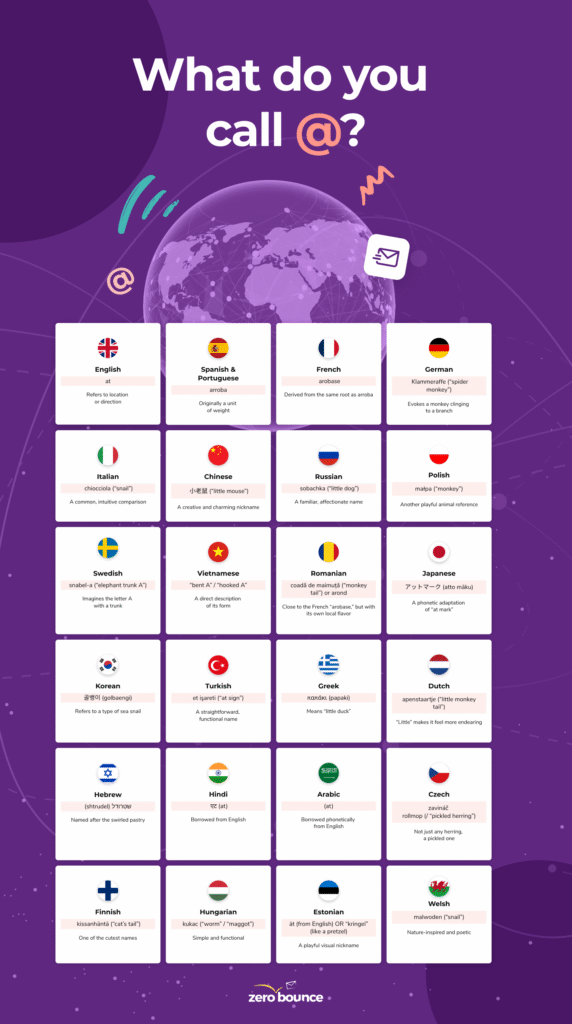
The story behind the @ symbol
Today we associate the @ symbol with email and social media handles, but did you know that it’s actually centuries old? Historians trace its origins back to the 1300s, when it was used in trade as an abbreviation to describe a unit of weight.
Its modern role began in 1971, when engineer Ray Tomlinson sent the first email between two computers connected to ARPANET, the early version of the internet. He chose the @ symbol to separate the username from the host. At the time, the character was rarely used and it made sense, as it naturally conveyed the idea of a user located at a specific machine.
Tomlinson’s choice became a standard that still defines email today.
Email is turning 55 this year – and still going strong
The @ symbol may feel like a small detail, but it sits at the center of one of the most widely used communication tools in the world.
Email remains deeply embedded in daily life. Recent data reflects just how prevalent it still is:
- 93% of people say they use email every day
- 60% say it’s their preferred channel for work communication
- 42% of Gen Z professionals say email is their favorite way to communicate at work
Messaging apps and collaboration tools have become popular, but email hasn’t faded. If anything, it continues to hold its place as a primary communication channel across generations.
That lasting relevance is also why April 23 has been recognized as Email Day.
Email Day was introduced by ZeroBounce as a way to recognize the invention and the person behind it. The date honors Ray Tomlinson’s birthday and the impact of email.
More than five decades after that first message, the system Tomlinson helped create is still in use around the world and remains central to how we connect and communicate.