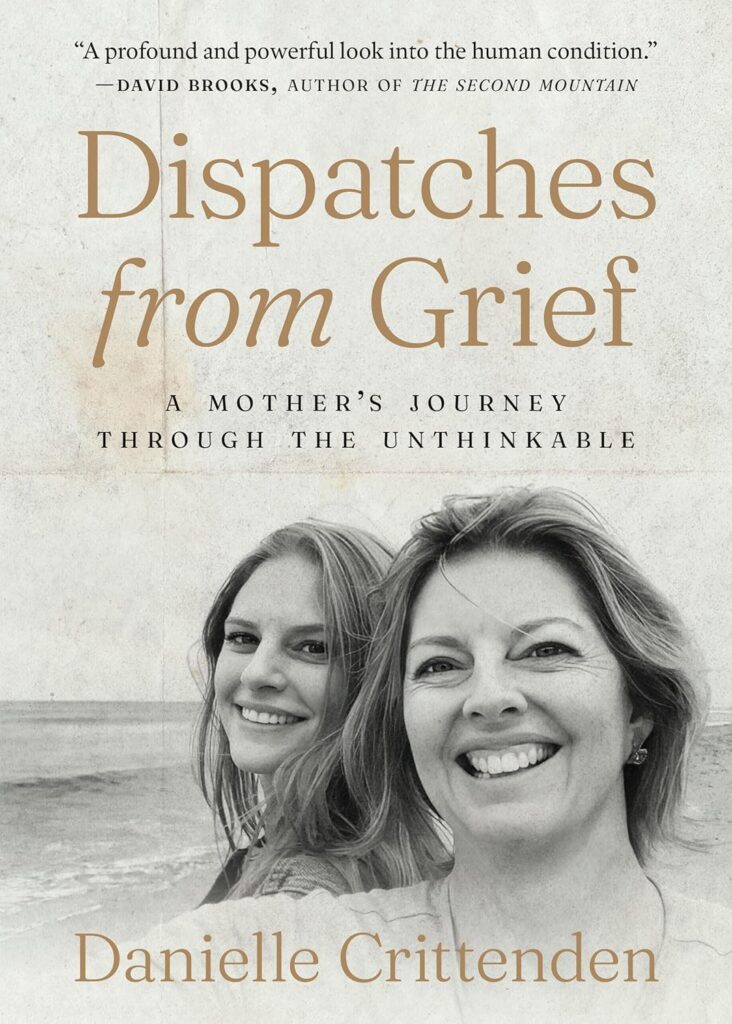
On a February morning three years ago, my husband David and I received a call that upended our lives forever. Our daughter Miranda — thirty-two years old, funny, fierce, beautiful — had suffered a sudden and catastrophic brain event. She never regained consciousness. She was buried a week later.
Miranda was the kind of person who made every room more itself. She introduced me to music I would never have found, food I would never have tried, cities I would never have loved. She was my travel concierge, my fashion conscience, my late-night gossip partner. When I was once treated dismissively at a job, I told Miranda. Her answer was instant: “Mom. You’re awesome. No one should make you feel that way.” I quit the next day.
When she died, I stepped into what I came to call the alternative universe: a place where the laws of physics have been scrambled, where feathers weigh more than bowling balls and the sun rises at midnight. It is a country with its own customs, its own language, its own particular loneliness.
One of the first shocks of that country is discovering how crowded it is. People I had known for decades turned out to be fellow citizens, their passports hidden until I showed mine. A friend from Lebanon revealed he had witnessed the executions of his father and brother at the age of nine. Another had lost both her brothers before she reached twenty. Another’s beloved sister had died decades earlier, and she told me that when her mind drifted back to that grief, she felt as if she were returning to the scene of a murder, the blood still dripping bright on the walls.
These friends had never shared their stories with me before. Why would they? What comfort could I have possibly brought them?
The people who had not yet been issued a passport to this country — the majority of the people I knew — responded to our loss in ways that were entirely predictable and almost entirely unhelpful, through no real fault of their own.
Some disappeared. Perhaps our tragedy exceeded their emotional vocabulary. I can’t even. So rather than attempt a word, they said nothing.
Others treated us like contagion, as if tragedy spreads like a virus. If it happened to David and Danielle…! These acquaintances tended to avoid the topic entirely. Imagine walking into a crowded room wearing a shirt with a fresh bloodstain spreading over your chest, yet everyone is determined to keep their gaze above your shoulders. You talk about the weather, a sports game, a current issue. Their eyes might fall for a moment, but they catch themselves and continue: Our son is studying economics now, we just got back from Spain.
David and I began calling a certain type of reaction “the Undertaker’s Stare.” You catch the eye of an acquaintance across a room, engaged in perfectly normal conversation with someone else. The person suddenly freezes. He wipes off his smile and turns to you with a woeful, readjusted expression of pure pity.
Of all the responses, the worst was advice. Time heals. You have to go through it, not around it. I remember when I lost my great-aunt…
I began to call this griefsplaining. At a party, a man I barely knew cornered me, gripping my hand. “Danielle, LISTEN,” he implored. “You must understand, you WILL get better. IT will get better. Please believe that. I KNOW. It will just TAKE TIME. TRUST ME on this.”
Sometimes these encounters turned darkly comic. The night before cleaning out Miranda’s apartment, her sister Bea and I checked into a nearby Brooklyn hotel. The reception clerk beamed at us.
“Why hello, ladies! Business or pleasure?”
So soon after Miranda’s death, we hadn’t yet developed poker faces for the unwary.
“Um, neither.” I glanced at Bea.
“Personal business,” she said quickly.
“Not even a show?” He kept his hospitality smile cranked to maximum. He simply couldn’t fathom why anyone would visit New York without planning fun.
I decided to drop the bomb. “My daughter died recently. We’re here to clean out her apartment.”
His eyebrows frowned, but the smile held. “I’m so sorry! But at least your daughter…what was her name?”
“Miranda.”
“At least Miranda’s in a better place now, right?” He gestured toward the upper floors.
“She was already in a good place,” I replied, so astonished I began to smile at myself. “A one-bedroom co-op in Brooklyn Heights near the promenade. That’s pretty good, right?”
New Yorker that he was, the man conceded the advantageousness of the real estate.
I understand the language problem. People want to offer comfort without causing offense but stumble over every word. Here, then, is what actually helps. Keep it simple. A squeeze of the hand. A sincere “How are you doing?” We’ll murmur something like, “It’s still hard,” or “We’re stumbling along.” You nod. We move on to safer ground. That is enough. That is, in fact, everything.
What grieving people need most is not to be fixed, explained, or guided through their experience by someone who has not lived it. We need only to be seen. To know that you have not forgotten, that you are not afraid of our wound, that you can sit beside it without flinching. You do not need a speech. You do not need a philosophy. You need only to show up — and to mean it when you ask how we are.
The rest, as they say, we will take from there.
An excerpt from Dispatches from Grief: A Mother’s Journey Through the Unthinkable