
On a windy, rainy afternoon, a technology executive was running late to pick up his kids and pulled into a fast-food drive-thru. A small sign outside promised that AI was lending a hand that day. He ordered something simple, but the AI voice agent heard a $25 meal with four different items. He tried to reason with it, eventually gave up, paid, and explained what had happened to the very kind cashier at the window. Someone smart had decided to roll out AI at the drive-thru, and on paper it was a good decision. Nobody seemed to have asked what would happen when it was windy, when it was raining, or when an order came through wrong. That gap between a sound decision and the result it actually produces is costly. Seventy-five percent of transformations never deliver the business value they were supposed to deliver.
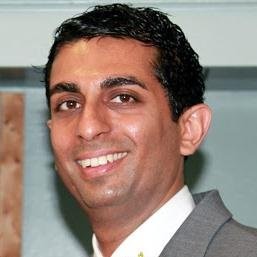
The executive in that drive-thru was Rajvir (Raj) Madan, Senior Vice President and Chief Digital and Information Technology Officer at Arcutis Biotherapeutics. Over more than 25 years, Madan has led global digital, data, and innovation work at GSK, Novartis, and L’Oréal. He holds an MBA from NYU Stern and was named to AIM Research’s AI100 for his work in AI and digital transformation. He calls himself an “engineer with a heart,” and he is writing a book called Decision Outcome Divide, which opens with that drive-thru story. His argument is simple and a little uncomfortable. Leaders put enormous energy into making the right call and far too little into what happens once that call reaches real people.
The Decision Is Not the Finish Line
Madan says leaders are “inherently trained on how to make really good decisions.” They secure alignment, gather the right inputs, and move quickly into execution. Familiar decision-making frameworks such as RACI and DACI support that process, and Madan gives them credit: “they’re really useful frameworks.” In his view, their limitation is that they stop at the moment of choosing.
What he proposes instead is outcome literacy, a discipline that starts where those frameworks end. It rests on one question: And then what? Madan describes outcome literacy as the practice of “tracing consequences of your decisions, intended or unintended, across customers, employees, systems, reputation, culture.” A decision is a starting point. How it lands on the people it touches decides whether it works.
The practical step is to ask that question before a decision is finalized, and to ask the people closest to the work rather than only yourself, “because they usually see the ripple effects.” If you cannot say what happens after the decision takes effect, Madan’s advice is direct: “you better slow down.”
“The outcome is the finish line, and we should be measured by what the outcome is.”
Rajvir (Raj) Madan, Senior Vice President and Chief Digital and Information Technology Officer, Arcutis Biotherapeutics
Your Best Playbook Can Become Your Biggest Blind Spot
Madan divides the work of closing the divide into layers, and the first one is internal. It starts with how the leader’s own mind works. “Our brains are very good at recognizing patterns,” he says. That strength becomes a liability when a leader assumes that what worked at a previous company will work at the current one. He compares it to a magician who asks a series of questions to steer your attention until your brain runs on autopilot. In business, he says, “we actually put our brains on autopilot more than we recognize.”
His remedy is what he calls the anti-pattern. Instead of reaching for the familiar playbook, “don’t apply the pattern, actually think about why that pattern is not going to work.” Madan speaks from experience. After succeeding at one company, he brought the same playbook to his next role. “And boy, was I wrong,” he says. He points to Kodak and Blockbuster as companies that failed to recognize that the pattern had shifted. As he puts it, “the previous pattern is now the anti-pattern.”
The inward work goes further than strategy. Madan says every leader brings their biases, triggers, and upbringing into the meeting room. He shared that he has spent the last 10 to 12 years in therapy examining what might shape his decisions, including his fears, his anxieties, his sense of control, and how he approaches conflict. He calls the result becoming an examined leader. A useful question for any reader is the one Madan poses himself: when does pattern recognition help, and when does it become a trap?
Why a Mediocre Decision Can Beat a Brilliant One
Madan places culture at the center of whether decisions succeed. He cites Peter Drucker’s famous line that culture eats strategy for breakfast, “and in my opinion, for lunch and dinner.” To make the idea less abstract, he defines culture as the behaviors, gestures, and “atomic habits” people show every day, “the unspoken set of rules” that determine whether they work with a change or against it.
That definition explains one of his most counterintuitive claims. A mediocre decision in a healthy culture will outperform a brilliant decision in a broken one. In a healthy culture, people speak up. They tell the leader a plan will not work, or ask how a patient or customer will react to a new tool. That feedback lets a leader course-correct and land a better outcome. A brilliant decision made without that feedback mechanism rarely delivers, because nothing signals that something has gone wrong.
The same logic applies when a decision asks for more than the culture can give. “If the organizational culture is not ready to absorb that decision, that decision is never going to work,” Madan says. A leader can call for more innovation, but a risk-averse organization will not carry that call forward. Before announcing a major change, he suggests asking honestly whether the culture is ready for it. If it is not, changing the culture comes first, and he acknowledges that “often takes a lot of courage.”
Clarity, Competence, and Control
Beyond feedback, Madan names two more cultural forces that determine whether decisions hold. The first is the difference between rewarding activity and rewarding outcomes. He has seen sales teams measured on the number of calls they make instead of “the revenue impact that they’re having for the organization.” An organization that rewards activity, he says, cannot close the divide, because its incentives point away from results.
The second is empowerment, which Madan is developing into an equation for his book. Empowerment done right has three components, and all three have to be true at once. Competence means people have the skills to execute. Control means clear ownership and accountability, or “who owns what, who is accountable for what,” along with clear decision structures. Clarity means people can tell what they should be working on and what they should not.
When any one of the three is missing, a decision cannot reach its intended outcome, however well it was designed. A leader who wants a decision to stick can check each one in turn. Does the team have the competence to carry it out? Is ownership clear? Do people know what to stop doing so they can focus on this?
AI Makes Every Decision Move Faster
Madan says AI is part of the urgency behind his book, and it raises the stakes in two ways. The first is speed. “With AI, you can not only make good decisions, but you can make really fast decisions,” he explains. Leaders can now ask an AI tool to help them decide, so the problem of skipping past consequences is compounded.
The second is scale. Madan believes every organization will have to transform because of AI, and that “transformation now is no longer an episodic event. It’s actually a continuous thing.” He notes that companies have already begun replacing CEOs and other senior executives because their boards felt those leaders lacked the transformation skills to move into the AI era. He argues that leaders will increasingly be measured on outcome literacy rather than decision literacy.
To make the idea concrete, Madan pictures a calm lake. The decision is a pebble dropped into it, and the waves that spread outward are the second- and third-order effects. Before any decision, he says, “the really important question to ask is what does it set in motion?” When an organization decides to route every customer through AI, one of those ripples is the customer who is not technology savvy and would rather talk to a person. A single-threaded decision like that, he says, means “you’re assuming that every customer is the same,” when “sometimes you need two paths going forward.” His answer is to bring frontline employees and a varied set of customers into the decision. Without their input, he says, “the chances of success are a pure toss-up.”
Decide With Your Heart and Your Mind
The “engineer with a heart” label comes from a conviction Madan returns to often: technology exists to serve people. “It could be the most brilliant piece of technology,” he says, but if people do not use it, “it’s a failure.” He points to keyboard design. The Dvorak keyboard was a much better keyboard from an engineering standpoint, yet the QWERTY layout won because it accounted for how people actually interact with it.
That is why Madan says, “you have to make a decision with your heart and with your mind.” The mind brings systems thinking, data, spreadsheets, and trade-off matrices. The heart considers how the decision will land on people and whether they will feel good about what they are being asked to use. Pull only one lever, he says, and you will not succeed.
He believes this balance matters more as AI advances. AI may come close to automating the way people think, but it cannot know a leader’s fears or anxieties, or the self-awareness they do or do not have. In Madan’s words, “the AI can replace our thinking but it cannot replace our emotion.”
Ask What It Sets in Motion
Madan is candid that he has not resolved every tension involved. Boards and executive teams want leaders to move fast, and some decisions require speed. Others require slowing down to ask exactly the questions he raises. He faces that dilemma all the time. “If you’re feeling that tension, that’s a healthy internal tension to feel, and it’s often a balancing act,” he says.
The single habit to carry into your next decision is to replace “Is this a good idea?” with “What does this set in motion?” Picture the pebble and the lake. Ask who the waves will reach, bring those people into the conversation, and check whether your culture is ready to carry the decision forward.
Good intentions and sound analysis are where leadership begins, not where it ends. Rajvir (Raj) Madan has spent more than 25 years leading digital change at some of the world’s largest healthcare and consumer companies. What he has seen is that the leaders who deliver real results are the ones who keep asking one more question: And then what?