

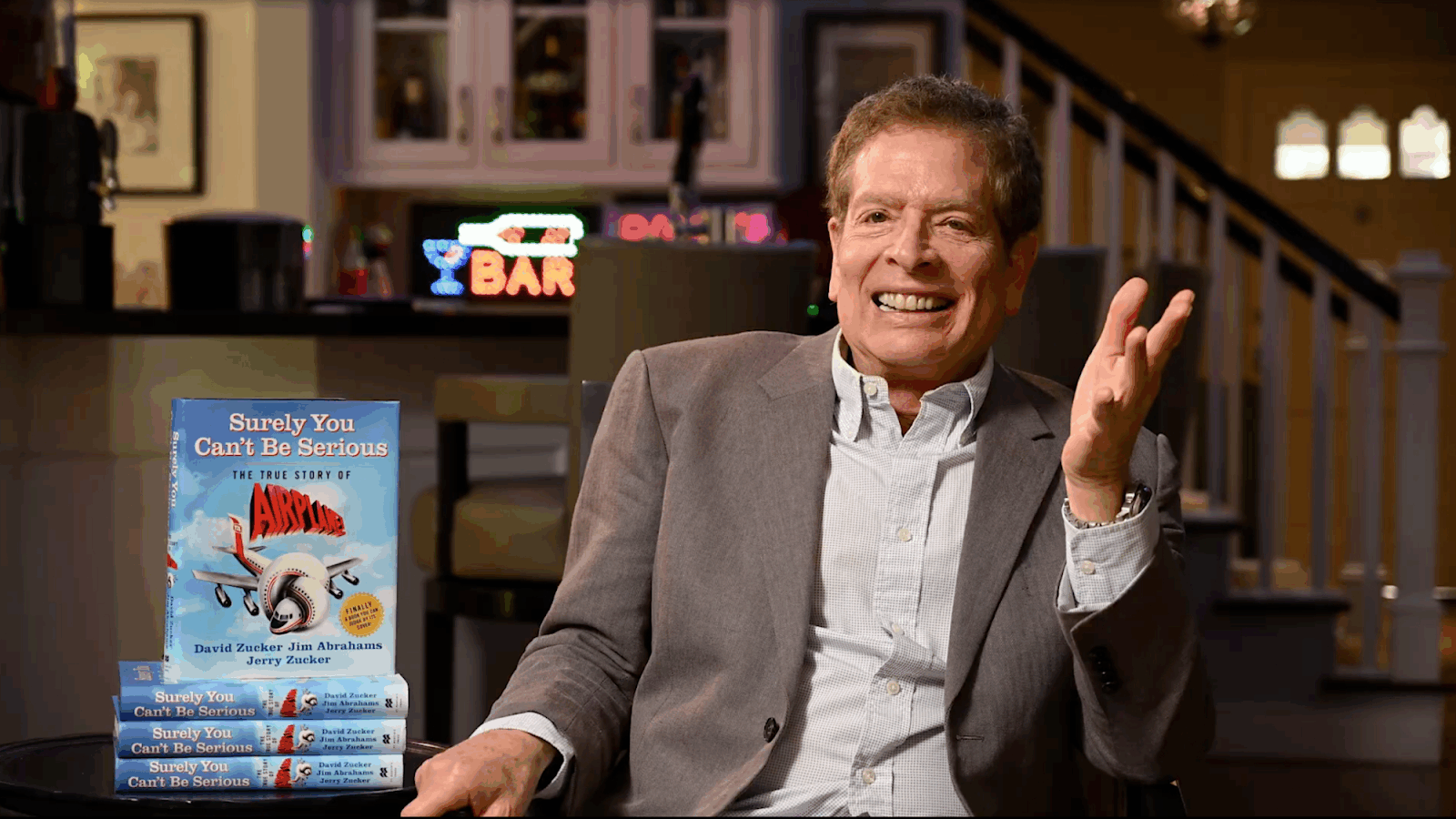
For David Zucker, wellness is less about strict regimens and more about balance, humor, and small daily rituals. Now in his seventies, the legendary filmmaker credits his longevity to a mix of routine exercise, lighthearted indulgences, and a healthy outlook. His formula is simple: a nightly gin martini, animal crackers for dessert, and enough discipline to still make it to the gym. Just as important, he believes laughter itself has sustained him—both creating it and living with the perspective it brings. In Zucker’s view, joy, persistence, and a good joke may be as essential to health as diet or exercise.
We had the pleasure of talking with David Zucker. David is a filmmaker whose work helped define the modern American parody film. Best known as one-third of the Zucker–Abrahams–Zucker trio, he co-wrote and co-directed Airplane! (1980) and The Naked Gun series, creating a signature comedic style built on deadpan delivery, visual gags, and a relentless pace of jokes. Over a career spanning nearly five decades, Zucker has remained a fixture in comedy, both shaping and satirizing pop culture.
Raised in a Jewish household in the Midwest, Zucker’s comedic sensibilities were evident from a young age. Alongside his brother Jerry and childhood friend Jim Abrahams, Zucker embraced humor as a central part of life, often playing the role of class clown. In the early 1970s, the trio formalized their comedic ambitions by founding the Kentucky Fried Theater. After moving to Los Angeles, the group staged a revue titled My Nose, famously ensuring their listing in the Los Angeles Times read: “My Nose runs continuously.” That brand of wordplay would become a hallmark of their later films.
The group’s first foray into film, The Kentucky Fried Movie (1977), offered a sketch-based format that allowed them to transition away from live theater. The success of that film laid the groundwork for their breakthrough project, Airplane! Released in 1980, the film was a parody of 1950s disaster movies and featured a then-novel concept: placing serious actors in absurd comedic roles. Zucker and his collaborators specifically sought out performers known for dramatic work—such as Leslie Nielsen, Peter Graves, and Robert Stack—thereby making the humor land with unexpected weight. The film became a surprise hit and is now regarded as one of the most influential comedies in American cinema.
Despite that success, Zucker and his collaborators initially resisted the push to create a sequel. Their proposal—turning Airplane II into a parody of The Godfather—was ultimately shelved after objections from director Francis Ford Coppola. The team instead pursued other projects, including Top Secret! (1984), Ruthless People (1986), and The Naked Gun: From the Files of Police Squad! (1988), the latter of which revived the failed ABC series Police Squad! and turned it into a long-running film franchise. Leslie Nielsen’s portrayal of Detective Frank Drebin became iconic, and the series cemented Zucker’s status as a key figure in comedic filmmaking.
While early successes were marked by ensemble casts and modest budgets, Zucker’s later work took on more contemporary targets. He directed Scary Movie 3 (2003) and Scary Movie 4 (2006), applying his parody formula to the horror genre. These films featured actors such as Anna Faris and Charlie Sheen, both of whom Zucker has praised for their professionalism and comic timing. In a recurring theme across his career, Zucker emphasized collaboration with non-traditional comedic actors to achieve unexpected laughs.
Throughout his career, Zucker has returned often to lessons learned early on: the importance of structure, character arcs, and originality. He has been candid about missteps—such as overlooking story development in Top Secret!—and points to those experiences as key to his growth as a filmmaker. Collaborations with other industry figures, including screenwriter Dale Launer and longtime writing partner Pat Proft, contributed to his evolution as a director who balances narrative cohesion with humor.
Zucker continues to develop projects outside of the traditional studio system, citing frustration with what he views as a risk-averse, corporate-driven Hollywood. One recent endeavor is Counter Intelijence, a repurposed version of a rejected Naked Gun script, reimagined as an international spy comedy. He is also pursuing The Star of Malta, a black-and-white film noir parody, and working with German producers on a comedy aimed at European audiences.
Outside of filmmaking, Zucker is involved in environmental causes and maintains strong personal ties to Israel, a country he has visited multiple times and supported through public advocacy. He also maintains friendships with younger comedy creators, such as Matt Stone and Trey Parker of South Park, whom he has credited for pushing boundaries in original ways.
Zucker’s most recent project, Mastercrash, is a self-described “crash course” in spoof filmmaking. Created in response to what he sees as the mishandling of parody in contemporary Hollywood, the course outlines fifteen rules for successful comedic storytelling. He remains critical of recent studio decisions, particularly regarding new adaptations of his earlier work, arguing that an understanding of comedic fundamentals is essential to replicating the genre he helped popularize.
In interviews, Zucker has emphasized that his longevity in the industry is due not only to talent, but also to persistence, patience, and the ability to adapt. He often recalls the words of his father: “I never learned a lesson that didn’t cost me money.” Now in his seventies, Zucker remains active, candid, and deeply committed to comedic originality.
He lives in Los Angeles, maintains a regular workout routine, and, by his own account, credits a nightly martini and animal crackers with keeping him healthy.
David Zucker, it’s a delight and an honor to meet you. Before we dive in deep, our readers would love to learn about David Zucker’s origin story. Can you share with us a story of your childhood and how you grew up?
David: I grew up in Milwaukee, right in the middle of the country. We watched Leave It to Beaver and Father Knows Best back then. I’ve seen a lot since those days, but we definitely absorbed a lot of pop culture. In high school, I think my brother, our partner Jim Abrahams, and I were class clowns. We really leaned into it—we started a theater and eventually moved our show out to Los Angeles. It was called Kentucky Fried Theater.
We named our show My Nose so that our weekly listing in the LA Times calendar section would read, “My Nose runs continuously.” That was our kind of humor in the early ’70s.
Eventually, we made Kentucky Fried Movie because we wanted to get out of the live theater business. That was a success. Three years later, we did Airplane. As my brother said, the movie business is impossible to get into or out of. We’ve been making movies ever since. I’d love to make more, but it’s tough in today’s Hollywood.
You probably have some amazing stories from your storied career. Can you share with the readers one or two that really stand out in your mind from your professional life?
David: Oh, jeez. There are a million. A lot of them are in our book Shirley, You Can’t Be Serious. That’s the true story of Airplane.
One that comes to mind is the first time we met Leslie Nielsen. He said, “You know, I did a MASH* episode.” We looked at each other and said, “We’ll pretend you didn’t say that,” because we didn’t want anyone who had anything to do with comedy. Airplane was meant to be a comedy without comedians, and that made it really tough to pitch to a studio and to cast.
Some of the actors, like Peter Graves, didn’t get it at first. He asked, “Why do you want me?” And we told him, “Peter, you are the joke.” They eventually understood, and they were all fantastic. The movie worked. We were like Columbus saying, “There’s land out there if you sail west.”
We managed to convince a studio. Michael Eisner was our hero—he was head of Paramount at the time. He found the script, heard about it, brought us in for a meeting, and we ended up at Paramount.
Any other stories come to mind? I know you have so many. What are some of your favorites from filmmaking?
David: There have been so many. I had a great time working on BASEketball. I got to work with Matt Stone and Trey Parker, who I have tremendous respect for because they do original work. They’d never be caught dead making Naked Gun 4 or taking my place. They know what they’re great at, and it was a joy working with them.
It was also great working with Leslie and Priscilla. On the Scary Movie films, working with Anna Faris and Charlie Sheen was fantastic. Charlie is a superb actor. He was always great on set—completely cooperative. People would ask, “How did you deal with Charlie Sheen? Isn’t he a wild man?” But he was a total professional.
I still stay in touch with Charlie and Simon Rex. And also Craig Mazin, who was one of the writers on Scary Movie. We still see each other from time to time. I also still write movies with Pat Proft, who was in Kentucky Fried Theater in the ’70s. We’ve worked together almost continuously since 1972.
It’s been said that sometimes our mistakes can be our greatest teachers. Do you have a story about a funny mistake you made when you were first starting out in filmmaking?
David: Yeah, my mistakes weren’t funny. My dad once told me, “I never learned a lesson that didn’t cost me money.” That really stuck with me.
And that’s kind of a lesson for filmmakers—not to start paying too much attention to your own reviews. You might start to believe you actually have talent. After Airplane, I think we took the wrong lesson from its success. We thought, “If you fill a movie with 80 minutes of jokes, you’ve got a movie.” But we still had a lot to learn about story and character.
Val Kilmer didn’t have a character arc in Top Secret, and we learned from that. Even though Top Secret is really funny—a lot of people say it’s their favorite movie we did—we still had growing to do.
Then we did Ruthless People, which was written by Dale Launer and directed by us. Watching Dale work was eye-opening. He’s a master craftsman. After that, I went on to do The Naked Guns, and I applied the same lessons to the Scary Movie series.
You need a character who has a clear problem in the first act. My brother always says: first act, get your hero up a tree; second act, throw stones at them; third act, get them down. That’s structure.
I used to think my dad was the smartest guy in the world, and I could never imagine being as smart as him. But then you realize, if you just live long enough, it’s experience. That’s where wisdom comes from.
I wish I could have cautioned the people doing Naked Gun 4. This isn’t easy. You really have to know the rules. I’m sure you’ll want to ask me about the 15 rules later, and about our master crash course. These are things I’ve learned, and I find myself saying, “No, don’t do this. You can’t do it that way.”
The people working on Naked Gun 4 mean well. They’re huge fans of Naked Gun, Airplane, Top Secret, all of it. One of the producers called me and, for ten minutes, just told me how much he loved all my movies. And it’s hard to argue with someone who keeps telling you you’re a genius.
I told him that Pat Proft, Mike McManus, and I wrote a complete script for Naked Gun 4. It was going to be great. Paramount loved it—until they didn’t. Then other people came in, and now they’re doing it.
I try not to be too bitter about it. I have a nice life. My kids love me. My ex-wife loves me. I have a house. It’s great.
We love hearing stories where someone a bit further ahead opens a door and creates an opportunity that changes someone’s career trajectory. Do you have a story where you did that for someone else—or where someone did that for you when you were younger?
David: I’m very proud of my association with the Impractical Jokers, with Pete and Bobby Farrelly, the Farrelly brothers, and Bennett Yellin. And Matt Stone and Trey Parker of South Park. When all these guys first came to LA, we were their first stop. They came to our office. I don’t know how much I helped them—maybe it was just a little—but I certainly wasn’t responsible for getting South Park made. I think they already had their first deal with Comedy Central at the time.
But I really value my association with some of these people I’ve met, especially the younger guys who say they were influenced by our movies. I can’t even tell you—Impractical Jokers, I don’t know if you’re familiar with them—they’re hysterical. I can’t watch 20 minutes of their stuff without choking with laughter.
It’s really heartening to be acquainted with people who are original. And I say that in contrast to… well, you know who I mean.
Were you always funny as a kid? Like, were you the class clown?
David: I have to say yes. I just remember from the time I was in first grade, I was making the kids in the class laugh. But none of that matters unless you pursue it. I always say, Jerry and Jim and I weren’t even the funniest guys in our class.
But after high school and college, everybody else got jobs. We just thought, let’s pursue this joke stuff. We started a little theater, and for a while, everybody else was way ahead of us. Then I think we caught up. And now, at least you’re interviewing me, so I must have done something.
What has been the most challenging project you’ve taken on, or the most challenging role, and why?
David: I think probably the Scary Movie films. We had a studio head, Bob Weinstein, who’s very good and knows what he’s doing—up to a point. But he’s a strong personality, and I’m a strong personality. There were definitely moments where we disagreed.
But it all came out great, and to this day, we’re friends. I’m happy to say that.
This is the centerpiece of our interview. You have so much impressive work, David. Please tell us about the exciting things you’re working on now and what you’ve got coming up in the near future.
David: Okay, well, the first thing we did—when Paramount rejected our Naked Gun 4 script—we repurposed it. It was a great father-son story. Leslie Nielsen wasn’t in it, but it would’ve centered on his son, someone like a 30-something actor, maybe Andy Samberg.
It wasn’t even going to be set in an LA cop station. It was going to be an international spy thriller. That’s what people are into these days. They don’t care about cop movies anymore. This was going to be Bourne Identity, James Bond, Mission: Impossible. We had a million great jokes and a solid story.
But Paramount decided to go with people who just wanted to copy what we did. I’ve seen some of the jokes in the trailer, and they’re doing puns like a character saying, “Take a chair,” and someone literally picks up the chair and walks off with it. That’s stuff we would’ve rejected in 1982—40 years ago. We’ve moved on from that. We always wanted to be original.
I can’t believe anyone would pay to see that. It’s like elevator music. If I’m trapped in an elevator, fine, but you wouldn’t cross the 405 and pay money to sit in a theater to hear it.
So we repurposed our script. We call it Counter Intelijence—spelled with one L and a J—and we’re really excited to get that going. We just need independent financing, because clearly the studios have no use for me anymore. But I’ll get it done, just like we got Airplane! done. Everyone said it was impossible.
Another thing I’m working on is a film noir comedy set in 1949. It’s going to be black and white. I’m really excited about it. It’s called The Star of Malta. It’s original, and that’s what I’m focused on—I don’t want to keep doing the same thing over and over. I want to do original things.
I’m also doing a movie for the German market. I went to the Berlinale, the German film festival, a year ago and met these producers. They think I’m great. You know the saying, “No man is a prophet in his own country.” They asked if I’d do a movie for them, and I said, “Sure, I’m not doing anything.”
We’re writing it now with a German writer. It’ll have a German director, and I’m really excited about it.
And of course, another project I’m excited about is Mastercrash. That came about because they’re doing Naked Gun 4, and they don’t know what they’re doing. It’s unbelievable.
Everybody loves the Naked Guns, Top Secret!, and Airplane!, and it looks easy. So they all think they know how to do it. But I realized, just because the guy at my dry cleaner’s a big fan, doesn’t mean he can make a movie.
So I got together with some people, and we created Mastercrash—to teach people the rules of doing this specific kind of spoof comedy. I’ve seen some of the jokes in the trailer for Naked Gun 4, and they break every rule. They literally don’t know how to do it.
I thought this course would be a good tool for those people, so they don’t make the same mistakes next time.
We talked about Airplane! and, as you know, it’s probably the most famous American comedy of all time. What do you think it was about Airplane! that made it so endearing and enduring?
David: Well, it broke all sorts of precedents. It was hard to pitch because we were pitching a comedy without comedians, and not just one first-time director—but three. At that time, Paramount was a great studio. The executives were wonderful. They not only got the script—and the script wasn’t even as good as it eventually became—they helped improve it.
Paramount, this so-called big bad studio, under Michael Eisner, Jeff Katzenberg, Frank Mancuso, Barry Diller—they assigned a Paramount executive to take us through a rewrite. We rewrote portions of the movie, and it got better.
I can’t heap enough praise on the Paramount of 40 years ago. You compare that to today, and they’re just knuckleheads. Now they’re making elevator music.
And Airplane!—you can only come from nowhere once, and we did it. We came from Milwaukee and created something totally new. After the success of Airplane!, the studio wanted us to do Airplane II. That’s what studios do. If something’s successful, they want a sequel.
At first, we said no. We didn’t want to just do more jokes on an airplane. We wanted to do something fresh and original. But they said, “Please, come up with an idea. We have to do this.” So we did come up with one—it’s in the book Surely You Can’t Be Serious.
The idea was, Bob Hays and Julie Hagerty land the plane, they’re in love, it’s a happy ending. He takes her home to meet his family and get married… and it’s The Godfather. He’s Michael Corleone. We still had the same cast—Stack, Bridges, Graves, Nielsen—but now they’re the heads of the five families.
Eisner and Katzenberg loved the idea. But they said, “We’d better check with Francis Coppola first.” They did, and Coppola said, “Please don’t do that, I want to do Godfather III.”
In the book, we say everyone would’ve been better off if they had just done Airplane II: The Godfather.
Is it surprising that Airplane! is still quoted and referenced decades later?
David: Yeah. If you had asked me in 1980 whether this movie would have had this kind of life and reputation 45 years later, I might’ve been surprised.
Now, it doesn’t surprise me, because everybody quotes it. I still read some of the things people write about it, and it’s so nice—it’s loved. That’s why we wrote the book.
Nobody really knew the story behind it. It’s a pretty interesting one. We started in Milwaukee with that “Let’s put on a show!” attitude, like Judy Garland and Mickey Rooney. Literally, that’s how it began.
We learned as we went along. We were still learning when we got to Paramount. And, as I said, they made the script 50% better.
When I finished the book, the first thing I did when I had a copy in hand was go to Michael Eisner’s office. I made an appointment and gave it to him personally, signed it. That’s how much we felt we owed him.
I thought I’d be there for 10 minutes and he’d say thank you, but he kept me there for an hour. We talked, and I hadn’t had a one-on-one conversation with him in 45 years. That was such a nice moment.
This is our signature question. David Zucker, you’ve been blessed with so much success and you must have learned a lot from your experiences. Looking back to when you first started, can you share seven things that you think are essential to becoming a highly successful filmmaker?
David: That’s a tall order. I’m usually straining to come up with three things, and now you’re asking for seven. But I do have seven. Just general things—and I bet tomorrow, after all this is wrapped, I’ll think of three more.
The first thing is talent. You just need it. You can’t do this if you don’t have some talent to begin with. The people doing this new Naked Gun thing have talent, but they’re missing a few of the other elements that are required.
The second thing is originality. That’s what they don’t have. One of the reasons I’ve been as successful as I have is because we always did new stuff. People don’t want to see something recycled from two years ago, let alone 40 or 45 years ago. I’ve always wanted to create something new. I didn’t even direct the third Naked Gun or the third Scary Movie. Someone else took over—I was done.
The third thing is persistence. You need so much of it. You can’t be discouraged by people who say no. I’ve heard plenty of no’s. But I’ve also had people who said yes, and our book Surely You Can’t Be Serious is dedicated to all those who said yes.
The fourth thing is knowing what you want. Someone once asked my brother Jerry, “What is a director?” I think it was during an interview. He thought for a second and said, “The director is the guy who knows what he wants.” When you’re on set directing, most of your time is spent answering questions from every department. You’ve got to have the answers. You’ve got to know what you want.
The fifth thing is patience. If you read the book, you’ll see that’s the lesson I had to learn the most. Jerry and Jim were more patient. I always thought we should have been doing things years earlier. I had to learn to take a breath and wait. That’s what I’m still learning now. This new Naked Gun project will pass, and eventually, I’ll get to do what would’ve been the real Naked Gun—Counter Intelijence.
The sixth thing is knowing what you’re doing. That means understanding the rules. You can’t have all the other qualities and then not know how to actually do the work. My dry cleaner wouldn’t know how to do it. Being a fan isn’t enough. That’s why we created Mastercrash. You can go to mastercrash.com and register. It’s not expensive, and I’m personally involved. People will even have a chance to interact with me one-on-one if they want. That’s what the 15 rules in the course are about—knowing what you’re doing. And the people doing Naked Gun 4, if I can say it one more time, don’t know the rules. I can tell just from a few jokes in the trailer.
And the seventh thing, which goes beyond filmmaking, is: don’t blame your failures on anyone else. I’ve wanted to, believe me. But every failure I’ve had can be traced back to a mistake I made. And you can learn from that. Fortunately, a couple of my so-called failures are now cult classics. People don’t even know they were flops. I always say my flops were just ahead of their time—like Police Squad. People love that series now. Maybe it really was just ahead of its time.
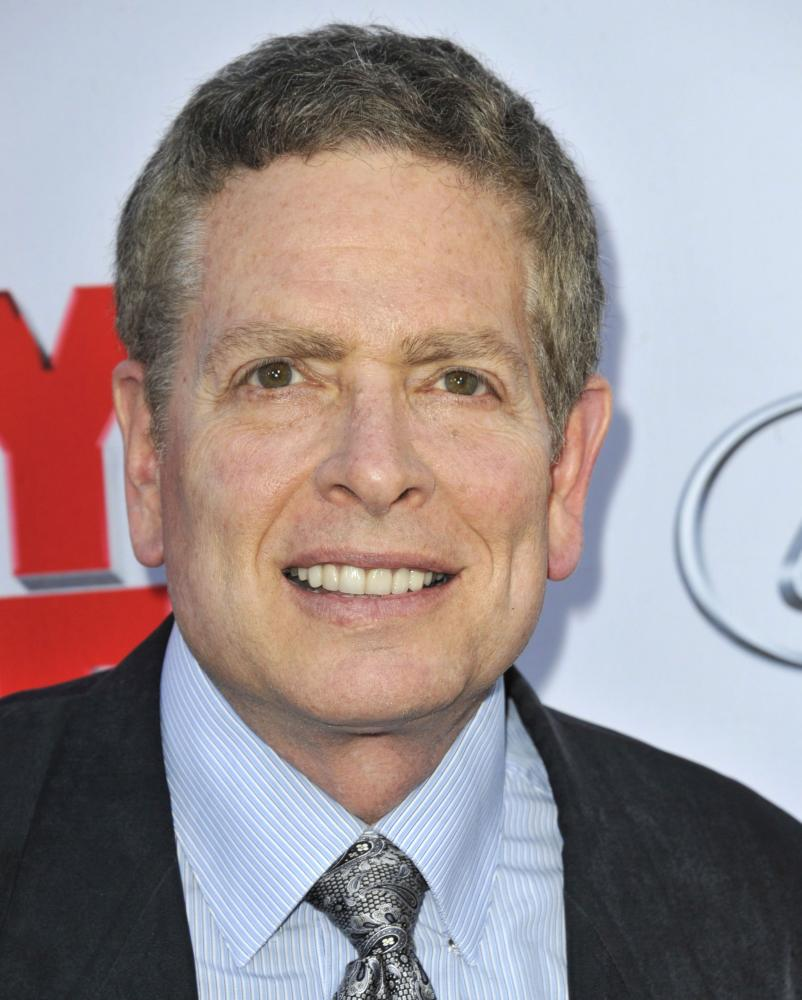
You’re thriving, you’re busy, you’re creating—you’ve been doing this for so many years. Most people at your stage in life are retired and just relaxing.
David: Or dead. Yeah, that makes it harder to make movies. I think that’s what Paramount assumed—that I was either dead or in a wheelchair or a walker, drooling. I mean, I am drooling, but I’m not in a wheelchair.
Can you share some of the health routines you follow to help your body, mind, and heart thrive?
David: Oh yeah. This is something anyone can emulate. I have a gin martini every night before dinner. That’s my secret. I also go to the gym. I don’t like going, but I do it. And I limit my desserts to animal crackers. That’s what I have for dessert.
So the secret is gin, gym, and crackers.
David: Yeah, Bombay and Lillet martini, straight up with a twist. And that’s kept me healthy for some reason. It’s like Popeye with the spinach, you know?
David Zucker, because of your amazing work and the platform you’ve built, you’re a person of enormous influence. If you could put out an idea, spread an idea, or inspire a movement that would bring the most good to the most people, what would that be?
David: Support Israel. If everybody would support Israel and realize it’s such a no-brainer. With all the reports of antisemitism, you even have people on the right—like Tucker Carlson and Candace Owens—kind of veering off course. A lot of truth gets obscured. I just wish people would really dig in and get the facts. I think it’s getting better. Israel is the only country within thousands of miles that has a water surplus. You get a country full of Jews, and they just figure it out. I think they could help all the countries in the region—if the money was spent on that instead of weapons. If I had one wish, that would be it.
I wish you continued success and good health, and only good things. I hope all your latest movies come out and become hits.
David: Right, yeah.
For David Zucker, wellness is less about strict regimens and more about balance, humor, and small daily rituals.