
Think about the last time you reached the end of a day and couldn’t say how you got there. The emails were answered, the errands were done, and your phone logged hours of scrolling, yet the day itself left almost no trace. That blur has become so common that most of us treat it as normal. It may also be one of the quiet reasons so many people feel older, more tired, and more scattered than they expect to. The problem isn’t simply that we’re busy. We take in more than ever and process less of it.
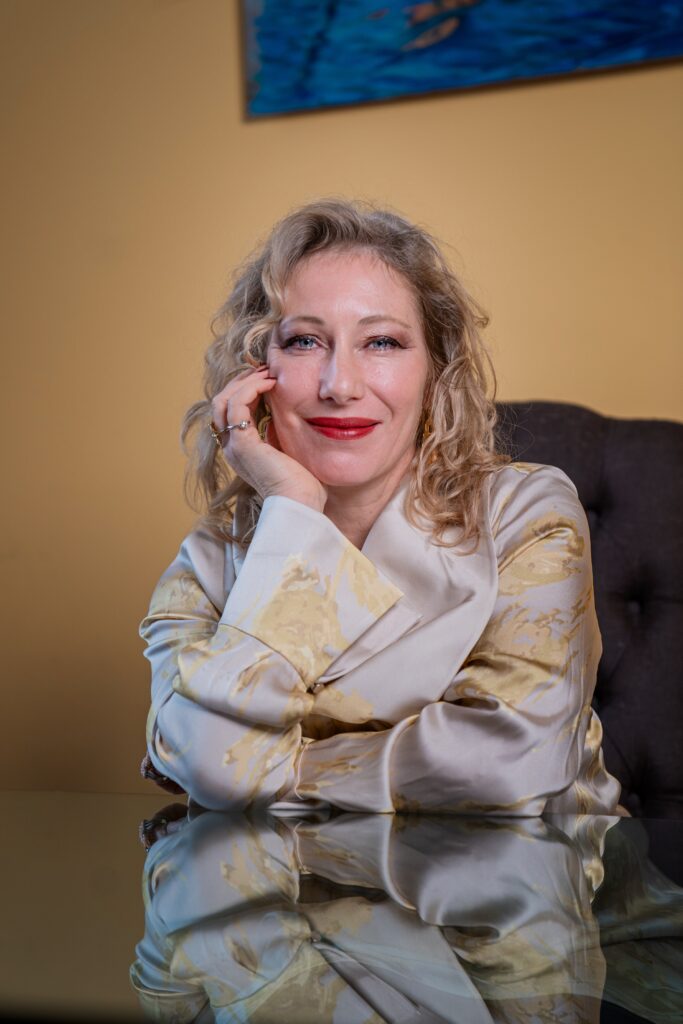
Few people are better placed to explain why than Stefania Lucchetti. She is an award-winning Italian poet and essayist and one of the most widely read contemporary Italian poets in the world, writing in both Italian and English. She is also a philosopher of what she calls technological humanism, the question of how we stay fully human as technology grows faster and more capable. Her perspective is unusual because she has lived on both sides of the divide. Lucchetti has worked as a technology lawyer for almost thirty years, was among the first technology lawyers in Europe, and holds a second master’s degree in clinical psychology. When she argues that curiosity and deep thinking are the closest thing we have to staying young, she isn’t speaking as someone who rejected the modern world. She is speaking as someone who helped build it.
The Hidden Cost of Living at Overspeed
Stefania Lucchetti does not blame information itself. She describes access to information as a great thing for humanity, pointing out that many people, even in parts of Europe and the United States, once lacked the means to develop culture and knowledge the way we can today. The trouble, she explains, is volume and pace. “We are overloaded by information and we don’t always have the time to process that information,” she says.
That gap between taking something in and actually processing it carries a real cost. According to Lucchetti, the first casualty is our inner life. “We tend to disregard our feelings and our thoughts because we don’t have time to sit with them,” she explains. Our lives keep working and our days stay efficient, but something inside goes untended. Over time, she says, “we lose track of how we got to the end of the day,” and eventually we lose track of how we arrived at a certain place in our lives.
The practical takeaway is to treat processing as part of the work rather than an optional extra. Lucchetti’s point is that we must deliberately recover our ability to think deeply about what we are reading, what we are doing, and how we are living our days, so the steady torrent of information and requests doesn’t carry us along.
Why Curiosity Keeps the Mind Young
For Stefania Lucchetti, curiosity is essential to keeping the mind young. She defines it as “a way of looking at the world and always trying to find something new and something interesting.” Travel shows it most clearly. Even after a lifetime of travel, and even when traveling with young children is more burden than pleasure, she still comes home surprised by what she saw and thinking about things in a new way.
The danger, Lucchetti explains, is what happens when curiosity fades. She notices that many adults stop listening to new music and stop reading new kinds of books, returning again and again to the same familiar content. “They rarely venture outside that comfort zone. But that comfort zone keeps getting smaller.” She admits it happens to her too. When she is tired and lets herself get comfortable, her days start to feel the same.
Her remedy is refreshingly small. She asks her children to play her new music. She suggests picking up a book on a topic you have never read about, or visiting a museum in your own town that you once dismissed as boring. Each of these choices, she says, “helps you really keep your boundaries large.”
If your spark of curiosity has gone dim, Lucchetti offers an even gentler starting point: stop for a coffee somewhere you have never stopped before. Notice how the early morning light differs from the evening light, and how your mood shifts with it. That inward attention matters just as much, because “curiosity is not only about what happens outside ourselves, but also about what is happening inside.” Many people, she observes, run on autopilot inside their own minds, with the same reactions, the same thoughts, and the same emotional temperature toward everything new. Her invitation is to notice what happens within you and look for something about yourself you hadn’t noticed before.
Language Is Where Shallowness Starts and Where It Ends
When asked how an ordinary person can push back against speed and superficiality, Stefania Lucchetti’s answer is precise: pay attention to language. She considers it the strongest tool we have against shallowness, and she believes the need has grown more urgent in the age of artificial intelligence. “Everything is written in the same way, every sentence sounds the same,” she observes. “And in sounding the same, it loses meaning.”
Her solution is to use language in what she calls a “surgical sort of way.” That begins with listening, which she describes as the first step. Then it means asking yourself, whenever you speak or write, what kind of words you are using and whether they actually carry meaning. Words that simply echo what everyone else says, in the way everyone else says it, end up saying nothing at all.
This is a practice anyone can start today. The next time you write an email or a message, pause before sending it and ask whether each sentence reflects what you actually think, or whether it is a phrase you have borrowed on autopilot. Choosing one precise word over a familiar, empty one is a small act of deep thinking.
A Two-Minute Poem Can Change Your Whole Day
Deep thinking sounds like something that requires hours of free time. Stefania Lucchetti disagrees, and her reason is practical. Poetry, she points out, is unusually well suited to modern life for a simple reason: “poetry is short.” It may no longer be fashionable, she admits, but “it takes only a few minutes to read a poem.”
She suggests keeping a book of poems nearby and reading one while you have your morning coffee or while your computer turns on at your desk. The reading takes two minutes, but the effect lasts much longer. The poem stays in your mind and your emotions, and “then it keeps talking to you” throughout the day.
Lucchetti also explains why poetry works this way. Poems rarely describe a specific situation. Instead, they express how someone feels and thinks while something is happening, which makes them universal. Readers recognize those feelings even when their own circumstances are completely different, and that recognition opens up new ways of perceiving reality.
You don’t have to consider yourself a poetry person to use this way of seeing. Lucchetti recommends noticing details, even in your own home, and paying attention to whatever makes you feel a certain way, good or bad. “There is no judgment on the feeling or thought, but just noticing a thought or a feeling.” Then put it into clear language, whether you say it out loud, write it in a private notebook, or share it with someone you live with.
“Poetry is everywhere you look. Poetry is a way of looking at things.”
Stefania Lucchetti, award-winning poet, essayist, and technology lawyer
You Decide How Long an Experience Lives Inside You
One of the most striking ideas in Stefania Lucchetti’s philosophy is the difference between measuring life in speed and measuring it in depth. When you measure life in depth, she explains, an experience doesn’t have to end when the outside world decides it is over. “It lasts for as much as you make it last within yourself, for as much as you need it to last.”
The principle works in both directions. Lucchetti notes that you can also decide an experience should be very short inside you. Once you start paying attention, you realize that you control how long an experience lasts within you and how much of your own energy you give it, whatever happens outside.
This reframe matters because it gives you back a form of agency that speed takes away. A meaningful moment can be extended by thinking about it, writing about it, and continuing to feel it. A draining one can be given less room. Either way, you are choosing where your inner energy goes rather than letting the pace of the day decide for you.
Staying Human While Technology Accelerates
Stefania Lucchetti is clear that her philosophy is not anti-technology. Her law school thesis focused on the liberalization of telecommunications, and she has spent almost thirty years in the field. She notes that technology made it possible for her to have this very conversation from Milan. Technology can be wonderful, she says, but “it needs to be used in a way that is helpful,” and every person is responsible for how they use it, including how much time they spend on it and how they communicate through it.
That last point is central to technological humanism. Lucchetti points to social media, where people often comment as if no one were reading. “But actually there is another person on the other side.” She explores this theme in her essay The Bricks of the New Babel, which addresses language, identity, and the ethics of digital citizenship. She also titled one of her poetry collections Poetry Is Cyberpunk, drawing on the cyberpunk philosophy of the 1980s, which imagined humans resisting the overwhelming power of machines. Her version of that resistance is attention to language, feelings, and thoughts, even while we use technology.
She offers a simple set of questions for any digital exchange: “What am I saying? Why am I saying it? How am I feeling when I say it?” Then she adds a fourth: what does the other person feel as they receive it?
Looking ahead, Lucchetti believes our cognitive abilities will need to evolve. We will have to learn to tell what is real from what is fake, what is meaningful from what is not, and to stop something once we realize it is no longer doing us any good. “As technology becomes faster and stronger,” she says, “we need to become stronger, and I mean mentally stronger.” Her hope rests on a simple fact: humans built this technology out of curiosity. “We created it. So we should not be overwhelmed by it.”
Five Minutes Alone Is Where Depth Begins
When Stefania Lucchetti speaks directly to the person who feels rushed, scattered, and a little numb, her advice is deliberately modest. Find whatever moment you can in your day “to just be alone for five minutes.” As a mother of three, she knows how hard that can be, and she acknowledges that people with intense jobs face the same struggle. The moment can come at any time of day.
Her favorite way to use it is a short walk on your own, moving from one place to another. She calls walking “a wonderful, wonderful meditation technique,” and she believes five minutes alone can begin to completely change the way you think about the world, opening the door to deeper reflection on your life.
So start there. Take five minutes today, walk somewhere alone, and notice one thing, outside you or inside you, that you would normally rush past. As Stefania Lucchetti, a poet who has spent nearly three decades inside the fast world of technology, reminds us, staying young was never about keeping pace. It is about staying curious enough to notice the life you are already living.