Like many of us, I’ve struggled with self-acceptance throughout my life. Exhausting myself by turning my attention outward, prioritizing external validation, I’ve watched myself deny my truth by staying in relationships longer than appropriate, numbing myself with substances, and overworking to hide from what I’m feeling. In this time of my life, a practice of actualizing acceptance brings a sense of peace.
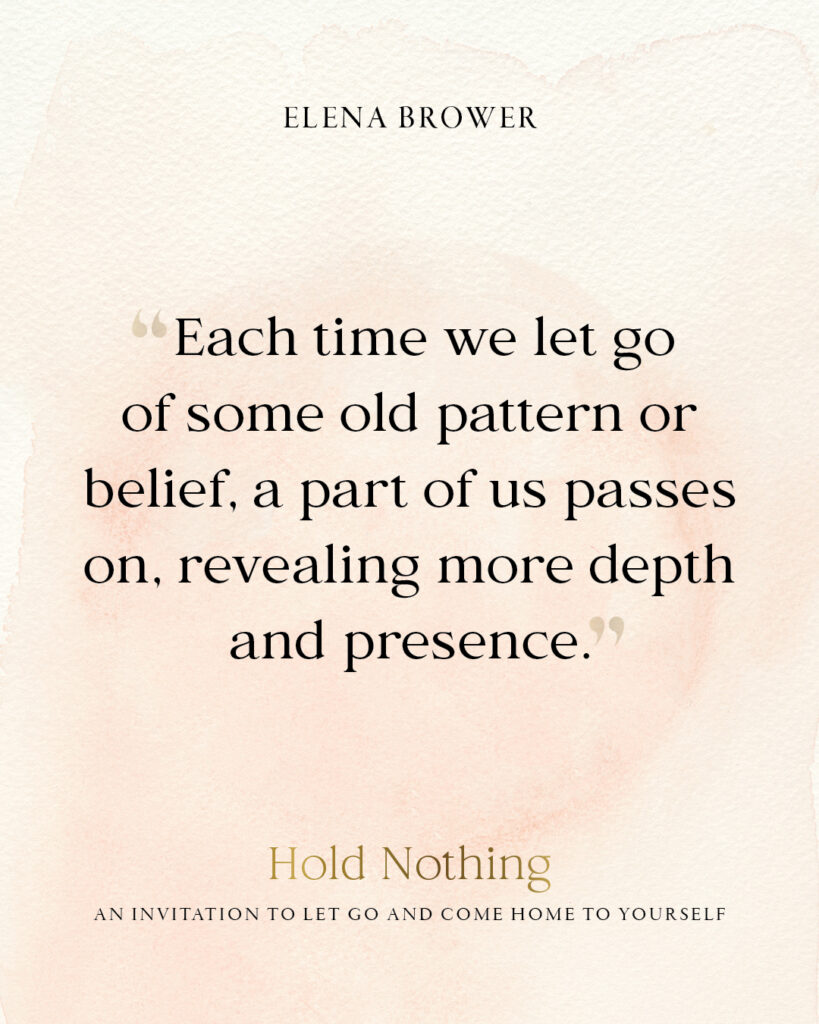
FLOWERS ARE SANCTUARIES
The relationship I have with flowers dates to my childhood, when my mom would drop me off at her sister’s house, and together my aunt and I would create arrangements for her small flower delivery business. My aunt respected me as a human and valued my assistance. The time with her was special, the artist in me felt seen, and since then, my time in Nature offers a haven for me, and each flower is a tiny, pristine sanctuary. Where do you feel that feeling of refuge? Where are the smallest sanctuaries in your world?
For the first time in ages, I’m home by myself for several days. Seated silently at the far end of the dining room table staring at snow falling, I can see the trees receiving dense concentrations of snowflakes. The forest seems to be breathing. My son’s away, my partner is traveling for work—the quiet is both deafening and a balm for my entire being.
Having folded all the remaining laundry and tidied the house, the afternoon mercifully lingers. While arranging some books to scaffold today’s writing session, I recall that I’ve got fresh lacy-edged tulips on the kitchen counter, fleeting and precious, like little women. I start trimming their stems at a slow cadence, taking thirty minutes or so, and staring into each of their faces. Each is a living being, a whole personality, telling me stories about life and death, care and consequences. Flowers are sanctuaries. I fall in love with each of them.
Placing them into three vases at three different altars around the house—the kitchen, my desk, and my bedroom—I realize it’s twenty minutes past five in the evening, and meditation begins in ten minutes. Drawn to the cushion, I quietly sit. I try not to berate myself for postponing the writing.
Words and thoughts dance across my mind like light bulbs, lighting up, then going dark. It reminds me of catching a firefly in a jar at no more than eight years old and the smell of that summer evening. Staring at the trapped being feels upsetting to me. I remember letting her go immediately. If only I knew how to do that with my thoughts, I think. What floats in next is a fascicle by Dogen, the story of the udumbara blossom, which in this tale stands for all the precious teachings. Dogen Zenji devoted an entire fascicle in his monumental body of work, the Shobogenzo, to praising a particular blossom, the udumbara, the flower of enlightenment, said to bloom once every three thousand years. In this tale, the Buddha’s disciple Mahakasyapa, a patriarch of Chan (the Chinese precedent for Zen), receives the entire body of the teachings in one moment, as the Buddha holds up an udumbara flower to indicate the scope and the treasury of the teachings.