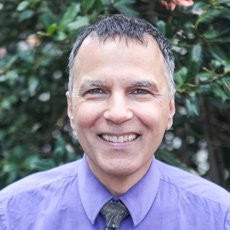

Imagine you are driving down the highway with a friend when the check engine light comes on. Your friend tells you not to worry, reaches into a bag, pulls out a roll of black tape, and covers the light. The dashboard looks fine again, so you keep driving. This is the story Dr. Anthony Salzarulo tells new clients in the first few minutes of their first appointment, because he says it describes exactly what has been happening to their bodies for years. The light was information. Covering it did not make the problem smaller. It made the eventual repair bigger.
Dr. Anthony Salzarulo is a holistic health consultant and homeopath with more than thirty years of experience helping people identify and address the root causes of chronic health challenges. He holds professional degrees and licensure in Chiropractic and Physical Therapy, along with certifications in Iridology and Homeopathic Biotherapeutic Drainage, and he completed a five-year mentorship with the holistic physician Dr. Rudolph Ballentine. He has lectured at Mount Sinai Medical Center, Hunter College, and the Hospital for Special Surgery, and he now works with clients virtually across the United States. What he brings to a conversation about chronic symptoms is not a rejection of medicine. It is a different first question.
Why Suppressing a Symptom Costs More Than It Saves
Dr. Salzarulo draws a hard line between managing a symptom and addressing what produced it. In his framing, the symptom is the check engine light, and the medication is often the tape. “It’s really important to investigate what is driving the symptom,” he said, noting that in the current environment it is rarely just one thing. In his practice, he sees people who arrive already taking several medications, each one added to manage the side effects of the one before it.
He is blunt about how ordinary this pattern has become. Dr. Salzarulo practices in New York City, surrounded by major hospitals and specialists, and he says the most common sentence he hears is that someone has seen doctor after doctor, collected prescription after prescription, and still feels worse. The takeaway for a reader is not to abandon anything. It is to notice whether anyone has actually asked why the light went on.
The Garden Principle, and Why It Changes the Question
The framework Dr. Salzarulo returns to throughout his work is the garden. When a gardener sees vegetables failing, the gardener does not blame the vegetables. He checks the soil, the water, the sunlight, the minerals, the drainage, and the weeds. The plant is reporting on its conditions.
“If the vegetables of the garden are not growing right, it doesn’t help to blame the vegetables, because the vegetables are expressing the state of the garden.”
Dr. Anthony Salzarulo, holistic health consultant and homeopath
So what, in his terms, is the human garden? Dr. Salzarulo describes it as roughly fifty to a hundred trillion cells suspended in fluid, along with the microbiome and whatever toxins have accumulated. He cites the Chemical Abstract Service count of more than three hundred thousand registered industrial chemicals, and the Environmental Protection Agency’s list of eighty-six thousand chemicals identified as potentially harmful, of which he says fewer than two percent have been properly tested for long-term effects on human health. That garden has clear requirements: hydration, rest, movement, sunlight, nutritious and anti-inflammatory food, stress reduction, and support for the body’s own elimination. Most people are short on several of these at once, and the point Dr. Salzarulo makes is that you can assess most of them yourself. Look honestly at your sleep, your water, your food, and your stress, and you already know something real about your soil.
Two Reasons Cells Malfunction
Here Dr. Salzarulo gets specific, and this is the most useful part of the conversation for anyone trying to understand their own chronic symptoms. He credits the late teacher Raymond Francis with the idea that at the deepest level there is one problem, cellular malfunction, and that what we call a diagnosis is largely a description of where in the body that malfunction is happening and how far it has gone.
Cells malfunction for two reasons, in his account: cellular toxicity and cellular deficiency, and he says the two always occur together. Toxicity covers environmental and dietary chemicals, heavy metals, and the infectious drivers he says are routinely missed, including Lyme and its coinfections, mold and mycotoxins, viruses, bacteria, parasites, and fungal overgrowth. He uses tuna as the illustration for how heavy metals accumulate. The fish is not born with them. It eats, stores, and rises up the food chain, and the older the fish, the higher the load. People do the same thing. Deficiency is the other half, meaning not enough hydration, rest, oxygen, or real nutrition, which he says is nearly impossible to get from processed food.
The practical version of this, according to Dr. Salzarulo, is a set of tests many people have never been offered. He routinely asks clients whether they have ever had a mycotoxin test, a Lyme test, or a heavy metals test, and he says the answer is usually no, even from people who have already seen multiple specialists.
Where the Body Sends What It Cannot Eliminate
One of the most clarifying things Dr. Salzarulo explains is what happens when the body’s main elimination pathways get overwhelmed. He names the liver, kidneys, colon, and lungs as the primary emunctories, which he defines simply as the organs and systems that filter and excrete toxins from the body. When those are overloaded, he says, the body shunts the load to secondary channels, and that is where a great many stubborn, recurring symptoms show up.
This is one reason skin has become a focus of his practice. He describes people who cycle through dermatologists, creams, and steroids for years while the condition keeps returning, and he attributes the pattern to treating the outlet rather than the load. He places the sinuses and the lymphatic system in the same category. Dr. Salzarulo calls the lymph system the sewer system of the body, and one of his simplest recommendations is dry body brushing before a shower, which he says exfoliates but, more importantly, helps activate lymphatic movement. That is something a reader can understand and act on immediately.
The Habits That Actually Tend the Garden
The daily practices Dr. Salzarulo recommends are unglamorous on purpose, and most of them are about moving the nervous system out of what he calls sympathetic dominance and back toward parasympathetic baseline. Get natural light shortly after waking, which he says helps set the circadian rhythm and the HPA axis. Go to bed and get up at consistent times. Eat within a window of ten hours or less, because late-night snacking never lets cortisol and insulin reach baseline before sleep. Splash cold water on your face to elicit the dive reflex, or finish a shower with thirty seconds of cold.
The one he returns to most often is the four-seven breath, inhaling for four and exhaling for seven. He uses an aviation image to explain why frequency matters more than duration. A plane flying from New York to Los Angeles is off course more than ninety-nine percent of the time, but it has a mechanism that keeps resetting it, which is why it does not end up in Argentina. Doing the breath three or four times a day is that reset. Dr. Salzarulo relied on it heavily himself during a period when mold exposure and Lyme coinfections left his own nervous system so dysregulated that he could not stay on a train into the city or get on a plane.
On water, his instruction is specific. Aim for roughly half your body weight in ounces, so a hundred-and-sixty-pound person would target at least eighty ounces, and drink it on a schedule rather than waiting to feel thirst. “Drink as a practice, not because you’re thirsty,” he said. He pairs all of it with a rule he states out loud to every client: no shame, no blame.
Alongside, Not Instead Of
Dr. Salzarulo is asked constantly whether his approach requires giving something up, and his answer is consistently no. He describes a client with Graves disease who arrived braced for him to tell her to stop her medication. “Absolutely not,” he told her, explaining that the goal is to improve the underlying conditions first, and that some people will not come off medication at all, which he says is fine. He applies the same caution to supplements, noting that homeopathy is not contraindicated with medication in his experience, while certain herbs such as St. John’s wort can be a different matter, and that this is exactly the kind of thing to check rather than guess. He also readily recommends conventional intervention when it is the right tool, including telling a client in his late seventies to go ahead with a knee replacement.
Just Don’t Quit
The image Dr. Salzarulo offers to anyone who feels too far behind to start is a child learning to walk. No toddler falls a few times and concludes that walking is not for them. They fall, they get up, and eventually they run, because they have not yet learned to read falling as failure.
He says the same logic applies to health habits. You will be inconsistent. You will drop the water routine for a week and stay up too late scrolling. His instruction is to keep going in that direction anyway, because the garden responds to the trend rather than to perfection. He adds an encouraging observation from three decades of watching people change: as you eat healthier food, you begin to desire it, and the practices start to feel as automatic as brushing your teeth.
What Dr. Salzarulo most wants people to understand is the thing nobody told him when he was young and struggling with his own health, which is that the body has tremendous healing capacity when you give it what it needs and take away what it does not. Pick one thing tomorrow, whether that is water, morning light, or the four-seven breath, and then keep going. After more than thirty years of helping people restore their health this way, Dr. Anthony Salzarulo is convinced the garden is far more responsive than most people have ever been told.