

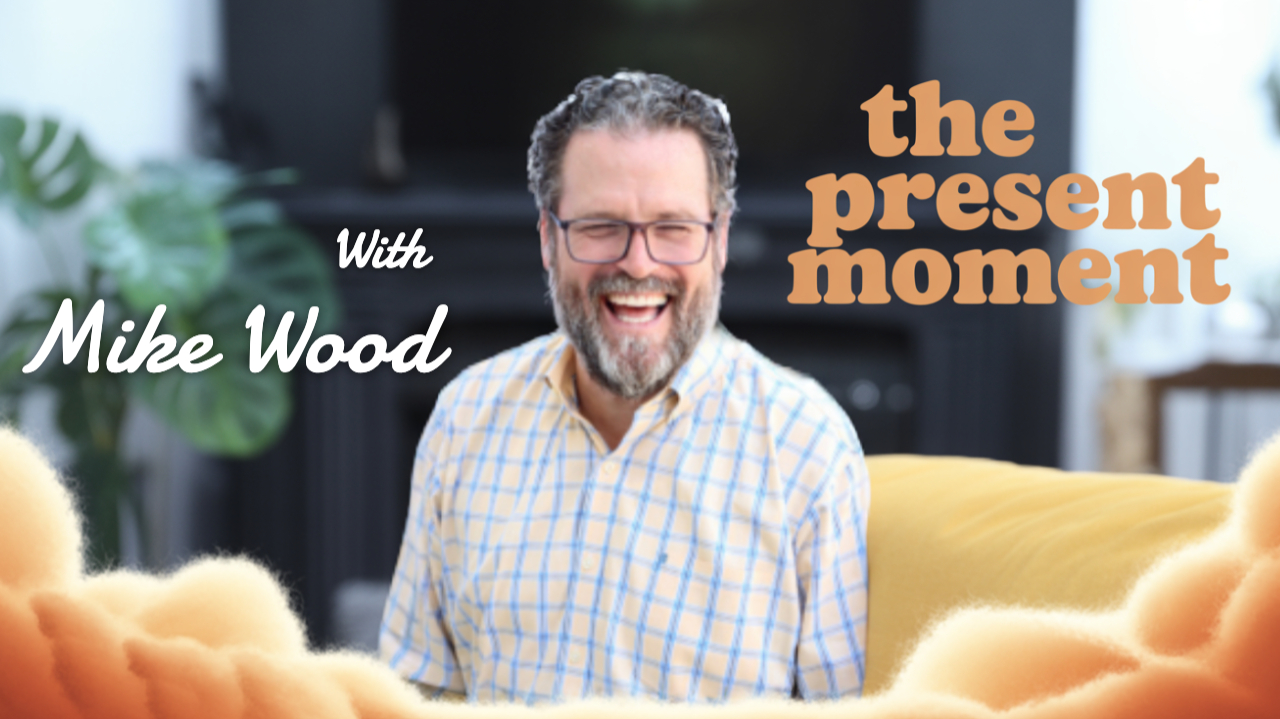
Don’t look for peace out in the world. It’s here within you, right now.
– Mike Wood
For many people, the search for peace begins externally—with achievement, discipline, or the promise that life will settle once the next milestone is reached. For Mike Wood, that search eventually turned inward, toward a skill that sounds simple but proves transformative: learning how to return, again and again, to the present moment.
Wood’s understanding of presence did not come from philosophy or spiritual language at first. It arrived unexpectedly, when he was ten years old, standing alone on a fog-covered football field before a game. In the stillness, his inner dialogue dropped away. What remained was a brief but unmistakable sense of calm and clarity—an experience he would carry quietly for decades, long before he had words for it.
When Outer Success Doesn’t Quiet the Mind
As Wood grew older, life looked successful by conventional measures. He built a business, met expectations, and learned to face fear through boxing and discipline. Yet internally, anxiety, depression, and relentless mental noise followed him. The contrast between outer achievement and inner distress became impossible to ignore.
What Wood began to notice was not a personal failure, but a pattern shared by many: a mind trained to live in the past or the future, replaying old wounds or scanning for potential threats. Over time, he came to see the subconscious not as an enemy, but as a well-intentioned system stuck in overdrive—trying to protect by keeping attention away from the unknown.
Presence as a Trainable Skill
Rather than framing meditation as something abstract or mystical, Wood defines it practically: single-point focus. Choosing one anchor—breath, sensation, or sound—and returning to it gently whenever the mind wanders. In this narrowing of attention, the nervous system settles, and the body receives a signal of safety.
Moments of deep presence would sometimes arise spontaneously. Years after that football field, Wood recalls holding a grape between his fingers and becoming so absorbed in the sensation that everything else fell away. The instant he tried to describe the moment, it vanished. The lesson was clear: presence cannot be grasped or analyzed. It can only be entered.
Why the Mind Resists “Now”
Wood explains that the subconscious does not distinguish between time periods. Emotional experiences from childhood can be replayed with the same intensity decades later, as if they are happening in the present. This is why fear, shame, or self-criticism can feel sudden and overwhelming.
Living in this loop keeps the nervous system activated. Stress chemistry rises, thoughts accelerate, and the body remains braced. Presence interrupts that cycle. When attention returns to what is happening right now, anxiety has less material to work with.
Small Tools That Shift the System
Wood emphasizes that presence is not achieved through willpower, but through repetition and simplicity. Among the practices he returns to:
- Gratitude journaling in the morning, not as positivity, but as a way to anchor attention in the present.
- Box breathing—a slow, even pattern used by first responders and military units—to rapidly calm the nervous system.
- Sensory resets, especially smell, which can pull attention fully into the moment in under two minutes.
- Timed reminders during the day that ask a single question: What time is it? The answer, always, is now.
Practiced consistently, these tools retrain the nervous system. Triggers that once spiked intensely begin to peak lower and pass faster. Calm becomes more accessible—not because life stops being challenging, but because the body learns a different response.
Peace as an Internal Reference Point
Wood’s work centers on helping people experience calm directly, rather than believing in it conceptually. High emotional intensity, he notes, reduces clarity and effectiveness. Steadiness, on the other hand, allows better decisions, healthier relationships, and a quieter inner life.
If he could speak to his younger self—the boy standing in the fog—his message would be simple: peace isn’t something you earn or find later. It’s available now, in the only moment that exists.
Learning to return to that moment does not remove difficulty from life. It changes how we meet it. And for many, that change is enough to shift everything.
